Bruguiera parviflora
(Roxb.) Wight & Arn. ex Griff.
Slender-fruited Orange Mangrove
iNaturalist· cc-by-sa
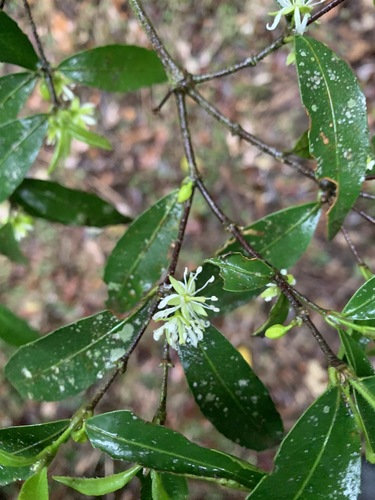
(c) Abu Hamas, alguns direitos reservados (CC BY-SA), enviado por Abu Hamas
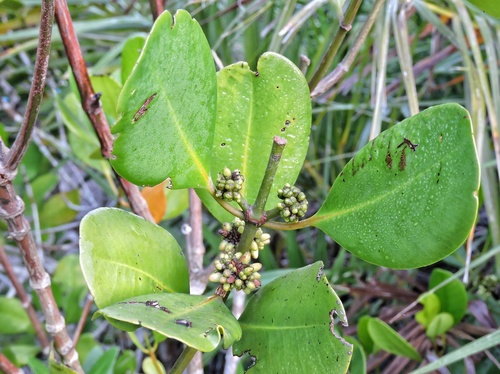
iNaturalist· cc-by-sa
(c) Abu Hamas, alguns direitos reservados (CC BY-SA), enviado por Abu Hamas
iNaturalist· cc-by
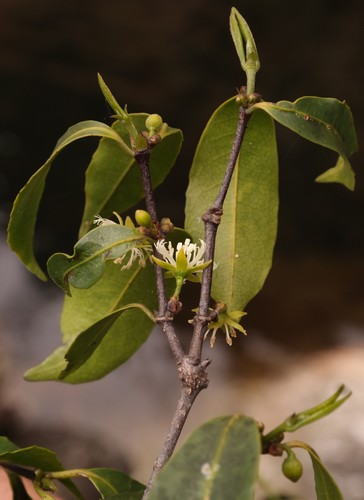
(c) Tim, alguns direitos reservados (CC BY), enviado por Tim
Summary
Source: WikipediaBruguiera parviflora is a tree in the family Rhizophoraceae. The specific epithet parviflora is from the Latin meaning 'small flowers'.
Description
A straight growing tree of medium size. It reaches 35 m high. The trunk is straight and up to 30 cm across. The bark is smooth and grey with white blotches. It can have buttresses up to 1 m high and has knee shaped aerial roots. The leaves are in tufts at the end of the upward bending twigs. The leaves are dull or yellowish green, long and tapering at both ends. They are 4-11 cm long by 2-4 cm wide. The leaf stalk is less than 2.5 cm. The flowers are in groups of 2-5 on stalks in the axils of leaves. The flowers are small being 0.3 cm across. The fruit is long, about 1.5- 3 cm and with 8 tiny teeth clasping the slender (10-20 cm) long hypocotyl.
Edible Uses
The germinating embryo is eaten as a vegetable. The fruit itself is only occasionally used as food.
Traditional Uses
The fruit if eaten is only occasionally used. The germinating embryo is eaten as a vegetable.
This uses section is brief — help expand it
Distribution
A tropical plant. It grows on the inner edge of the mangrove swamp on level or slightly sloping ground. It occurs along flooded tidal rivers and can be flooded by normal high tides. It prefers stiff, humus rich mud. It is not shade tolerant so needs open land to germinate and grow. It occurs from India to Vanuatu.
Where It Grows
Asia, Australia*, Brunei, India, Indochina, Indonesia, Malaysia, Myanmar, Pacific, Papua New Guinea, PNG, SE Asia, Solomon Islands, Thailand, Vanuatu,
Cultivation
Seeds can be planted directly or seedlings can be transplanted. The fruit can easily be spread by rain and water and often washes onto the higher pieces of mangrove swamp land.
Production
In the southern hemisphere it flowers and fruits in July.
Other Information
It is not known if it is used for food in Papua New Guinea.
Notes
There are 6 Bruguiera species. They grow in tropical mangrove swamps.
Synonyms
Also Known As
Byu-kyettet, Hnit, Lenggadai, Langkadai, Nangkadai, Small-leafed Orange mangrove, Tua dam, Tua kao, Vurada
References (21)
- Ambasta S.P. (Ed.), 2000, The Useful Plants of India. CSIR India. p 89
- Burkill, I.H., 1966, A Dictionary of the Economic Products of the Malay Peninsula. Ministry of Agriculture and Cooperatives, Kuala Lumpur, Malaysia. Vol 1 (A-H) p 378
- Bircher, A. G. & Bircher, W. H., 2000, Encyclopedia of Fruit Trees and Edible Flowering Plants in Egypt and the Subtropics. AUC Press. p 67 (As Bruguiera parvifolia ?)
- Cooper, W. and Cooper, W., 2004, Fruits of the Australian Tropical Rainforest. Nokomis Editions, Victoria, Australia. p 428
- Ding Hou, 1958, Rhizophoraceae in Flora Malesiana 5(4) p 464
Show all 21 references Hide references
- Dobriyal, M. J. R. & Dobriyal, R., 2014, Non Wood Forest Produce an Option for Ethnic Food and Nutritional Security in India. Int. J. of Usuf. Mngt. 15(1):17-37
- Elliot, W.R., & Jones, D.L., 1982, Encyclopedia of Australian Plants suitable for cultivation. Vol 2. Lothian. p 383
- Floyd, A.G., 1977, Ecology of the Tidal Forests in the Kikori-Romilly Sound Area Gulf of Papua. Ecology Report No 4 Division of Botany, Lae, Papua New Guinea. p 30
- French, B.R., 2010, Food Plants of Solomon Islands. A Compendium. Food Plants International Inc. p 302
- Frodin, D.G. & Leach, G.L., 1982, Mangroves of the Port Moresby Region. Biology Department Occasional Paper No 3 Revised edition. Papua New Guinea, p 32
- Henderson, C.P. and I.R.Hancock, 1988, A Guide to the Useful Plants of the Solomon Islands. Res. Dept. Min of Ag. & Lands. Honiara, Solomon Islands. p 152
- Lazarides, M. & Hince, B., 1993, Handbook of Economic Plants of Australia, CSIRO. p 40
- Lovelock, C., & Clarke, S., 1999, Field Guide to the Mangroves of Queensland. Australian Institute of Marine Science. p 58
- Menninger, E.A., 1977, Edible Nuts of the World. Horticultural Books. Florida p 115
- Paczkowska, G . & Chapman, A.R., 2000, The Western Australian Flora. A Descriptive Catalogue. Western Australian Herbarium. p 512
- Peekel, P.G., 1984, (Translation E.E.Henty), Flora of the Bismarck Archipelago for Naturalists, Division of Botany, Lae, PNG. p 400, 398
- Roy, S. D., et al, 2009, Mangroves of Andaman and Nicobar Islands. ICAR p 16
- Tiwi Plants and Animals. 2001, Aboriginal flora and fauna knowledge from Bathurst and Melville Islands, northern Australia. Northern Territory Botanical Bulletin; No. 24 p 31
- Trans. Med. Soc. Calcutta 8:10. 1836
- Wheeler, J.R.(ed.), 1992, Flora of the Kimberley Region. CALM, Western Australian Herbarium, p 560
- World Checklist of Useful Plant Species 2020. Royal Botanic Gardens, Kew