Bruguiera cylindrica
(L.) Bl.
Small-fruited Orange mangrove
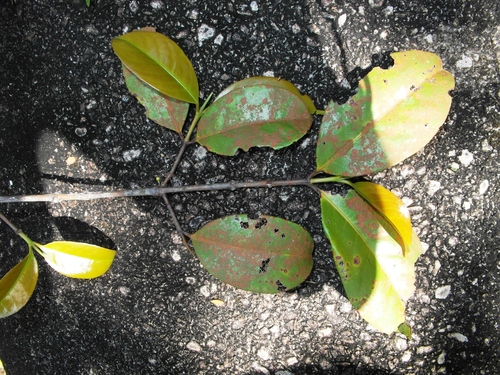
iNaturalist· cc-by-sa
(c) Abu Hamas, some rights reserved (CC BY-SA), uploaded by Abu Hamas
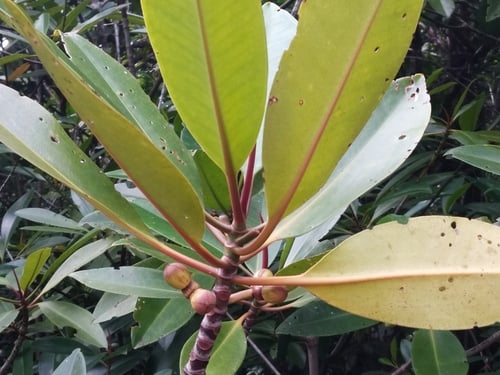
iNaturalist· cc-by-nc
(c) budak, some rights reserved (CC BY-NC), uploaded by budak
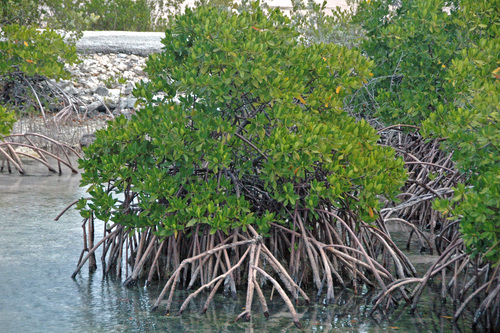
iNaturalist· cc-by-sa
(c) Douglas Goldman, some rights reserved (CC BY-SA), uploaded by Douglas Goldman
Summary
Source: WikipediaBruguiera cylindrica is a small tree in the mangrove family Rhizophoraceae, native to tropical Asia and Australia. It was first described in 1827 and has the conservation status of least concern.
Description
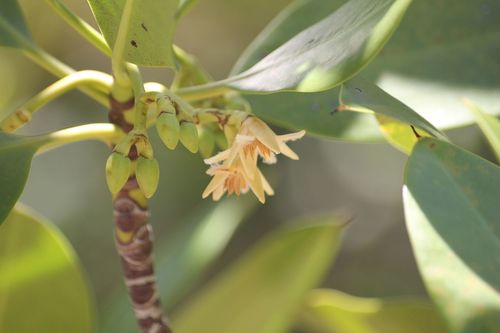
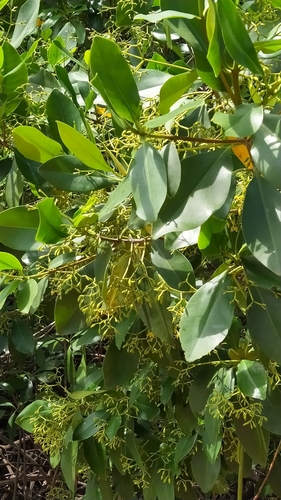
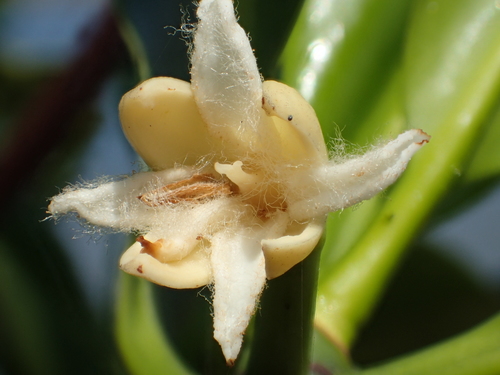
A tree up to 23 m high. The trunk is 30 cm across. It is much smaller and like a shrub when in poor soil. It has stilt roots and aerial roots. The bark is grey to dark brown and cracked along and across its length. The leaves are oval but tapering towards both ends. They are 5-17 cm long and 2-8 cm wide. The leaves are thick. They are dark green on top and lighter green below. The midrib is sunken on the top of the leaf and raised below. The leaf stalk is 1-3 cm long. The flowers are cream coloured and borne as 3 flowered clusters on equal length stalks. Flowers are 3 cm long. The flower stalk is 1-4 mm long. There are 8 white petals with lobes. The fruit and hypocotyl are green. The hypocotyl or stem below the seed leaves is 4-15 cm long and 5 mm wide and may be curved. The outer part of the flower is fringed with white hairs. The hypocotyl is green when young and brownish when old. The seed germinates before the fruit falls from the tree.
Edible Uses
The young shoots are eaten raw. The radical from the seed is eaten after boiling. The bark is used as a spice.
Traditional Uses
The young shoot is edible. The radical from the seed is eaten after boiling.
This uses section is brief — help expand it
Medicinal Uses
The timber of Bruguiera cylindrica is dense, reddish and strong and is used in construction. It is used for parts of the hull and, especially, for the keel of canoes in the Maldive Islands. It burns well as firewood and can be converted into charcoal. The crushed bark has an unusual odour which is repulsive to fish and this wood is not therefore used for fish traps. Nevertheless, extracts are made from the pneumatophores which are used in the manufacture of perfume. Parts of the tree are eaten; the root tips are relished in Thailand; the bark supplies a spice and the young shoots are boiled and served as a vegetable. In Maldives the propagules are boiled and eaten as a vegetable in the islands where it grows. In traditional medicine, the skin of the fruit is used to stop bleeding and the leaves are used to lower blood pressure.
Distribution
A tropical plant. It grows on stiff clay soils and is replaced by other mangrove species on better drained soils. It grows in areas only occasionally flooded by very high tides. They grow to 20 m altitude.
Where It Grows
Andamans & Nicobar, Asia, Australia, Brunei, Cambodia, China, India, Indochina, Indonesia, Malaysia, Maldives, Myanmar, Pacific, Papua New Guinea, PNG, Philippines, SE Asia, Sri Lanka, Thailand, Vietnam,
Cultivation
The seed can be planted directly from the tree.
Other Uses
The bark is said to be of some value as a local source of tannins. However, it is thin and of too low a yield for commercial use. The heartwood is reddish to reddish-brown upon exposure. The wood is hard, very heavy and strong. It is straight grained and fine textured. The logs shrink and check excessively in seasoning, while the wood is easy to work and finishes well. It is non-durable when exposed to weather or in contact with the ground. Valued more as a fuel, though it is also used for purposes such as temporary constructions. Fisherman say that the wood has a peculiar odour which frightens away fish; and many do not like to use it for making fishtraps. The wood is commonly used for fuel and for making charcoal. This species is able to establish itself in newly formed soils along the coast that are unsuitable for other mangroves - it can thus stabilize the soils and bring about conditions to allow other trees to become established.
Other Information
It is not known if it is used for food in Papua New Guinea.
Notes
There are 6 Bruguiera species. They grow in tropical mangrove swamps.
Synonyms
Also Known As
Bakau berus, Berus kechil, Berus, Bodavaki, Byu, Kakandan, Kandoo, Madam, Pasak kao, Prui, Pyu, Saung, Tajang sukun, Tanjang, Ton lui, Tua deng, Tua kao, Vet tru
References (19)
- Ambasta S.P. (Ed.), 2000, The Useful Plants of India. CSIR India. p 88
- Argent, G et al, nd, Manual of the Larger and More important non Dipterocarp Trees of Central Kalimantan Indonesia. Volume 2 Forest Research Institute, Samarinda, Indonesia. p 523
- Bircher, A. G. & Bircher, W. H., 2000, Encyclopedia of Fruit Trees and Edible Flowering Plants in Egypt and the Subtropics. AUC Press. p 67
- Burkill, I.H., 1966, A Dictionary of the Economic Products of the Malay Peninsula. Ministry of Agriculture and Cooperatives, Kuala Lumpur, Malaysia. Vol 1 (A-H) p 377
- Castillo, C., 2013, The Archaeobotany of Khao Sam Kaeo and Phu Khao Thong: The Agriculture of Late Prehistoric Southern Thailand. Ph. D. thesis University College, London p 379
Show all 19 references Hide references
- Cooper, W. and Cooper, W., 2004, Fruits of the Australian Tropical Rainforest. Nokomis Editions, Victoria, Australia. p 427
- Ding Hou, 1958, Rhizophoraceae in Flora Malesiana 5(4) p 461
- Dobriyal, M. J. R. & Dobriyal, R., 2014, Non Wood Forest Produce an Option for Ethnic Food and Nutritional Security in India. Int. J. of Usuf. Mngt. 15(1):17-37
- Elliot, W.R., & Jones, D.L., 1982, Encyclopedia of Australian Plants suitable for cultivation. Vol 2. Lothian. p 383
- Forest Inventory and Planning Institute, 1996, Vietnam Forest Trees. Agriculture Publishing House p 597
- Frodin, D.G. & Leach, G.L., 1982, Mangroves of the Port Moresby Region. Biology Department Occasional Paper No 3 Revised edition. Papua New Guinea, p 26
- Lim, T. K., 2015, Edible Medicinal and Non Medicinal Plants. Volume 9, Modified Stems, Roots, Bulbs. Springer p 18
- Menninger, E.A., 1977, Edible Nuts of the World. Horticultural Books. Florida p 115
- Reis, S. V. and Lipp, F. L., 1982, New Plant Sources for Drugs and Foods from the New York Botanical Garden herbarium. Harvard. p 206
- Roy, S. D., et al, 2009, Mangroves of Andaman and Nicobar Islands. ICAR p 14
- Selvam, V., 2007, Trees and shrubs of the Maldives. RAP Publication No. 2007/182
- Sujanapal, P., & Sankaran, K. V., 2016, Common Plants of Maldives. FAO & Kerala FRI, p 59
- Walter, A. & Sam C., 2002, Fruits of Oceania. ACIAR Monograph No. 85. Canberra. p 278
- World Checklist of Useful Plant Species 2020. Royal Botanic Gardens, Kew