Bruguiera gymnorhiza
(L.) Savigny
Red mangrove, Large-fruited orange mangrove
iNaturalist· cc-by
(c) Scott W. Gavins, some rights reserved (CC BY)
iNaturalist· cc-by
(c) Scott W. Gavins, some rights reserved (CC BY)
iNaturalist· cc-by
(c) Scott W. Gavins, some rights reserved (CC BY)
Description
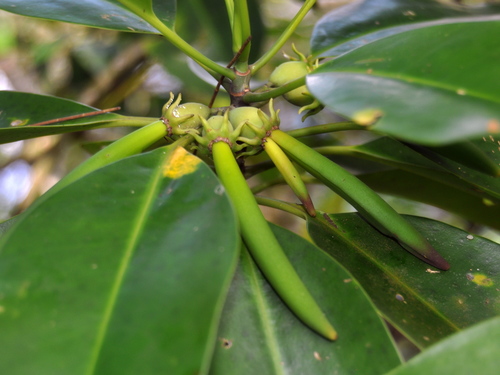
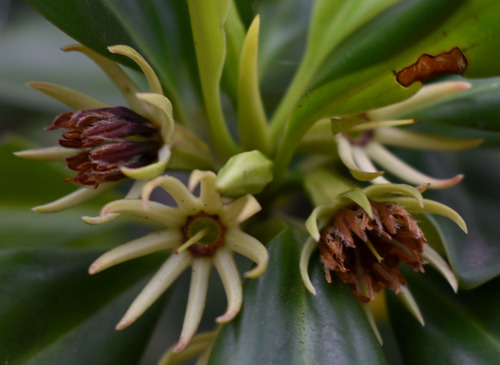
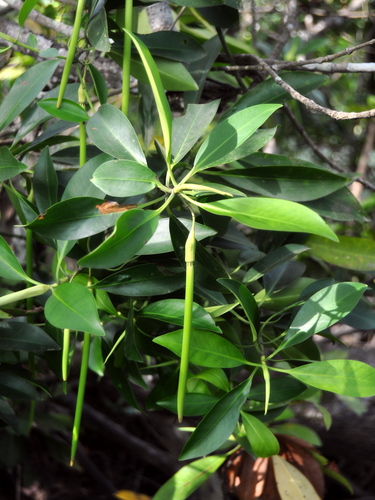
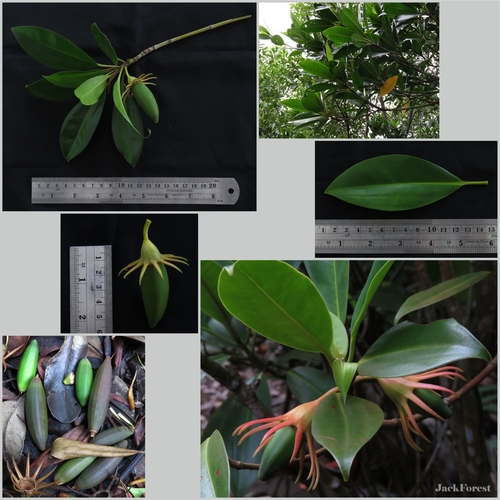
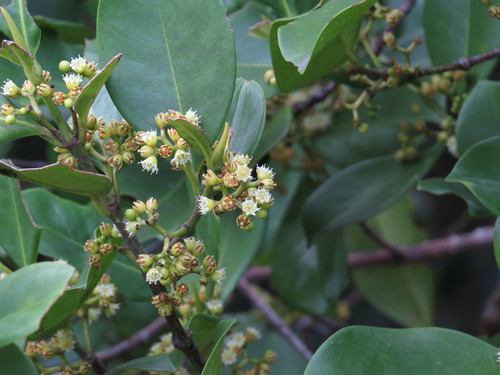
A large evergreen tree up to 36 m high with stilt and knee-like roots. The trunk can be 80 cm across and is mostly straight. The bark is rough and grey on the outside and red inside. The leaves are mostly clustered near the ends of the many branches. The leaves are oval and leathery simple leaves and 15- 22 cm x 6-9 cm. They are pointed at the tip and the base is wedge shaped. The tip of the leaves does not have the midrib extended. The upper surface is shiny and the lower surface dull. The leaf stalk is red. The flowers are distinctive and often found washed up along the sand and mud. They are red and occur singly in the axils of leaves. They are 3 to 4 cm across. The outer case of sepals is bell shaped and leathery and for half its length has narrow pointed teeth. These are usually 12 to 15 in number. The fruit is long in shape and 3 cm long. It can germinate and produce a hypocotyl which is a long green structure growing from the centre of the flower and is up to 25 cm long. It has ridges along it. The leaves are more densely grouped together than with Bruguiera sexangula and also the fruit are longer.
Edible Uses
The fruit are boiled twice in water with the outer covering removed between cookings, then eaten for their starchy content. Young leaves may be eaten cooked.
Traditional Uses
The fruit are boiled twice in water, the outer covering being removed between the cookings. The starchy fruit are then eaten. Young leaves may be eaten, cooked. The timber is a good fuel but corrodes metal while burning.
Medicinal Uses
The bark is used as an astringent medicine against diarrhoea and sometimes malaria. It is used as an abortifacient. The bark is applied externally for treating burns. A decoction of the root, combined with the leaves of Piper pyrifolium, is used as a remedy for bleeding, diabetes and hypertension. The fruits are suitable as an eye medicine.
Known Hazards
A major use of the tree is for wood products. Its uses in agroforestry include a woodlot, mulch/organic matter production, soil stabilization, coastal protection, windbreak, wildlife/marine food and habitat and bee forage. The wood is widely used, including for firewood, building construction (including structural components such as poles, beams and rafters), canoe parts, fishingstakes, spears, copra-huskers, chips for pulp production, tool handles and digging sticks. In the Andaman Islands, the trunks have been used for telephone and transmission poles, it seems rot-resistant (i.e. durable in direct contact with the ground). The wood has a high calorific values, and is used as fuel on some Pacific Islands (e.g. Kosrae), and for charcoal production in Indonesia, and Cambodia. In the Marshall Islands, it has been used for keel-pieces (maal), outrigger (kie), and outrigger struts (kein-eon erre). Paddles are also made from the wood on some islands. The fruit (propagule/hypocotyl) is reported as being eaten after scraping/grating, washing, drying and cooking to remove tannins, and sometimes mixed with coconut in Melanesia and Nauru. The fruit is sold as a vegetable at Honiara Market, Solomon Islands. For the Sowek people, living on Supiori Island, Papua Province, Indonesia, the fruit is a staple, or primary food, of their diet, due to its high carbohydrate content. The bark is used as an abortifacient and for treating burns in the Solomon Islands. The bark is reported to be used for diarrhoea and fever in Indonesia. The astringent (and mildly toxic) bark has also been used to treat malaria in Cambodia. The fruits has antiviral properties, and bark extracts of the closely related Bruguiera sexangula are reportedly active against at least two types of cancerous tumors (Sarcoma 180 and Lewis lung carcinoma). The bark is used for dying, with colours ranging from red-brown to black (requires repeated dying). For working with leather, the bark has a high tannin content, but tends to colour excessively unless collected "at the end of each growing season". The green propagules/hypocotyl are also eaten by many indigenous groups in northern Australia. For example, on northwestern Cape York Peninsula, in the Weipa region, Thaynakwithi people (also referred to as Thyanhngayth dialect, Awngthim language people) call the species nhomb and explain that the propagules could be baked, then mashed or pounded and the flesh placed into a sieve-like woven bag before being soaked in water. Amongst the people of Wanigela, Northern (Oro) Province, in southeastern Papua New Guinea, the cooked hypocotyls are eaten, providing one of their staples, and used in the ethnomedicine as antimicrobial and insecticidal. The Batjamal and Emi speaker of the Wadjiginy language, who live near Anson Bay in the Northern Territory, Australia, use the durable and hard wood to make spear tips (batjagada [Batjama], ijinde [Emi]), with a Bambusa arnhemica shaft. The reddish fine-textured wood is used for local building in Cambodia, such constructions as huts, wharfs, fences, and fishery structures. Charcoal from the wood is excellent. The bark is used to dye fishing nets, and to tan animal skins. A decoction of the bark is taken in to combat diarrhoea. There is evidence of the hypocotyls being eaten in India, Bangladesh, and other parts of Southeast Asia. In the Maldives the propagules or green pods are eaten as a cooked vegetable. They are peeled first and then boiled, the water being discarded and renewed at least four times. The propagules of this species are more appreciated than those of Bruguiera cylindrica.
Distribution
A tropical plant. They occur in mangrove swamps throughout the Philippines, and Asian and Pacific countries. It occurs in mangrove swamps but in the driest, best aerated soil. It can tolerate brackish or salt water flooded by high tide. It normally grows between sea level and 2 m altitude. It does best with temperatures between 20-30°C. It grows in acid to neutral soils with a pH between 4 and 7.4. It can grow in arid places.
Where It Grows
Africa, American Samoa, Andamans, Asia, Australia, Bangladesh, Bougainville, Brunei, Cambodia, Caroline Islands, China, Christmas Island, Chuuk, East Africa, East Timor, Ethiopia, Fiji, FSM, Guam, Hawaii, India, Indochina, Indonesia, Japan, Kenya, Kiribati, Madagascar, Malaysia, Maldives, Marshall Islands, Micronesia, Mozambique, Myanmar, Nauru, New Caledonia, Pacific, Pakistan, Palau, Papua New Guinea, PNG, Philippines, Rotuma, Ryukyu, Samoa, SE Asia, Seychelles, Solomon Islands, South Africa, Southern Africa, Sri Lanka, Taiwan, Tanzania, Thailand, Timor-Leste, Tonga, Vanuatu, Vietnam, Wallis and Futuna, Yap,
Cultivation
It grows wild. Seeds normally germinate and sprout while still attached to the tree. These seeds or seedlings can be planted or transplanted. They are simply stuck into the mud.
Propagation
Seed germinates whilst still attached to the tree. Seedlings can be collected either from the trees or from the ground, they are equally viable. They can be planted in a nursery, and transferred to the field 3 - 4 months later. Seedlings develop best where the tidal range is only about 0.35 metres and the salinity is 1 - 2.5%.
Other Uses
The bark is suitable for tanning as it contains up to 35% tanning substance in air-dry bark. It is often mixed with other tannins in the tanning industry. The tannins can be used to preserve fibres in ropes, sails etc. The tannin can be extracted by boiling the bark in large vessels and evaporating down to a solid. As in other mangrove species, the percentage of tannin in the bark varies largely from 20% to 43% on dry weight basis, depending on age, season and habitat. The bark of the trunk of large, aged trees is richest in tannin. A phlobaphene colouring matter from the bark is sometimes used as a dye for black or dark-brown colour, but this use is considered as minor. The bark provides orange to reddish brown dyes without mordanting, and purplish brown, grey and black colours if the fibres or textiles are treated with iron-rich mud or iron salts. The skin of the seeds is used to prepare a black dye for traditional skirts in the Pacific. The heartwood is red brown; it is distinctly demarcated from the pale brown sapwood. The grain is usually interlocked, texture fine and even. The wood is heavy (about 980 kg/m cubic), strong, hard, moderately durable when exposed to the weather or in contact with the ground. It is used for piles, house posts, rafters, fishing stakes, and telegraph poles. Poles have a life of about 10 years. The wood can also be used for the paper industry, but the paper is of poor quality. The timber is used for fuel and for making charcoal. It makes a very good fuel and charcoal. The energy value of the wood is 18,950–20,200 kJ/kg. This species might be successfully used for reforestation in areas where mangroves have been destroyed. It is planted by the coast to provide protection from sea spray, storm surge, and salt-water incursion. The tree has been planted in fresh water swamps and also to stabilize dunes.
Production
It is a slow growing tree. Flowering is from March to April in the Northern hemisphere and May to November in the southern hemisphere. Fruiting is in the following 2 months. Flowers and fruit can also occur throughout the year. Seeds can keep their germination ability for 5 to 6 months. Because the fruit contain tannin the fruit need to be grated then washed and rinsed before being cooked in coconut milk to give flavour.
Other Information
In Australia the fruit are now rarely used but in the Solomon Islands these fruit are becoming a more popular item for sale and cooking. It is important in some small Pacific Islands.
Notes
There are 6 Bruguiera species. They grow in tropical mangrove swamps.
Nutrition
| Part | Moisture | kJ | kcal | Protein | Vit A | Vit C | Iron | Zinc |
|---|---|---|---|---|---|---|---|---|
| Fruit | 64 | — | — | 2.2 | — | — | 1.2 | 0.5 |
| Leaves | — | — | — | — | — | — | — | — |
Synonyms
Also Known As
Aongo, Betut, Biiu, Bodu kandoo, Burma mangrove, Busaing, Denges, Dogo, Dogo-kana, Dogo salusalu, Dogo tagane, Etam, Etum, Fago, Fogo, Jon, Kandeka, Kankara, Kankra, Kekra, Khoa, Ko'a ania, Koa kini, Large-leaved Mangrove, Mangle machu, M'tumansi, Mchofi, Mkifu, Mshinzi, Muia, Ong, Pang ka hua sum, Pasak, Petu, Rasinia, Sigapukokandam, Sohmw, Sraol, Tangampoly, Tango, Tanjung, Te buangi, Thuddaponna, Tiotsa, Tiri, Tiri wai, Togo, Tongo, Tumbus, Tumu merah, Tumu, Tumus, Vet du
References (76)
- Ambasta S.P. (Ed.), 2000, The Useful Plants of India. CSIR India. p 88
- Argent, G et al, nd, Manual of the Larger and More important non Dipterocarp Trees of Central Kalimantan Indonesia. Volume 2 Forest Research Institute, Samarinda, Indonesia. p 523
- Awasthi, A.K., 1991, Ethnobotanical studies of the Negrito Islanders of Andaman Islands, India - The Great Andamanese. Economic Botany 45(2) pp274-280.
- Barrau, J., 1976, Subsistence Agriculture in Melanesia. Bernice P. Bishop Museu, Bulletin 219 Honolulu Hawaii. Kraus reprint. p 17, 53 (As Bruguiera eriopetala)
- Bircher, A. G. & Bircher, W. H., 2000, Encyclopedia of Fruit Trees and Edible Flowering Plants in Egypt and the Subtropics. AUC Press. p 67 (As Bruguiera conjugata)
Show all 76 references Hide references
- Brock, J., 1993, Native Plants of Northern Australia, Reed. p 103
- Burkill, I.H., 1966, A Dictionary of the Economic Products of the Malay Peninsula. Ministry of Agriculture and Cooperatives, Kuala Lumpur, Malaysia. Vol 1 (A-H) p 376 (As Bruguiera conjugata)
- Castillo, C., 2013, The Archaeobotany of Khao Sam Kaeo and Phu Khao Thong: The Agriculture of Late Prehistoric Southern Thailand. Ph. D. thesis University College, London p 379
- Cherikoff V. & Isaacs, J., The Bush Food Handbook. How to gather, grow, process and cook Australian Wild Foods. Ti Tree Press, Australia p 198
- Clarke, W.C. & Thaman, R.R.(Eds.), 1993, Agroforestry in the Pacific Islands: Systems for sustainability. United Nations University Press. New York. p 225
- Cooper, W. and Cooper, W., 2004, Fruits of the Australian Tropical Rainforest. Nokomis Editions, Victoria, Australia. p 427
- Cribb, A.B. & J.W., 1976, Wild Food in Australia, Fontana. p 81
- Cronin, L., 1989, The Concise Australian Flora. Reed. p 148
- L. A. J. Desrousseaux et al., Encycl. 4:696. 1798
- Dharani, N., 2002, Field Guide to common Trees & Shrubs of East Africa. Struik. p 300
- Ding Hou, 1958, Rhizophoraceae in Flora Malesiana 5(4) p 461
- Dobriyal, M. J. R. & Dobriyal, R., 2014, Non Wood Forest Produce an Option for Ethnic Food and Nutritional Security in India. Int. J. of Usuf. Mngt. 15(1):17-37
- Elevitch, C.R.(ed.), 2006, Traditional Trees of the Pacific Islands: Their Culture, Environment and Use. Permanent Agriculture Resources, Holualoa, Hawaii. p 139
- Elliot, W.R., & Jones, D.L., 1982, Encyclopedia of Australian Plants suitable for cultivation. Vol 2. Lothian. p 383
- Fell, D.G. & Stanton, D.J., 2015: The vegetation and flora of Mabuyag, Torres Strait, Queensland. Memoirs of the Queensland Museum – Culture 8(1):1-33. Brisbane. ISSN 1440-4788.
- Floyd, A.G., 1977, Ecology of the Tidal Forests in the Kikori-Romilly Sound Area Gulf of Papua. Ecology Report No 4 Division of Botany, Lae, Papua New Guinea. p 28
- Forest Inventory and Planning Institute, 1996, Vietnam Forest Trees. Agriculture Publishing House p 598
- Franklin, J., Keppel, G., & Whistler, W., 2008, The vegetation and flora of Lakeba, Nayau and Aiwa Islands, Central Lau Group, Fiji. Micronesica 40(1/2): 169–225, 2008
- French, B.R., 2010, Food Plants of Solomon Islands. A Compendium. Food Plants International Inc. p 301
- Frodin, D.G. & Leach, G.L., 1982, Mangroves of the Port Moresby Region. Biology Department Occasional Paper No 3 Revised edition. Papua New Guinea, p 30
- Furusawa, T., et al, 2014, Interaction between forest biodiversity and people's used of forest resources in Roviana, Solomon Islands: implications for biocultural conservation under socioeconomic changes. Journal of Ethnobiology and Ethnomedicine, 10:10
- GTZ 1996, A Guide to some Indigenous Fijian Trees. GTZ Suva. p 81
- Haslam, S., 2004, Noosa's Native Plants. Noosa Integrated Catchment Assn. Inc. p 126
- Havel, J.J., 1975, Forest Botany, Volume 3 Part 2 Botanical taxonomy. Papua New Guinea Department of Forests, p 230
- Hedrick, U.P., 1919, (Ed.), Sturtevant's edible plants of the world. p 138
- Henderson, C.P. and I.R.Hancock, 1988, A Guide to the Useful Plants of the Solomon Islands. Res. Dept. Min of Ag. & Lands. Honiara, Solomon Islands. p 105
- Heywood, V.H., Brummitt, R.K., Culham, A., and Seberg, O. 2007, Flowering Plant Families of the World. Royal Botanical Gardens, Kew. p 279
- Hosen, M. Z., et al, 2020, Comparison or Physicochemical and Antioxidant Properties of Edible Fruits in the Sundarbans' Mangrove Forest, Bangladesh. Bangladesh J. Bot. 49 (3): 671-678
- Isaacs, J., 1987, Bush Food, Aboriginal Food and Herbal Medicine. Weldons. p 129
- Kiple, K.F. & Ornelas, K.C., (eds), 2000, The Cambridge World History of Food. CUP p 1740
- Kitalong, A. H., DeMeo, R. A., & Holm, T., 2013, A Field Guide to the Native Trees of Palau. 2nd edition. USDA p44
- Lazarides, M. & Hince, B., 1993, Handbook of Economic Plants of Australia, CSIRO. p 40
- Lebot, V. & Sam, C., Green desert or ‘all you can eat’? How diverse and edible was the flora of Vanuatu before human introductions?. Terra australis 52
- Levitt, D., 1981, Plants and people. Aboriginal uses of plants on Groote Eylandt. Australian Institute of Aboriginal Studies, Canberra. p 119
- Lovelock, C., & Clarke, S., 1999, Field Guide to the Mangroves of Queensland. Australian Institute of Marine Science. p 56
- Low, T., 1991, Wild Food Plants of Australia. Australian Nature FieldGuide, Angus & Robertson. p 45
- Low, T., 1992, Bush Tucker. Australia’s Wild Food Harvest. Angus & Robertson. p 83
- Martin, F.W. & Ruberte, R.M., 1979, Edible Leaves of the Tropics. Antillian College Press, Mayaguez, Puerto Rico. p 216
- McClatchey, W. C., 2012, Wild food plants of Remote Oceania. Acta Societatis Botanicorum Poloniae 81(4) 371-380
- Melzer, R. & Plumb, J., 2011, Plants of Capricornia. Belgamba, Rockhampton. p 288
- Monsalud, M.R., Tongacan, A.L., Lopez, F.R., & Lagrimas, M.Q., 1966, Edible Wild Plants in Philippine Forests. Philippine Journal of Science. p 532
- Morley, B.D., & Toelken, H.R., (Eds), 1983, Flowering Plants in Australia. Rigby. p 172
- Palgrave, K.C., 1996, Trees of Southern Africa. Struik Publishers. p 655
- Palmer, E and Pitman, N., 1972, Trees of Southern Africa. Vol. 3. A.A. Balkema, Cape Town p 1609
- Parham, H. B. R, 1940, Supplement to the Journal of the Polynesian Society No. 16. Fiji Plants: Their Name and Uses.
- Parham, B. E. V., 1972, Plants of Samoa. New Zealand Department of Scientific and Industrial Research. Information Series. No. 85 p 129
- Peekel, P.G., 1984, (Translation E.E.Henty), Flora of the Bismarck Archipelago for Naturalists, Division of Botany, Lae, PNG. p 400, 398
- Powell, J.M., Ethnobotany. In Paijmans, K., 1976, New Guinea Vegetation. Australian National University Press. p 108 (As Bruguiera conjugata)
- PROSEA handbook Volume 13 Spices. p 274
- Seeman, B., 1865-1873, Flora Vitiensis p 92
- Royal Botanic Gardens, Kew (1999). Survey of Economic Plants for Arid and Semi-Arid Lands (SEPASAL) database. Published on the Internet; http://www.rbgkew.org.uk/ceb/sepasal/internet [Accessed 10th June 2011]
- Ruiters-Welcome, A. K., 2019, Food plants of southern Africa. Ph.D. thesis. Univ. of Johannesburg p 94
- Ryan, M. (Ed.), 2003, Wild Plants of Greater Brisbane. Queensland Museum. p 43
- Sahni, K.C., 2000, The Book of Indian Trees. Bombay Natural History Society. Oxford. p 103
- Sainty, G.R. & Jacobs, S.W.L., 1981, Waterplants of New South Wales. Water Resources Commission. NSW p 291
- Scarth-Johnson, V., 2000, National Treasures. Flowering Plants of Cooktown and Northern Australia. Vera Scarth-Johnson Gallery Association. Cooktown, Australia. p 21
- Schatz, G.E., 2001, Generic Tree Flora of Madagascar. Royal Botanical Gardens, Kew and Missouri Botanical Garden. p 313
- Selvam, V., 2007, Trees and shrubs of the Maldives. RAP Publication No. 2007/184
- Smith, A.C., 1981, Flora Vitiensis Nova, Lawaii, Kuai, Hawaii, Volume 2 p 607
- Sujanapal, P., & Sankaran, K. V., 2016, Common Plants of Maldives. FAO & Kerala FRI, p 60
- Terra, G.J.A., 1973, Tropical Vegetables. Communication 54e Royal Tropical Institute, Amsterdam, p 33
- Thaman, R. and W. Clarke, Paper on Agroforestry on Aneityum and Tanna, Vanuatu from Internet (As Bruguiera eriopetala)
- Thaman, R. R., 1987, Plants of Kiribati: A listing and analysis of vernacular names. Atoll Research Bulletin No. 296
- Tiwi Plants and Animals. 2001, Aboriginal flora and fauna knowledge from Bathurst and Melville Islands, northern Australia. Northern Territory Botanical Bulletin; No. 24 p 31
- United Nations University. Appendix One hundred Pacific Island agroforestry trees (2)
- van Wyk, B, van Wyk, P, and van Wyk B., 2000, Photographic guide to Trees of Southern Africa. Briza. p 73
- Walter, A. & Sam C., 2002, Fruits of Oceania. ACIAR Monograph No. 85. Canberra. p 278
- Welcome, A. K. & Van Wyk, B.-E., 2019, An inventory and analysis of the food plants of southern Africa. South African Journal of Botany 122 (2019) 136–179
- Wiersema, J. H. & Leon, B., 2013, World Economic Plants. A Standard Reference CRC Press. 2nd Ed. p 121
- World Checklist of Useful Plant Species 2020. Royal Botanic Gardens, Kew
- www.worldagroforestrycentre.org/treedb/