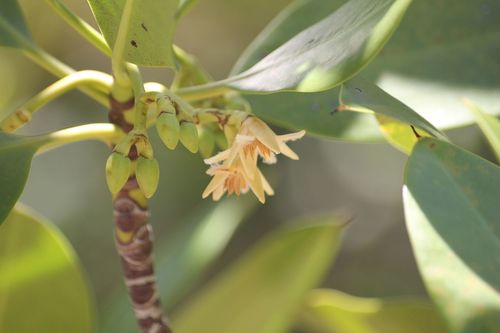
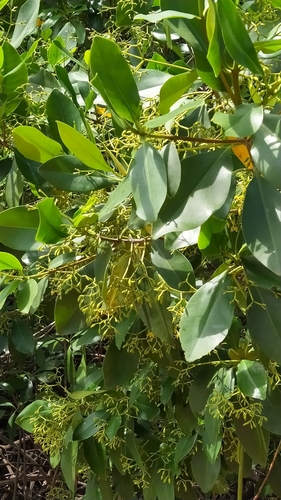
Bruguiera exaristata
Ding Hou
Rib-fruited Orange Mangrove
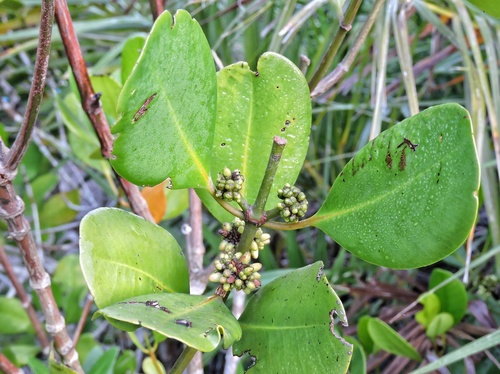
iNaturalist· cc-by-nc
(c) Russell Cumming, some rights reserved (CC BY-NC), uploaded by Russell Cumming
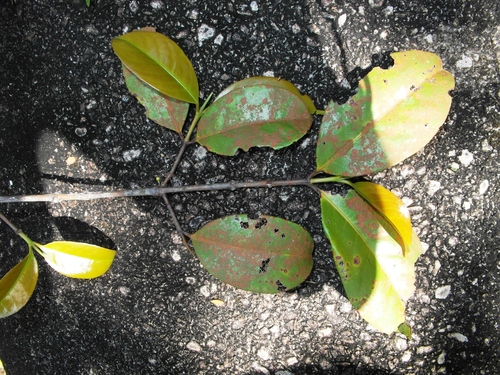
iNaturalist· cc-by-nc
(c) milmanindo, some rights reserved (CC BY-NC), uploaded by milmanindo
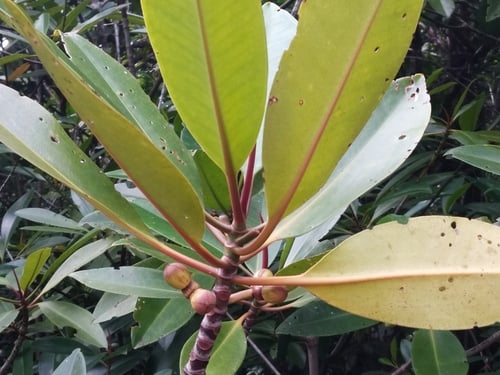
iNaturalist· cc-by-nc
(c) Russell Cumming, some rights reserved (CC BY-NC), uploaded by Russell Cumming
Summary
Source: WikipediaBruguiera exaristata, commonly known as the rib-fruited mangrove or rib-fruited orange mangrove, is a mangrove of the family Rhizophoraceae. The species is pollinated by birds. The species also contains tropine esters of acetic, benzoic, n-butyric, isobutyric, propionic, and isovaleric acids. The tropane alkaloid brugine is found in the bark of this species.
Description
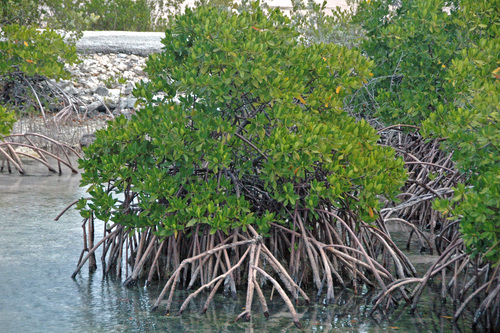
A small spreading tree. It grows 3-10 m high. It has buttresses at the base and many knee like aerial roots. The bark is dark grey and has a chequered pattern. The leaves grow opposite each other and are crowded towards the ends of branches. They are smooth and thick and leathery. They are oval with a sharply pointed stalk. The leaf blade is 4-10 cm long by 2-5 cm wide. The leaves are dark green and shiny on top and lighter green below. The leaf stalk is about 2 cm long. The leaf scar leaves 3 small distinct U shaped traces on the stem. The flowers are large and orange. They are 2-3.5 cm long by 1-3 cm wide. They are enclosed in a prominent green ring of sepals. The flowers hang down from the axils of the upper leaves. The fruit is cone shaped and about 1.5 cm long. The seed germinates on the plant. This produces a long narrow hypocotyl 4-9 cm long and 0.6-0.8 cm wide. It has ribs along its length. It is orange brown and with a ring of lobes from the flower at the end. The seed germinates on the bush before the fruit falls.
Edible Uses
The fruit is eaten but requires special preparation before consumption.
Traditional Uses
The fruit is eaten. It needs special preparation.
This uses section is brief — help expand it
Distribution
It is a tropical plant. They are found along river banks and estuaries. It is more common in areas with a seasonal rainfall and long dry season.
Where It Grows
Asia, Australia*, Bangladesh, East Timor, Indonesia, Malaysia, Pacific, Papua New Guinea, PNG, SE Asia, Timor-Leste,
Cultivation
Seeds can be planted directly from the tree. Seedlings transplant easily.
Production
In Australia plants flower from May to November and fruit June to December.
Other Information
It is not known if it is used for food in Papua New Guinea.
Notes
There are 6 Bruguiera species. They grow in tropical mangrove swamps.
Synonyms
References (16)
- Brock, J., 1993, Native Plants of Northern Australia, Reed. p 102
- Cherikoff V. & Isaacs, J., The Bush Food Handbook. How to gather, grow, process and cook Australian Wild Foods. Ti Tree Press, Australia p 198
- Cooper, W. and Cooper, W., 2004, Fruits of the Australian Tropical Rainforest. Nokomis Editions, Victoria, Australia. p 427
- Elliot, W.R., & Jones, D.L., 1982, Encyclopedia of Australian Plants suitable for cultivation. Vol 2. Lothian. p 382
- Frodin, D.G. & Leach, G.L., 1982, Mangroves of the Port Moresby Region. Biology Department Occasional Paper No 3 Revised edition. Papua New Guinea, p 28
Show all 16 references Hide references
- Hedrick, U.P., 1919, (Ed.), Sturtevant's edible plants of the world. p 364 ? (As Kandelia rheedii)
- Jackes, B. R., 2010, Plants of Magnetic Island. 3rd Edition. James Cook University, Australia. p 22
- Kenneally, K.E., Edinger, D. C., and Willing T., 1996, Broome and Beyond, Plants and People of the Dampier Peninsula, Kimberley, Western Australia. Department of Conservation and Land Management. p 172
- Lazarides, M. & Hince, B., 1993, Handbook of Economic Plants of Australia, CSIRO. p 40
- Melzer, R. & Plumb, J., 2011, Plants of Capricornia. Belgamba, Rockhampton. p 287
- Morley, B.D., & Toelken, H.R., (Eds), 1983, Flowering Plants in Australia. Rigby. p 172
- Paczkowska, G . & Chapman, A.R., 2000, The Western Australian Flora. A Descriptive Catalogue. Western Australian Herbarium. p 511
- Roth, W.E., 1901, (As Bruguiera rheedii)
- Tiwi Plants and Animals. 2001, Aboriginal flora and fauna knowledge from Bathurst and Melville Islands, northern Australia. Northern Territory Botanical Bulletin; No. 24 p 31
- Wheeler, J.R.(ed.), 1992, Flora of the Kimberley Region. CALM, Western Australian Herbarium, p 560
- World Checklist of Useful Plant Species 2020. Royal Botanic Gardens, Kew