Carallia brachiata
(Loureiro) Merrill
Billabong tree, Corkwood
iNaturalist· cc-by-nc
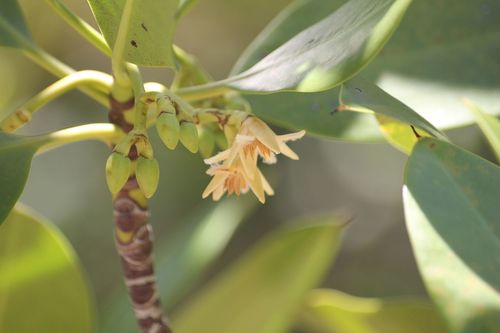
(c) kerrycoleman, some rights reserved (CC BY-NC), uploaded by kerrycoleman
iNaturalist· cc-by-sa
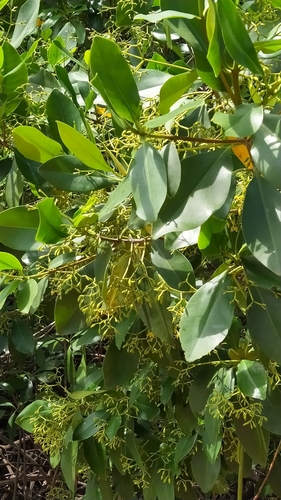
(c) Dinesh Valke, some rights reserved (CC BY-SA)
iNaturalist· cc-by-sa
(c) Dinesh Valke, some rights reserved (CC BY-SA)
Summary
Source: WikipediaCarallia brachiata is a species of flowering plant in the family Rhizophoraceae. This large tree grows to a height of 25 metres (82 ft) and is found from Australia, through South East Asia to the Western Ghats. It is the host plant of the moth Dysphania percota in India and Dysphania numana in Australia.
Description
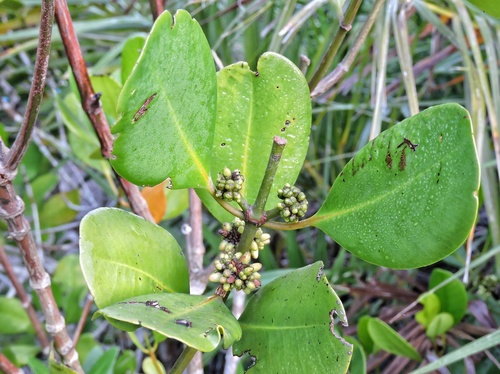
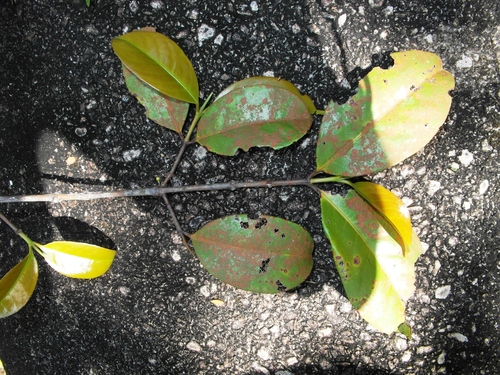
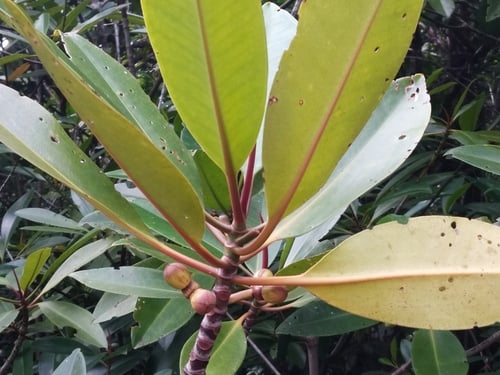
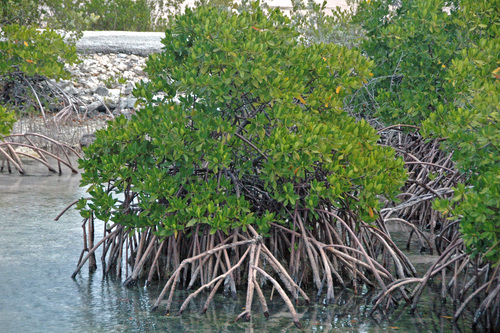
A medium sized tree. It grows up to 5-15 m tall. Sometimes it has aerial roots. The bark is cream and thick. It has cracks along it and a corky texture. The branches are in pairs which cross at right angles. It has spreading branches which point upwards. It spreads to 3-6 m wide. It can occasionally have buttresses and aerial roots. The leaves are oval and broad. They are 7-14 cm long by 4-8 cm wide. The leaves are rich glossy green on top. They have a papery texture and the underside is covered with tiny black spots. The midrib is raised underneath the leaf. The leaf stalk is 1.2 cm long. The flowers are small and composed of 5-8 greenish petals up to 2 mm long. The flowers are borne in clusters in short woody stems. These are produced in the axils of leaves or on old wood. The fruit are succulent berries which are green but turn red when ripe. They are 0.6 cm across. The have persistent sepals at their crown. The ripe fruit are edible. There is one seed inside. It is 4-5 mm across.
Edible Uses
The ripe fruit are eaten raw and are especially popular with children, though they are acidic. The leaves are used to make a tea-like drink. The seeds yield an edible oil.
Traditional Uses
The ripe fruit are eaten raw. They are acidic. The leaves are used for a tea like drink. The seeds yield an edible oil.
This uses section is brief — help expand it
Medicinal Uses
The juice from the macerated leaves is used in the treatment of fevers The pulverized bark is rubbed on the body in the treatment of smallpox. The leaves and bark are used in local medicine to treat septic poisoning and itch.
Distribution
A tropical plant. It grows in rainforests along river banks and the edges of freshwater swamps. It will grow on a range of soils. It can grow on salty soils or in areas with salt spray. In Indonesia it grows to 1,800 m altitude. In Madagascar it grows up to 1,500 m altitude. In XTBG Yunnan. In Townsville Anderson BG.
Where It Grows
Andamans, Asia, Australia, Bangladesh, Bhutan, Brunei, Cambodia, China, East Africa, East Timor, Himalayas, India, Indochina, Indonesia, Laos, Madagascar, Malaysia, Myanmar, Nepal, Northeastern India, Pacific, Papua New Guinea, PNG, Philippines, SE Asia, Solomon Islands, Sri Lanka, Thailand, Timor-Leste, Vietnam,
Cultivation
Plants can be grown from seed. The seed should be sown fresh.
Propagation
Seed - of limited viability, it is best sown as soon as it is ripe. Sown fresh, 45 - 100% of the seed can be expected to germinate within 4 - 15 weeks. Seedlings may be kept in the nursery for 2 years before being planted out in the field. Techniques for rapid multiplication by terminal branch cuttings have been developed in India; they include treatments with a fungicide and growth hormones.
Other Uses
The heartwood is yellowish brown to reddish brown; it is indistinctly to moderately distinctly demarcated from the paler sapwood. The grain is straight, interlocked or slightly wavy, texture coarse and uneven. The wood is of medium weight; strong; durable under cover, but durability in contact with the ground or when exposed to the weather is moderate to poor; it is prone to termite and marine borer attack. Easy to saw and plane, the beautifully marbled wood takes a fine polish and is suitable for general construction, house building, posts, cabinet work, furniture, parquet flooring, railway sleepers, musical instruments, tool handles, picture frames, veneer, interior finish and panelling, pallets and packing material. Due to its high energy value the wood yields good-quality fuel wood and charcoal. Plants growing in China have been found to be quite resistant to heavily polluted environments. This makes the plant a good candidate for use in reforestation and reclamation schemes on degraded and heavily polluted land.
Production
It is moderately fast growing. In northern Australia it fruits June to October. (April to July). In NE Thailand fruit are available June to August.
Other Information
It is not known if it is used as a food in Papua New Guinea. The fruit are especially eaten by children.
Notes
There are about 15 Carallia species.
Nutrition
| Part | Moisture | kJ | kcal | Protein | Vit A | Vit C | Iron | Zinc |
|---|---|---|---|---|---|---|---|---|
| Fruit | 77.2 | 395 | 94 | 2.2 | — | 4 | — | — |
| Leaves - tea | — | — | — | — | — | — | — | — |
| Seeds - oil | — | — | — | — | — | — | — | — |
Synonyms
Also Known As
Andipunaru, Anwirdu, Bibis, Cork Tree, Daini jam, Ganding, Hpun, Kanthekera, Karalli, Kathal boula, Kesinga, Kieng pra, Kierpa, Lotkao, Mahithekera, Maniawga, Maniawya, Matan, Merpoi, Merpuing, Muyu, Panasi, Pohon bilabong, Pohon buah kanis, Punschi, Roskao, Sepat, Sohkhwe, Theiria, Theng vothung, Tromeng, Varanga, Yat
References (59)
- Ambasta S.P. (Ed.), 2000, The Useful Plants of India. CSIR India. p 103
- Argent, G et al, nd, Manual of the Larger and More important non Dipterocarp Trees of Central Kalimantan Indonesia. Volume 2 Forest Research Institute, Samarinda, Indonesia. p 525
- BARC, 2016, State of Biodiversity for Food and Agriculture in Bangladesh. Bangladesh Agricultural Research Council.
- Bindon, P., 1996, Useful Bush Plants. Western Australian Museum. p 73.
- Bircher, A. G. & Bircher, W. H., 2000, Encyclopedia of Fruit Trees and Edible Flowering Plants in Egypt and the Subtropics. AUC Press. p 82
Show all 59 references Hide references
- Brock, J., 1993, Native Plants of Northern Australia, Reed. p 115
- Burkill, I.H., 1966, A Dictionary of the Economic Products of the Malay Peninsula. Ministry of Agriculture and Cooperatives, Kuala Lumpur, Malaysia. Vol 1 (A-H) p 454
- Calvert, G., 2010, The Burdekin Delta Tree Guide. Lower Burdekin Landcare Association., Inc., Ayr p 43
- Cherikoff V. & Isaacs, J., The Bush Food Handbook. How to gather, grow, process and cook Australian Wild Foods. Ti Tree Press, Australia p 198
- Cooper, W. and Cooper, W., 2004, Fruits of the Australian Tropical Rainforest. Nokomis Editions, Victoria, Australia. p 428
- Cowie, I, 2006, A Survey of Flora and vegetation of the proposed Jaco-Tutuala-Lore National Park. Timor-Lests (East Timor) www.territorystories.nt/gov.au p 52
- Cribb, A.B. & J.W., 1976, Wild Food in Australia, Fontana. p 74
- Dobriyal, M. J. R. & Dobriyal, R., 2014, Non Wood Forest Produce an Option for Ethnic Food and Nutritional Security in India. Int. J. of Usuf. Mngt. 15(1):17-37
- Elliot, W.R., & Jones, D.L., 1982, Encyclopedia of Australian Plants suitable for cultivation. Vol 2. Lothian. p 461
- Ethnobotany of Karbis. Chapter 4 in p 103 (As Carallia lucida)
- French, B.R., 2010, Food Plants of Solomon Islands. A Compendium. Food Plants International Inc. p 305
- Garde, M., et al, 2003, A Preliminary List of Kundedjnjenghmi Plant Names. Northern Land Council. (Arnhem Land, Australia)
- Gardner, S., et al, 2000, A Field Guide to Forest Trees of Northern Thailand, Kobfai Publishing Project. p 186
- Ghorbani, A., et al, 2012, A comparison of the wild food plant use knowledge of ethnic minorities in Naban River Watershed Nature Reserve, Yunnan, SW China. Journal of Ethnobiology and Ethnomedicine; 8:17
- Havel, J.J., 1975, Forest Botany, Volume 3 Part 2 Botanical taxonomy. Papua New Guinea Department of Forests, p 231
- Hazarika, T. K., et al, 2012, Studies on wild fruits of Mizoram, India used as ethno-medicines. Genetic Resources and Crop Evolution. Published on line 03 February, 2012
- Hibbert, M., 2002, The Aussie Plant Finder 2002, Florilegium. p 60
- Hiddins, L., 1999, Explore Wild Australia with the Bush Tucker Man. Penguin Books/ABC Books. p 127
- http://palaeoworks.anu.edu.au/Nuno_PhD/04.pdf
- Hu, Shiu-ying, 2005, Food Plants of China. The Chinese University Press. p 574
- Jackes, B.R., 2001, Plants of the Tropics. Rainforest to Heath. An Identification Guide. James Cook University. p 76
- Jones D, L, 1986, Ornamental Rainforest Plants in Australia, Reed Books, p 204
- Kar, A., & Borthakur, S. K., 2008, Wild edible fruits of Karbi's of Karbi Anglong district of Assam, India, Pleione 2(2): 175-181 (As Carallia lucida)
- Kar, A., et al, 2013, Wild Edible Plant Resources used by the Mizos of Mizoram, India. Kathmandu University Journal of Science, Engineering and Technology. Vol. 9, No. 1, July, 2013, 106-126
- Kenneally, K.E., Edinger, D. C., and Willing T., 1996, Broome and Beyond, Plants and People of the Dampier Peninsula, Kimberley, Western Australia. Department of Conservation and Land Management. p 172
- Lalfakzuala, R., 2007, Ethnobotanical usages of plants in western Mizoram. Indian Journal of Traditional Knowledge. Vol 6(3) pp 480-493
- Lazarides, M. & Hince, B., 1993, Handbook of Economic Plants of Australia, CSIRO. p 47
- Levitt, D., 1981, Plants and people. Aboriginal uses of plants on Groote Eylandt. Australian Institute of Aboriginal Studies, Canberra. p 119
- Melzer, R. & Plumb, J., 2011, Plants of Capricornia. Belgamba, Rockhampton. p 288
- Morley, B.D., & Toelken, H.R., (Eds), 1983, Flowering Plants in Australia. Rigby. p 172
- Paczkowska, G . & Chapman, A.R., 2000, The Western Australian Flora. A Descriptive Catalogue. Western Australian Herbarium. p 512
- Pasha, M. K. & Uddin, S. B., 2019, Minor Edible Fruits of Bangladesh. Bangladesh J. Plant Taxon. 26(2): 299–313
- Patiri, B. & Borah, A., 2007, Wild Edible Plants of Assam. Geethaki Publishers. p 52
- Phawa, G. M., Dkhar, E. K. & Marbaniang, D., 2019, Indigenous Wild Edible Plants of Bataw Village, East Jaintia Hills District, Meghalaya. International Journal of Arts, Science and Humanities. 7(2)
- Phon, P., 2000, Plants used in Cambodia. © Pauline Dy Phon, Phnom Penh, Cambodia. p 132
- Plants of Papua New Guinea LAE herbarium record
- Reis, S. V. and Lipp, F. L., 1982, New Plant Sources for Drugs and Foods from the New York Botanical Garden herbarium. Harvard. p 206
- Roth, W.E., 1901,
- Sarma, H., et al, 2010, Updated Estimates of Wild Edible and Threatened Plants of Assam: A Meta-analysis. International Journal of Botany 6(4): 414-423
- Scarth-Johnson, V., 2000, National Treasures. Flowering Plants of Cooktown and Northern Australia. Vera Scarth-Johnson Gallery Association. Cooktown, Australia. p 165
- Schatz, G.E., 2001, Generic Tree Flora of Madagascar. Royal Botanical Gardens, Kew and Missouri Botanical Garden. p 313
- Singh, H.B., Arora R.K.,1978, Wild edible Plants of India. Indian Council of Agricultural Research, New Delhi. p 53
- Smith, N and Wightman, G.M., 1990, Ethnobotanical Notes from Belyuen Northern Territory Australia. Northern Territory Botanical Bulletin No 10. Parks and Wildlife Commission of the Northern Territory. p 7, 8
- Smith, N. M., 1991, Ethnobotanical Field Notes from the Northern Territory, Australia, J. Adelaide Bot. Gard. 14(1): 1-65
- Suksri, S., et al, 2005, Ethnobotany in Bung Khong Long Non-Hunting Area, Northeast Thailand. Kasetsart J., (Nat. Sci) 39: 519-533
- Sukarya, D. G., (Ed.) 2013, 3,500 Plant Species of the Botanic Gardens of Indonesia. LIPI p 180
- Teron, R. & Borthakur, S. K., 2016, Edible Medicines: An Exploration of Medicinal Plants in Dietary Practices of Karbi Tribal Population of Assam, Northeast India. In Mondal, N. & Sen, J.(Ed.) Nutrition and Health among tribal populations of India. p 155 (As Carallia lucida)
- Townsend, K., 1994, Across the Top. Gardening with Australian Plants in the tropics. Society for Growing Australian Plants, Townsville Branch Inc. p 122
- Vigilante, T., et al, 2013, Island country: Aboriginal connections, values and knowledge of the Western Kimberley islands in the context of an island biological survey. Records of the Western Australian Museum Supplement 81: 145-182
- Wheeler, J.R.(ed.), 1992, Flora of the Kimberley Region. CALM, Western Australian Herbarium, p 562
- Wightman, G. & Andrews, M., 1991, Bush Tucker Identikit. Common Native Food Plants of Australia’s top end. Conservation Commission Northern Territory. p 6
- Wightman, G. M. & Andrews, M.R., 1989, Plants of Northern Territory Monsoon Vine Forests (Vol 1). Conservation Commission of Northern Territory. p 30
- World Checklist of Useful Plant Species 2020. Royal Botanic Gardens, Kew
- Yunupinu Banjgul, Laklak Yunupinu-Marika, et al. 1995, Rirratjinu Ethnobotany: Aboriginal Plant Use from Yirrkala, Arnhem Land, Australia. Northern Territory Botanical Bulletin No 21. Parks and Wildlife Commission of the Northern Territory. p 26.