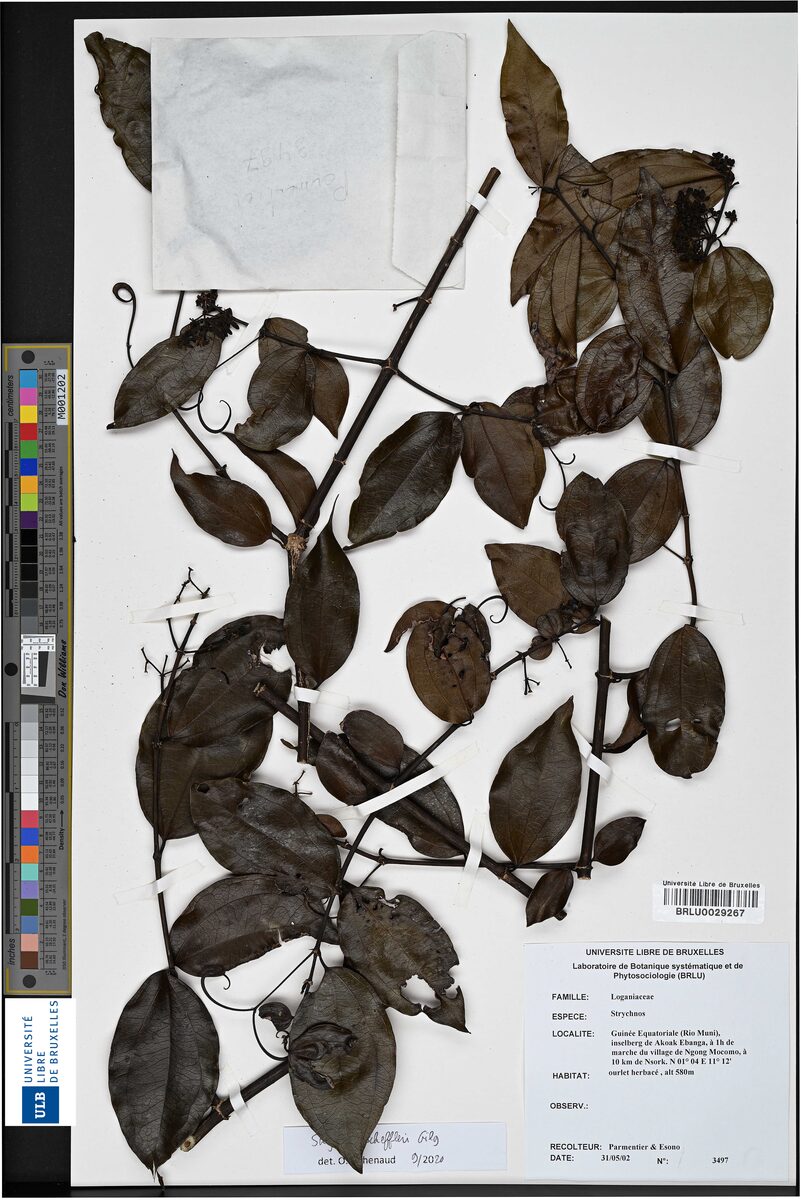
Strychnos pungens
Solered.
Monkey apple, Spiny leaved wild orange
iNaturalist· cc-by-nc
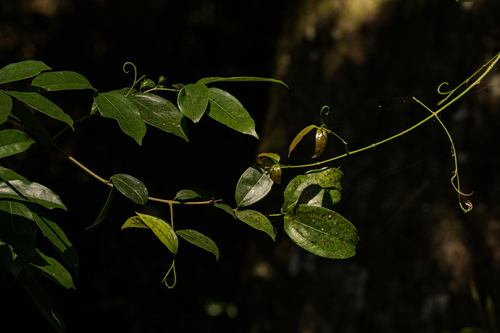
(c) Reuben Heydenrych, some rights reserved (CC BY-NC), uploaded by Reuben Heydenrych
iNaturalist· cc-by-nc-nd
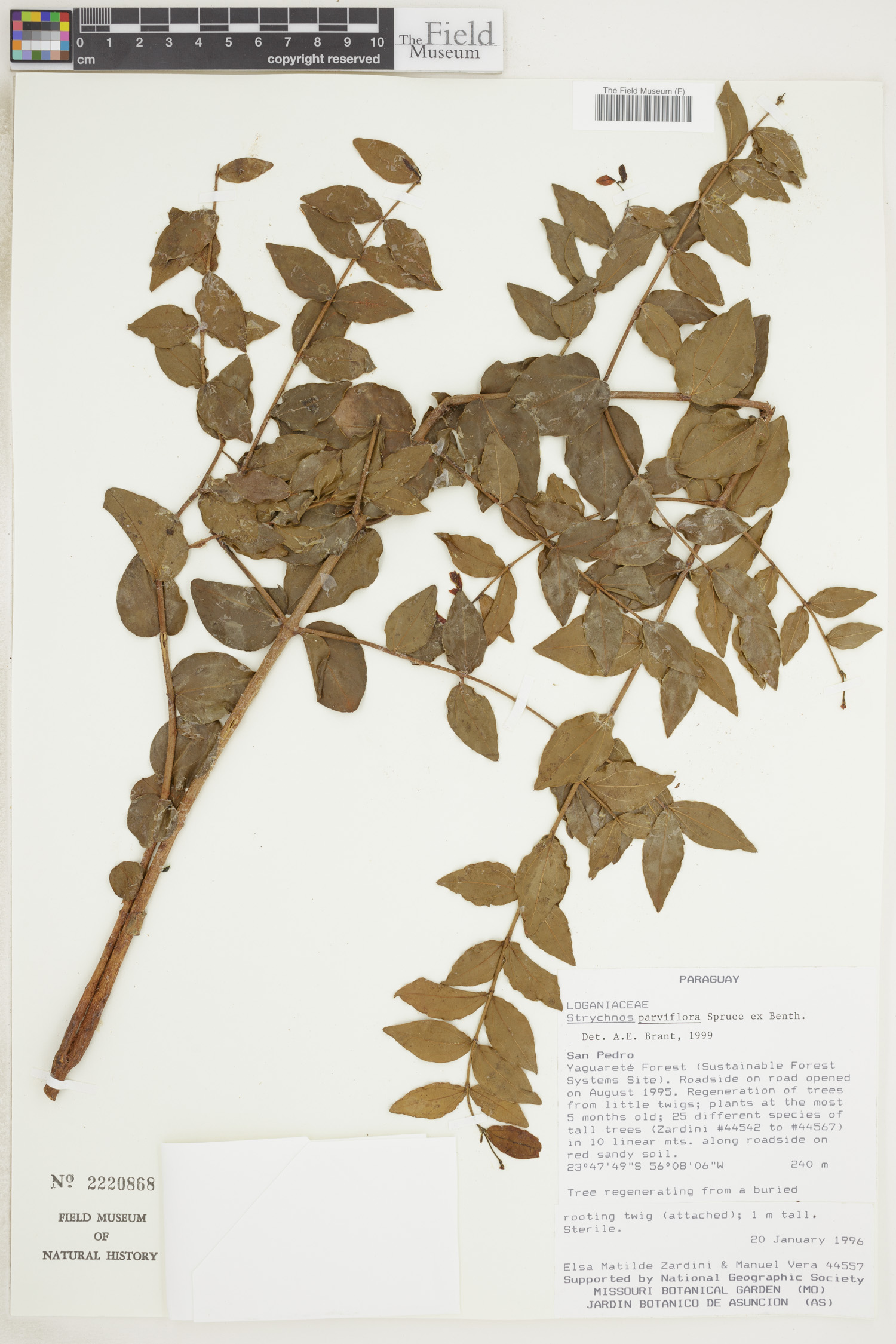
(c) Joseph Heymans, some rights reserved (CC BY-NC-ND), uploaded by Joseph Heymans
iNaturalist· cc-by-nc
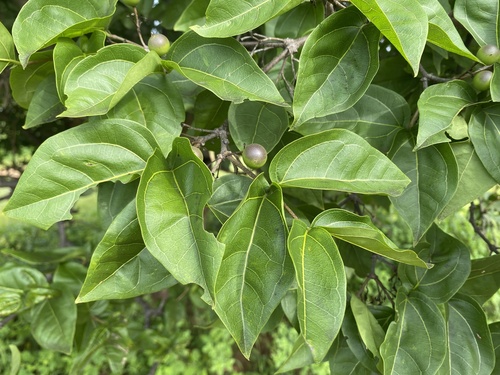
(c) Mike “Champ” Krzychylkiewicz, some rights reserved (CC BY-NC), uploaded by Mike “Champ” Krzychylkiewicz
Summary
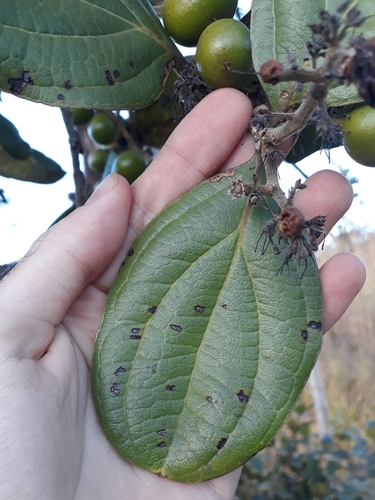
Source: WikipediaStrychnos pungens (English: spine-leaved monkey-orange, Afrikaans: Stekelblaarklapper) is a tree which belongs to the Loganiaceae. Usually about 5 m (16 ft) tall, occurring in mixed woodland or in rocky places. Branches are short and rigid. Leaves are smooth, stiff, opposite, elliptic and with a sharp, spine-like tip. Occurring in South Africa on the Witwatersrand, Magaliesberg and further north to northern Namibia, northern Botswana and Zimbabwe. The fruit is large (120 mm (4.7 in) diameter), round and with a smooth hard shell, bluish-green in colour and turning yellow when ripe. The pulp of ripe fruit is rich in citric acid and is edible, but the seeds are mildly poisonous. The tree is a close relative of Strychnos nux-vomica, the source of strychnine.
Description
An evergreen tree. It grows 2-6 m tall. It has a low spreading crown. The trunk has rough grey bark. The leaves are hard and leathery. They occur in opposite pairs. They have stiff sharp tips. Leaves are 1.5-6.5 cm long by 0.7-3 cm wide. They are oblong and the tips have a sharp spine like point. The base is often narrowed. The flower buds are flask shaped and yellow-green. They are in small clusters in the axils of leaves or on old wood. The flowers are starry and green. The fruit are large. They can be 10 cm across and weigh 0.45 kg. The skin is thick and woody and green turning yellow when ripe. There are many seeds in a yellowish strong smelling pulp. There are 20-100 seeds.
Edible Uses
The ripe fruit pulp is eaten raw or used to make drinks; young green fruits are roasted in sand under fire and eaten; the bitter fresh seeds are eaten or crushed with pulp for drinks.
Traditional Uses
The flesh can be eaten. The pulp of the ripe fruit is eaten raw, never cooked. It is also used for drinks. The young green fruit is roasted in the sand under the fire and then eaten. The seeds although bitter are eaten when fresh. The seeds and pulp is also crushed for a drink. CAUTION: Many Loganiaceae are very poisonous.
Medicinal Uses
A decoction of roots is used as a remedy for stomach-ache and bronchitis. An infusion from the leaves is used as a lotion for sore eyes.
Known Hazards
Various parts of Strychnos plants, especially the seeds and bark, contain toxic alkaloids such as strychnine and brucine. The fleshy pulp of the ripe fruits, however, is often edible. The seeds are poisonous.
Distribution
A tropical plant. It can grow in deep sandy soils and on stony hill slopes. It grows between 120-1,755 m above sea level. It can grow in salty soils. It grows in areas with an annual rainfall above 250 mm. It can grow in arid places. It grows in Miombo woodland in Africa.
Where It Grows
Africa, Angola, Botswana, Central Africa, Congo, East Africa, Eswatini, Malawi, Mozambique, Namibia, South Africa, Southern Africa, Swaziland, Tanzania, Zambia, Zimbabwe,
Cultivation
Plants can be grown from seeds but seeds can take 6 months to germinate.
Other Uses
The empty fruit shells are used for making rattles. The shell, after the flesh has been removed, is left to dry for some time and is then filled with hard dry seeds - preferably those from Rhynchosia resinosa. The fruit shell is also sometimes used as a drinking vessel. The translucent seeds are sometimes used in making necklaces. The yellow wood is used for fuel.
Nutrition
| Part | Moisture | kJ | kcal | Protein | Vit A | Vit C | Iron | Zinc |
|---|---|---|---|---|---|---|---|---|
| Fruit | 72.1 | 367 | 88 | 1.1 | — | 10.7 | 0.6 | 0.3 |
| Fruit | 64.3 | 338 | 81 | 4.6 | — | — | — | — |
Synonyms
Also Known As
Kahola muanda, Kakomekome, Mabumi, Mahwahwa, Mbitu, Mbumi, Mhandagi, Mkome, Mogwawa, Mubanga-kyulu, Mudo, Mugwati, Mukome, Mukwakwa, N'demeteme, Omupwaka, Umgwadi, Witu
References (33)
- Baidu-Forson, J.J., et al ,2014,. Assessment of agrobiodiversity resources in the Borotse flood plain, Zambia. CGIAR Research Program on Aquatic Agricultural Systems. Penang, Malaysia. Working Paper: AAS-2014-12.
- Cheikhyoussef, A & Embashu, W., 2013, Ethnobotanical knowledge on Indigenous fruits in Ohangwena and Oshito regions in Northern Namibia. Journal of Ethnobiology and Ethnomedicine 9:34
- H. G. A. Engler & K. A. E. Prantl, Nat. Pflanzenfam. 4(2):40. 1892
- Fowler, D. G., 2007, Zambian Plants: Their Vernacular Names and Uses. Kew. p 62
- Fox, F. W. & Young, M. E. N., 1982, Food from the Veld. Delta Books. p 261
Show all 33 references Hide references
- http://www.fao.org/forestry/25323-096344a3de335832e8f363c3ac5184a66.pdf
- INFOODS:FAO/INFOODS Databases
- Jardin, C., 1970, List of Foods Used In Africa, FAO Nutrition Information Document Series No 2.p 163
- Larson, T. J., 1970, Hambukushu Ethno-botany. Botswana Notes and Records. Vol 13.
- Leger, S., 1997, A Description of Today's Use of Plants in West Bushmanland (Namibia). German Development Service. PO Box 220035, 14061 Berlin, Germany. http://www.sigridleger.de/book/
- Long, C., 2005, Swaziland's Flora - siSwati names and Uses http://www.sntc.org.sz/flora/
- Magwede, K., van Wyk, B.-E., & van Wyk, A. E., 2019, An inventory of Vhavenḓa useful plants. South African Journal of Botany 122 (2019) 57–89
- Malaisse, F., 1997, Se nourrir en floret claire africaine. Approche ecologique et nutritionnelle. CTA., p 69
- Mannheimer, C. A. & Curtis. B.A. (eds), 2009, Le Roux and Muller's Field Guide to the Trees and Shrubs of Namibia. Windhoek: Macmillan Education Namibia. p 402
- Maroyi, A. & Cheikhyoussef, A., 2017, Traditional knowledge of wild edible fruit in southern Africa: A comparative use patterns in Namibia and Zimbabwe. Indian Journal of Traditional Knowledge. 16(3): 385-392
- Mason, 1971,
- Mokganya, M. G. et al, 2018, An evaluation of additional uses of some wild edible fruit plants of the Vhembe District Municipality in the Limpopo Province, South Africa. Indian Journal of Traditional Knowledge. Vol 17(2) April 2018, pp 276-281
- Quin, 1959,
- Palmer, E and Pitman, N., 1972, Trees of Southern Africa. Vol. 2. A.A. Balkema, Cape Town p 1857
- Peters, C. R., O'Brien, E. M., and Drummond, R.B., 1992, Edible Wild plants of Sub-saharan Africa. Kew. p 142
- Rodin, 1985,
- Roodt, V., 1998, Trees & Shrubs of the Okavango Delta. Medicinal Uses and Nutritional value. The Shell Field Guide Series: Part 1. Shell Botswana. p 196
- Royal Botanic Gardens, Kew (1999). Survey of Economic Plants for Arid and Semi-Arid Lands (SEPASAL) database. Published on the Internet; http://www.rbgkew.org.uk/ceb/sepasal/internet [Accessed 1st May 2011]
- Ruiters-Welcome, A. K., 2019, Food plants of southern Africa. Ph.D. thesis. Univ. of Johannesburg p 74
- Schmidt, E., Lotter, M., & McCleland, W., 2007, Trees and shrubs of Mpumalanga and Kruger National Park. Jacana Media p 544
- Story, 1958,
- Tanaka, 1980,
- Tredgold, M.H., 1986, Food Plants of Zimbabwe. Mambo Press. p 125
- van Wyk, B, van Wyk, P, and van Wyk B., 2000, Photographic guide to Trees of Southern Africa. Briza. p 298
- Wehmeyer, A. S, 1986, Edible Wild Plants of Southern Africa. Data on the Nutrient Contents of over 300 species
- Welcome, A. K. & Van Wyk, B.-E., 2019, An inventory and analysis of the food plants of southern Africa. South African Journal of Botany 122 (2019) 136–179
- Wild, 1975,
- World Checklist of Useful Plant Species 2020. Royal Botanic Gardens, Kew