Sambucus cerulea
Raf.
Blue Elderberry, Blue elder
iNaturalist· cc-by-nc
(c) Matthew Zlatunich, some rights reserved (CC BY-NC), uploaded by Matthew Zlatunich
iNaturalist· cc-by-nc
(c) Matthew Zlatunich, some rights reserved (CC BY-NC)
Summary
Source: WikipediaSambucus cerulea or Sambucus nigra subsp. cerulea, with the common names blue elderberry and blue elder, is a coarse textured shrub species of elder in the family Adoxaceae.
Description
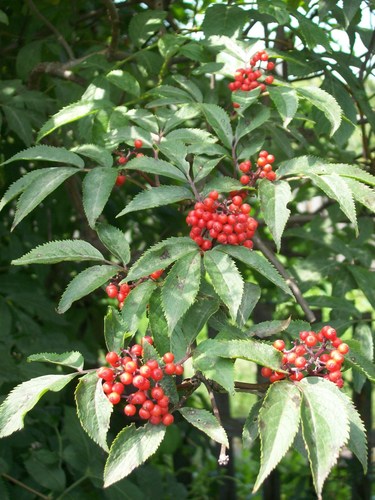
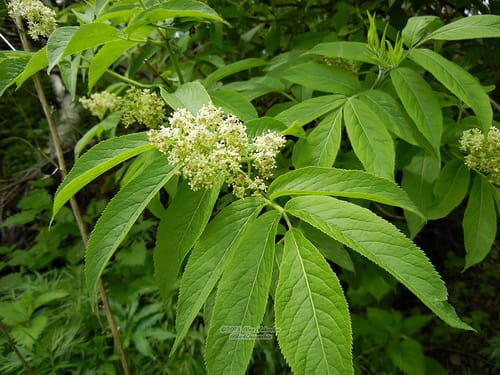
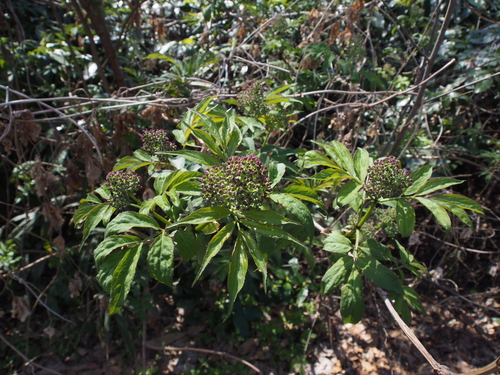
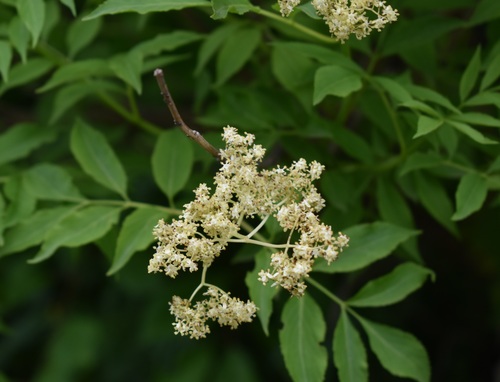
A tall shrub. It has an irregular shape. It can be a small tree up to 10 m tall. The trunk can be 20 cm across. The bark is thin and light brown. The leaves have 5-9 leaflets on a central stalk which has a groove. The stalk is 6-12 cm long. The leaflets are 5-15 cm long and sword shaped. They are bluish-green above and paler underneath. They do not have hairs. They have an unpleasant smell when crushed. The twigs are stout and the buds are large. The flowers are creamy white in flat topped clusters. These have 5 branches. The clusters are 7-15 cm across. They appear after the leaves have fully grown. The fruit are bluish-black. They are 3-5 mm across. They are juicy and sweet with 3 seeds.
Edible Uses
The flower blossoms can be used to make tea. The fruits can be eaten raw (despite containing a toxin), dried, or as jelly.
Traditional Uses
The fruit are eaten raw. They are dried before using in jellies, juices, wines, pies, fruit sauces, sherbets, soups, relishes. Flower clusters are made into fritters or pickles. Individual flowers are used in pancakes, muffins, syrups, or vinegars. The dried flowers are brewed for tea.
Known Hazards
The raw berries contain a toxin which, if eaten raw, may induce nausea in some people.
Distribution
It is a temperate plant. It usually grows on dry open sites with gravelly or stony soils.
Where It Grows
Australia, Canada, Central America, Mexico, North America, USA,
Cultivation
It can be grown from roots.
Notes
There are about 25 Sambucus species. Also put in the family Sambucaceae. The fruit have high antioxidant activity.
Dangerous Lookalikes
This plant can be confused with the following toxic species. Always verify identification carefully before consuming any wild plant.
Pokeweed
Phytolacca americana
Jakec
Blue Elderberry
Sambucus cerulea
(c) Matthew Zlatunich, some rights reserved (CC BY-NC), uploaded by Matthew Zlatunich
Pokeweed: Thick red/purple herbaceous stems (no bark), berries in a line (raceme), simple large leaves, large white taproot.
Blue Elderberry: Woody bark, berries in broad flat clusters (cymes), compound leaves with 5-7 leaflets.
Synonyms
Also Known As
Blue elder, Blue-berry elder, Mexican elder, Sauco, Chicnan
References (24)
- Alsogr. amer. 48. 1838
- Beckstrom-Sternberg, Stephen M., and James A. Duke. "The Foodplant Database." http://probe.nalusda.gov:8300/cgi-bin/browse/foodplantdb.(ACEDB version 4.0 - data version July 1994) (As Sambucus caerulea)
- Bocek, B. R., 1984, Ethnobotany of Costanoan Indians, California, Based on Collections by John P. Harrington. Economic Botany 38(2): 240-255
- Bodkin, F., 1991, Encyclopedia Botanica. Cornstalk publishing, p 905
- Elias, T.S. & Dykeman P.A., 1990, Edible Wild Plants. A North American Field guide. Sterling, New York p 190
Show all 24 references Hide references
- Esperanca, M. J., 1988. Surviving in the wild. A glance at the wild plants and their uses. Vol. 1. p 130
- Facciola, S., 1998, Cornucopia 2: a Source Book of Edible Plants. Kampong Publications, p 222 (As Sambucus glauca)
- Farrar, J.L., 1995, Trees of the Northern United States and Canada. Iowa State University press/Ames p 174
- Flowerdew, B., 2000, Complete Fruit Book. Kyle Cathie Ltd., London. p 178 (As Sambucus caerulea)
- Glowinski, L., 1999, The Complete Book of Fruit Growing in Australia. Lothian. p 176 (As Sambucus caerulea)
- Hedrick, U.P., 1919, (Ed.), Sturtevant's edible plants of the world. p 592 (As Sambucus caerulea)
- Hibbert, M., 2002, The Aussie Plant Finder 2002, Florilegium. p 286 (As Sambucus caerulea)
- http://www.stoller-eser.com/Flora/ethnobotany_table.htm
- John, L., & Stevenson, V., 1979, The Complete Book of Fruit. Angus & Robertson p 129 (As Sambucus caerulea)
- Kiple, K.F. & Ornelas, K.C., (eds), 2000, The Cambridge World History of Food. CUP p 1771 (As Sambucus caerulea)
- Mabberley, D. J., 1990, The plant-book: a portable dictionary of the higher plants. Cambridge University Press. NY.
- MacKinnon, A., et al, 2009, Edible & Medicinal Plants of Canada. Lone Pine. p 125
- Plants for a Future database, The Field, Penpol, Lostwithiel, Cornwall, PL22 0NG, UK. http://www.scs.leeds.ac.uk/pfaf/ (As Sambucus caerulea)
- Segura, S. et al, 2018, The edible fruit species in Mexico. Genet Resour Crop Evol (2018) 65:1767–1793 (Also as Sambucus velutina)
- Turner, N., 1995, Food Plants of Coastal First Peoples. Royal BC Museum Handbook p 66
- Turner, N., 1997, Food Plants of Interior First Peoples. Royal BC Museum Handbook p 103
- USDA, ARS, National Genetic Resources Program. Germplasm Resources Information Network - (GRIN). [Online Database] National Germplasm Resources Laboratory, Beltsville, Maryland. Available: www.ars-grin.gov/cgi-bin/npgs/html/econ.pl (10 April 2000)
- Wiersema, J. H. & Leon, B., 2013, World Economic Plants. A Standard Reference CRC Press. 2nd Ed. p 611
- World Checklist of Useful Plant Species 2020. Royal Botanic Gardens, Kew