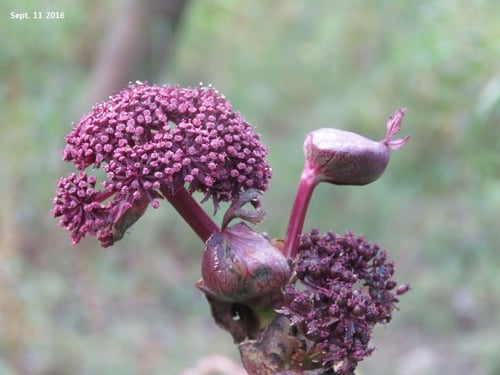
Apium graveolens var. rapaceum
(Miller) Gaudin
Celeriac, Celery root, Turnip-rooted celery
Summary
Source: WikipediaApium graveolens, known in English as celery, is an Old World species of flowering plant in the family Apiaceae. It was first described by Carl Linnaeus in 1753. The species is widely naturalised outside of its natural range and is used as a vegetable; modern cultivars have been selected for their leaf stalks (celery), a large bulb-like hypocotyl (celeriac), and their leaves (leaf celery).
Description
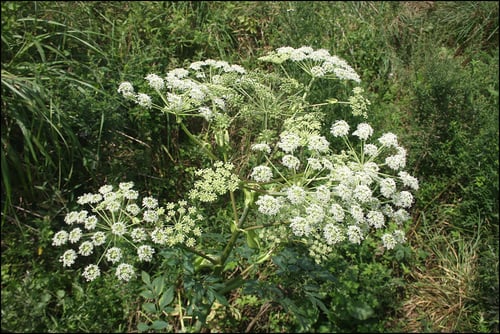
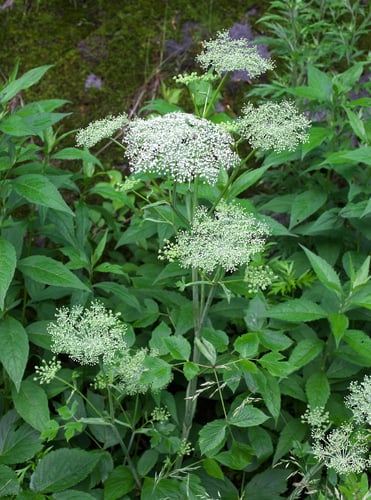
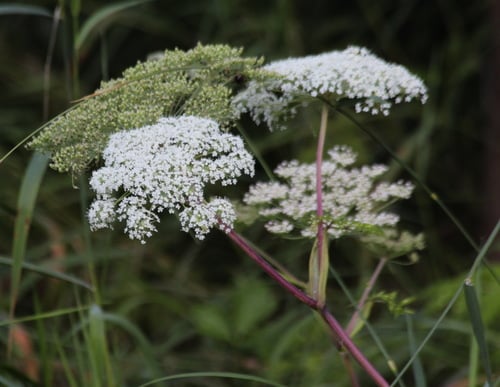
A plant that normally takes 2 years to complete its life-cycle. It grows about 1 m tall. The bases of the stem are swollen. They are like a turnip. The leaf stalks are slender.
Edible Uses
Wild celery was used for its medical properties and as a condiment by the Ancient Egyptians, Greeks and Romans, and also in China. The species was later developed as a vegetable, particularly in Italy from the 16th century. Modern cultivars have been selected for different uses, falling into three groups according to the part that is mainly eaten: Celery (Apium graveolens Dulce Group; syn. Apium graveolens var. dulce), is used for its leaf stalks, which may be eaten raw or cooked. Celeriac (Apium graveolens Rapaceum Group; syn. Apium graveolens var. rapaceum), is used for its swollen bulb-like hypocotyl. Leaf celery or smallage (Apium graveolens Secalinum Group; syn. Apium graveolens var. secalinum), has larger leaves; both the leaves and stems are eaten.
Traditional Uses
It can be eaten raw or grated in salads, used as a flavouring in soups and stews or cooked as a vegetable. Leaves can be used as flavouring.
This uses section is brief — help expand it
Distribution
They are sensitive to frosts. It suits plant hardiness zones 5-10.
Where It Grows
Africa, Australia, Balkans, Canada, East Africa, Egypt, Europe, Hawaii, India, Macedonia, Mediterranean, Middle East, Netherlands, North Africa, North America, Pacific, South Africa, Southern Africa, Switzerland, Syria, Tasmania, USA,
Cultivation
Seeds are slow to germinate. Plants should be 25 cm apart. Side shoots are removed as they appear. The bulbs are harvested when 7.5-10 cm across.
Production
It takes 4 months until harvest. Roots can be stored in sand for eating in winter.
Other Information
It is a commercially cultivated vegetable.
Notes
There are about 20 Apium species.
Nutrition
| Part | Moisture | kJ | kcal | Protein | Vit A | Vit C | Iron | Zinc |
|---|---|---|---|---|---|---|---|---|
| Root - raw | 88.6 | 176 | 42 | 1.5 | 0 | 8 | 0.7 | 0.3 |
| Root - boiled | 92.3 | 113 | 27 | 1 | 0 | 4 | 0.4 | 0.2 |
| Leaves | — | — | — | — | — | — | — | — |
References (24)
- Bianchini, F., Corbetta, F., and Pistoia, M., 1975, Fruits of the Earth. Cassell. p 98
- Blamey, M and Grey-Wilson, C., 2005, Wild flowers of the Mediterranean. A & C Black London. p 160
- Cheifetz, A., (ed), 1999, 500 popular vegetables, herbs, fruits and nuts for Australian Gardeners. Random House p 34
- Cundall, P., (ed.), 2004, Gardening Australia: flora: the gardener's bible. ABC Books. p 164
- Facciola, S., 1998, Cornucopia 2: a Source Book of Edible Plants. Kampong Publications, p 15
Show all 24 references Hide references
- Fl. helv. 2:422. 1828
- Gouldstone, S., 1983, Growing your own Food-bearing Plants in Australia. Macmillan p 164
- Grubben, G. J. H. and Denton, O. A. (eds), 2004, Plant Resources of Tropical Africa 2. Vegetables. PROTA, Wageningen, Netherlands. p 91
- Hadfield, J., 2001, The A-Z of Vegetable Gardening in South Africa. Struik p 102
- Hedrick, U.P., 1919, (Ed.), Sturtevant's edible plants of the world. p 63
- Hibbert, M., 2002, The Aussie Plant Finder 2002, Florilegium. p 30
- Jardin, C., 1970, List of Foods Used In Africa, FAO Nutrition Information Document Series No 2.p 56
- Kays, S. J., and Dias, J. C. S., 1995, Common Names of Commercially Cultivated Vegetables of the World in 15 languages. Economic Botany, Vol. 49, No. 2, pp. 115-152
- Kiple, K.F. & Ornelas, K.C., (eds), 2000, The Cambridge World History of Food. CUP p 1749
- Lazarides, M. & Hince, B., 1993, Handbook of Economic Plants of Australia, CSIRO. p 22
- Lim, T. K., 2015, Edible Medicinal and Non Medicinal Plants. Volume 9, Modified Stems, Roots, Bulbs. Springer p 10
- Macmillan, H.F. (Revised Barlow, H.S., et al), 1991, Tropical Planting and Gardening. Sixth edition. Malayan Nature Society. Kuala Lumpur. p 362
- Plants for a Future database, The Field, Penpol, Lostwithiel, Cornwall, PL22 0NG, UK. http://www.scs.leeds.ac.uk/pfaf/
- Purseglove, J.W., 1968, Tropical Crops Dicotyledons, Longmans. p 650
- Schneider, E., 2001, Vegetables from Amaranth to Zucchini: The essential reference. HarperCollins. p 163
- Seidemann J., 2005, World Spice Plants. Economic Usage, Botany, Taxonomy. Springer. p 47
- USDA, ARS, National Genetic Resources Program. Germplasm Resources Information Network - (GRIN). [Online Database] National Germplasm Resources Laboratory, Beltsville, Maryland. Available: www.ars-grin.gov/cgi-bin/npgs/html/econ.pl (10 April 2000)
- van Wyk, B., 2005, Food Plants of the World. An illustrated guide. Timber press. p 64
- Wiersema, J. H. & Leon, B., 2013, World Economic Plants. A Standard Reference CRC Press. 2nd Ed. p 60