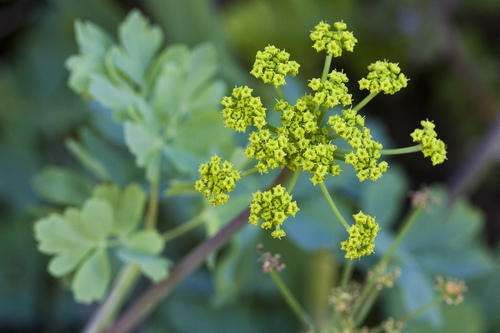
Cymopterus montanus
(Nutt.) Torr. & A. Gray
Mountain spring parsley
iNaturalist· cc-by-nc
(c) Stephen Andersen, some rights reserved (CC BY-NC)
iNaturalist· cc-by-nc
(c) Stephen Andersen, some rights reserved (CC BY-NC)
iNaturalist· cc-by-nc
(c) Stephen Andersen, some rights reserved (CC BY-NC)
Summary
Source: WikipediaPerennial herb growing 0.2 m tall, hardy with hermaphrodite, self-fertile flowers pollinated by insects. Tolerates light sandy, medium loamy, and heavy clay soils with good drainage. Grows in mildly acid to basic soils, cannot grow in shade, tolerates dry or moist soil.
Description
Perennial herb growing 0.2 m tall, hardy with hermaphrodite, self-fertile flowers pollinated by insects. Tolerates light sandy, medium loamy, and heavy clay soils with good drainage. Grows in mildly acid to basic soils, cannot grow in shade, tolerates dry or moist soil.
Edible Uses
The root is spindle-shaped and parsnip-like in form but considerably softer, sweeter, and more tender than an actual parsnip, and is used as a vegetable either raw or cooked. It can also be peeled, baked, dried, and ground into a powder for occasional use as a corn meal substitute. The seed is also edible, raw or cooked.
Traditional Uses
The young stems and leaves are eaten raw or cooked. The roots are peeled, baked and ground into a meal.
This uses section is brief — help expand it
Medicinal Uses
None known
Distribution
It is a temperate plant.
Where It Grows
Mexico, North America, USA,
Propagation
No specific information is available for this species, but sowing seed in a cold frame as soon as it is ripe is recommended where possible. Stored seed should be sown as early in the year as possible in a greenhouse. Seedlings should be pricked out into individual pots once large enough to handle and grown on under cover for at least their first winter, then planted into permanent positions in late spring or early summer after the last expected frosts. Division in spring or autumn may also be possible.
Other Uses
None known
Also Known As
Gamote, Pastinaca de monte
References (5)
- Beckstrom-Sternberg, Stephen M., and James A. Duke. "The Foodplant Database." http://probe.nalusda.gov:8300/cgi-bin/browse/foodplantdb.(ACEDB version 4.0 - data version July 1994) (As Phellopterus montanus)
- Hedrick, U.P., 1919, (Ed.), Sturtevant's edible plants of the world. p 257
- Hermandez Bermejo, J.E., and Leon, J. (Eds.), 1994, Neglected Crops. 1492 from a different perspective. FAO Plant Production and Protection Series No 26. FAO, Rome. p 30 (As Phellopterus montanus)
- Kermath, B. M., et al, 2014, Food Plants in the Americas: A survey of the domesticated, cultivated and wild plants used for Human food in North, Central and South America and the Caribbean. On line draft. p 290
- Plants for a Future database, The Field, Penpol, Lostwithiel, Cornwall, PL22 0NG, UK. http://www.scs.leeds.ac.uk/pfaf/
More from Apiaceae
Ligusticum scoticum
Scottish Lovage, Scottish licorice-root, Hulten's licorice-root
Ligusticum sinense
Chinese lovage, Mountain coriander
Ligusticum tenuissimum
Kobon
Lomatium ambiguum - (Nutt.)Coult.&Rose.
Biscuitroot, Wyeth biscuitroot
Lomatium bicolor var. leptocarpum
Wasatch desert parsley
Lomatium californicum
Wild celery-parsley, California lomatium