Rhus chinensis
Miller
Chinese gall, Chinese sumac, Nutgall tree
iNaturalist· cc0
no rights reserved, uploaded by 葉子
iNaturalist· cc-by-sa
(c) Colin Meurk, some rights reserved (CC BY-SA), uploaded by Colin Meurk
iNaturalist· cc-by-nc
(c) Liu JimFood, some rights reserved (CC BY-NC), uploaded by Liu JimFood
Summary
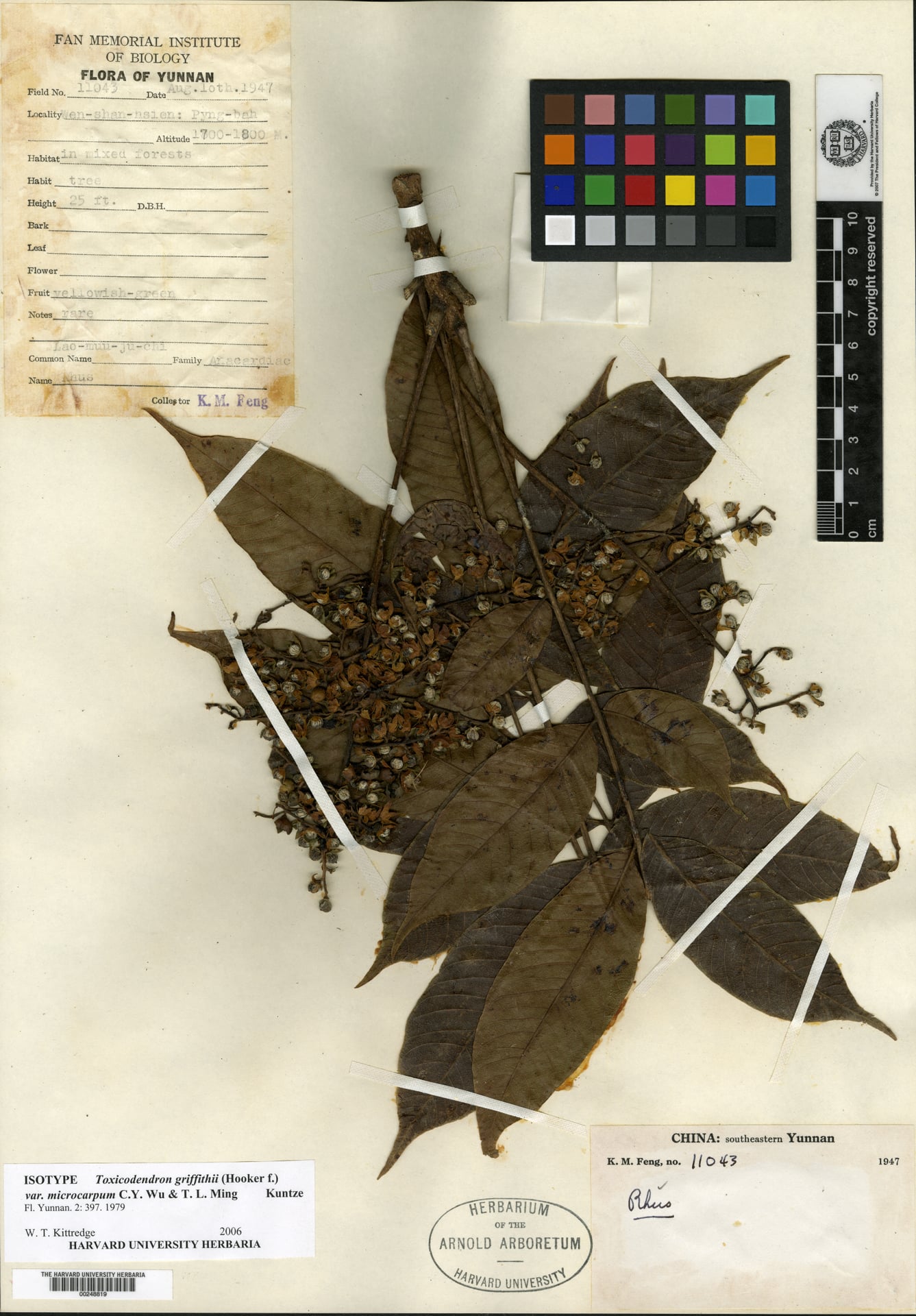
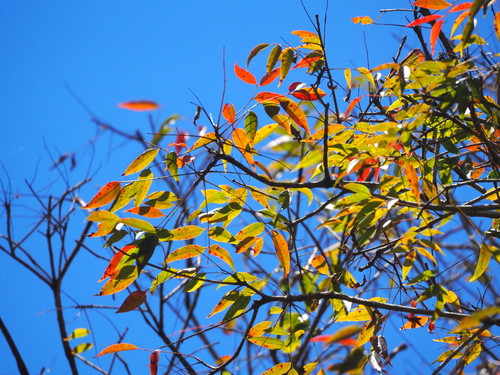
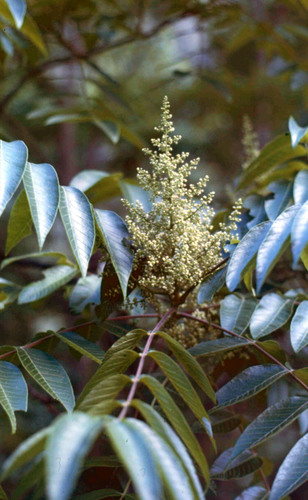
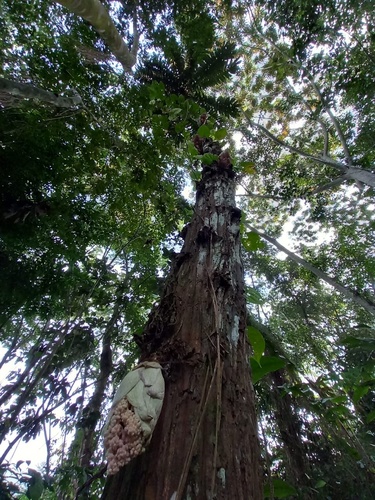
Source: WikipediaRhus chinensis, the Chinese sumac or nutgall tree, is a deciduous shrub or small tree in the genus Rhus. Growing to 6 m (20 ft) tall, it has downy shoots and leaves comprising several leaflets. These turn red in autumn before falling. The plant is common in East and South Asia, and is cultivated as an ornamental in temperate climates. Galls produced on the species that are called Chinese gall (Galla chinensis), are a source of gallotannins, molecules of hydrolyzable tannins. Infestation of the tree by Chinese sumac aphids (Melaphis chinensis Bell) may lead to production of a gall that is valued as a commercial product in China. Chinese galls are used in traditional Chinese medicine for coughs, diarrhea, night sweats, dysentery, and intestinal and uterine bleeding. Some research has suggested that chemical compounds found in Rhus chinensis possess in vitro antiviral, antibacterial, anticancer, hepatoprotective, antidiarrheal, and antioxidant activities. The aqueous extracts of the gall also inhibit alpha-glucosidase activity in vitro.
Description
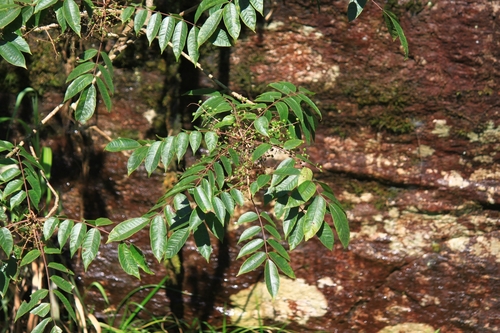
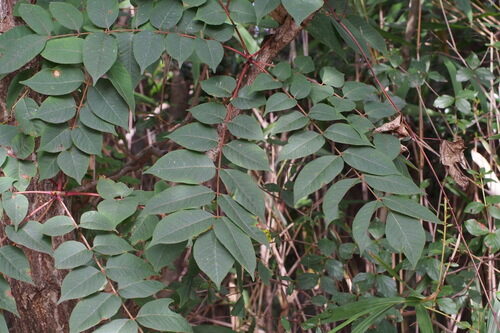
A shrub. It loses its leaves during the year. It grows 2-4 m high. Its shoots are downy. The branches have spines. The leaves have leaflets along the stalk. The leaves are 40 cm long. There are 7-13 leaflets on a stalk. The leaflets are about 5-12 cm long by 2-5 cm wide. The leaves turn red in autumn. The flowers are white. They are in cone shaped clusters. The fruit are round. They are bright orange-red.
Edible Uses
The fruit is edible cooked and has an acid flavour. It is also used medicinally. The fruit can serve as a substitute for salt or as a rennet substitute for curdling.
Traditional Uses
The fruit are used to make soup. They are very sour. The fruit are boiled and used in pickles. They are also boiled with sugar and used as a drink. The fruit are also used as a substitute for rennet in preparation of curd. The pounded seeds are added to foods as a spice and in chilli sauce. The seeds are used in chutney. The young shoots are eaten as a vegetable. They are boiled with rice.
Medicinal Uses
The leaves and roots are depurative and stimulate blood circulation; a decoction treats haemoptysis, inflammations, laryngitis, snakebite, stomachache, and traumatic fractures. The stem bark is astringent and anthelmintic. The fruit is used for colic. The seed treats coughs, dysentery, fever, jaundice, malaria, and rheumatism. The root bark is cholagogue. Galls on the plant are rich in tannin and are used internally for their astringent and styptic properties to treat diarrhoea and haemorrhage; they are also a frequent ingredient in polyherbal prescriptions for diabetes mellitus. An excrescence produced on the leaf by the insect Melaphis chinensis or M. paitan is antiseptic, astringent, and haemostatic. It is used internally for persistent cough with blood, chronic diarrhoea, spontaneous sweating, night sweats, bloody stool, urorrhoea, and bloody sputum, and applied externally to burns, traumatic bleeding, haemorrhoids, and mouth ulcers. Some caution is advised in using the leaves and stems regarding toxicity.
Known Hazards
There are some suggestions that the sap of this species can cause a skin rash in susceptible people, but this has not been substantiated. See also notes in 'Cultivation Details'.
Distribution
It is a warm temperate plant. It grows on forested hilly areas. In Borneo it grows up to 2,800 m above sea level. In Sikkim it grows between 600-1,800 m above sea level. It suits hardiness zones 8-11. Mt Cootha Botanical Gardens. Arboretum Tasmania. In Sichuan and Yunnan.
Where It Grows
Asia, Australia, Bhutan, Cambodia, China*, Himalayas, India, Indochina, Indonesia, Japan*, Korea, Laos, Malaysia, Myanmar, Nepal, Northeastern India, Pakistan, SE Asia, Sikkim, Singapore, Slovenia, Sri Lanka, Taiwan, Tasmania, Thailand, Vietnam,
Cultivation
Succeeds in a well-drained fertile soil in full sun. A very ornamental plant, it is not fully hardy in all parts of Britain and needs a hot summer in order to fully ripen its wood, suffering winter damage to late growth if the temperature falls below about -7°c. The young growth in spring can be damaged by late frosts. The plants are also susceptible to coral spot fungus and any winter damage will exacerbate the situation. Plants have brittle branches and these can be broken off in strong winds. Many of the species in this genus are highly toxic and can also cause severe irritation to the skin of some people, whilst other species such as this one are not poisonous. It is relatively simple to distinguish which is which, the poisonous species have axillary panicles and smooth fruits whilst non-poisonous species have compound terminal panicles and fruits covered with acid crimson hairs. The toxic species are sometimes separated into their own genus, Toxicodendron, by some botanists. Plants in this genus are notably resistant to honey fungus. Dioecious. Male and female plants must be grown if seed is required.
Propagation
Seed is best sown in a cold frame as soon as it is ripe. Pre-soak for 24 hours in hot water (starting at 80–90°C and allowed to cool) to leach out germination inhibitors; the soak water has a delicious lemon flavour and can be drunk. Stored seed also requires hot water treatment and can be sown in early spring in a cold frame. Prick seedlings into individual pots when large enough to handle and grow on under glass for their first winter. Plant out in late spring or early summer after the last expected frosts. Half-ripe cuttings of 10cm with a heel can be taken in July/August in a frame. Root cuttings 4cm long taken in December should be potted vertically in a greenhouse — good success rate. Suckers can be taken in late autumn to winter.
Other Uses
The leaves are rich in tannin and can be collected as they fall in autumn for use as a brown dye or mordant. A blue dye, usable also as an ink, is obtained from insect galls on the plant, formed in response to the greenfly Aphis chinensis. These galls contain up to 77% tannin. An oil extracted from the seeds attains a tallow-like consistency on standing and is used to make candles, which burn brilliantly but emit a pungent smoke. The wood is soft and is not used for timber.
Other Information
The leaves are sold in markets. It is cultivated.
Notes
There are about 200 Rhus species. It is also used in medicine.
Synonyms
Also Known As
Aomah, Arkhoi, Arkhur, Bakimlo, Bhagm ili, Bhaimlo, Bhaki amilo, Bhakimlo, Bokumba, Cha-mar-gyi, Chechar, Dasmila, Da-trig, Dharmil, Dieng-soh-ma, Dieng-soh-sma, Dudhe bhalayo, Dudla, Emoshi, Ga fa biu, Gambao, Gayu, Gimbao, Guomapuo, Ha da da xiu, Heimang, Hulug, Isewa, Kemeu, Khawm-hma, Khitma, Khokma, Khongna, Khongma, Kitma, Mahada, Mak somfot, Metqha, Moushi, Naga tenga, Naga-tenga, Nutgalltree, Oksaremp, Omosii, Opahpe, Osreksi, Po, Rashtu, Rushi, Sheng bao che, Siqmavq, Soh-ma, Sohsama, Solmluh, Som fod, Tagmo, Takhrit, Tamo, Tamushe, Tatri, Tetri, Thaksing, Thangkaerkung, Thissa, Tibi sing, Tibri, Tibru, Tsakshing, Tsomhu, Wansh, Xiema, Xima, Yaseba
References (67)
- Aiguo, C. & Zhiling, D., 2001, Managing Agricultural Resources for Biodiversity Conservation. Case Study Yunnan, Southwest China. Environment Liaison Center International. p 40
- Altschul, S.V.R., 1973, Drugs and Foods from Little-known Plants. Notes in Harvard University Herbaria. Harvard Univ. Press. Massachusetts. no. 2527 (As Rhus chinensis)
- Ambasta S.P. (Ed.), 2000, The Useful Plants of India. CSIR India. p 523 (As Rhus chinensis)
- Anderson, E. F., 1993, Plants and people of the Golden Triangle. Dioscorides Press. p 219
- Angami, A., et al, 2006, Status and potential of wild edible plants of Arunachal Pradesh. Indian Journal of Traditional Knowledge 5(4) October 2006, pp 541-550 (As Rhus semialata)
Show all 67 references Hide references
- Anonymous, 2000, Selected edible wild plants of Pakistan north of Lahore, Including Pakistan-held Jammu-Kashmir. Central Intelligence Agency. (As Rhus semialata)
- Aryal, K., Moe, A.T., Hein, P.P., Bay, Y.H.S., Htay, T., Aung, H.W., Shakya, B., Xuefei, Y., Shaoliang, Y. , 2020, Wild and non- cultivated edible plants and their contribution to local livelihoods in Putao, Myanmar. ICIMOD.
- Burkill, I. H., 1966,
- Cao, Y., et al, 2020, Ethnobotanical study on wild edible plants used by three trans-boundary ethnic groups in Jiangcheng County, Pu’er, Southwest China. Journal of Ethnobiology and Ethnomedicine (2020) 16:66
- Chase, P. & Singh, O. P., 2016, Bioresources of Nagaland: A Case of Wild 4 Edible Fruits in Khonoma Village Forest. in J. Purkayastha (ed.), Bioprospecting of Indigenous Bioresources of North-East India. p 51 (As Rhus semialata)
- Chayamarit, K., 1994, Preliminary Checklist of the Family Anacardiaceae in Thailand. Thai For. Bull. 22:1-25
- Chettri, N. & Sharma, E., Non-timber Forest Produce: Utilization, Distribution and Status in the Khangchendzonga Biosphere Reserve, Sikkim, India.
- Commentat. Soc. Regiae Sci. Gott. 5:27, t. 3. 1784 (As Rhus semialata)
- Cundall, P., (ed.), 2004, Gardening Australia: flora: the gardener's bible. ABC Books. p 1204
- Delang, C. O., 2007, Ecological Succession of Usable Plants in an Eleven-Year Fallow Cycle in North Lao P.D.R., Ethnobotany Research and Applications. Vol. 5:331-350
- Facciola, S., 1998, Cornucopia 2: a Source Book of Edible Plants. Kampong Publications, p 10
- Fu, Yongneng, et al, 2003, Relocating Plants from Swidden Fallows to Gardens in Southwestern China. Economic Botany, 57(3): 389-402
- Gard. dict. ed. 8: Rhus no. 7. 1768 (Osbeck, Reise. 302. 1765. nom. nudum)
- Gardner, S., et al, 2000, A Field Guide to Forest Trees of Northern Thailand, Kobfai Publishing Project. p 149
- Gautam, R. S., et al, 2022, Ethnobotanical Review of Wild Edible Plants of Nepal. Journal of Natural History Museum Volume 32, 2021-22 p 102
- Ghorbani, A., et al, 2012, A comparison of the wild food plant use knowledge of ethnic minorities in Naban River Watershed Nature Reserve, Yunnan, SW China. Journal of Ethnobiology and Ethnomedicine; 8:17
- Ghimeray, A. K., Lamsal, K., et al, 2010, Wild edible angiospermic plants of the Illam Hills (Eastern Nepal) and their mode of use by local community. Korean J. Pl. Taxon. 40(1) (As Rhus semialata)
- Ghimire, S. K., et al, 2008, Non-Timber Forest Products of Nepal Himalaya. WWF Nepal p 22
- Hedrick, U.P., 1919, (Ed.), Sturtevant's edible plants of the world. p 561 (As Rhus semialata)
- Hibbert, M., 2002, The Aussie Plant Finder 2002, Florilegium. p 251
- http://www.botanic-gardens-ljubljana.com/en/plants
- Jin, Chen et al, 1999, Ethnobotanical studies on Wild Edible Fruits in Southern Yunnan: Folk Names: Nutritional Value and Uses. Economic Botany 53(1) pp 2-14 (As Rhus chinensis)
- Hani Medicine of Xishuangbanna, 1999, p 655 (As Rhus chinensis)
- Kar, A., et al, 2013, Wild Edible Plant Resources used by the Mizos of Mizoram, India. Kathmandu University Journal of Science, Engineering and Technology. Vol. 9, No. 1, July, 2013, 106-126 (As Rhus semialata)
- Luczaj, L., et al, 2021, Wild food plants and fungi sold in the markets of Luang Prabang, Lao PDR. Journal of Ethnobiology and Ethnomedicine (2021) 17:6
- Lungphi, P., Wangpan, T. & Tangjang, S., 2018, Wild edible plants and their additional uses by the Tangsa community living in the Changlang district of Arunachal Pradesh, India. Pleione 12(2): 151 - 164. 2018.
- Luo, B., et al, 2019, Wild edible plants collected by Hani from terraced rice paddy agroecosystem in Honghe Prefecture, Yunnan, China. Journal of Ethnobiology and Ethnomedicine 15:56
- Medhi, P., Sarma, A and Borthakur, S. K., 2014, Wild edible plants from the Dima Hasao district of Assam, India. Pleione 8(1): 133-148
- Medhi, P. & Borthakur, S. K., 2012, Phytoresources from North Cachur Hills of Assam -3: Edible plants sold at Hflong market. Indian Journal of Natural Products and Resources. 3(1) pp 84-109 (As Rhus semialata)
- Medhi, P. & Borthakur, S. K., 2013, Wild edible plants sold by the Zeme Nagas at the makeshift market of Mahur, Dima Hasao district of Assam. Pleione 7(1): 84 - 93. 2013 (As Rhus semialata)
- Meitei, L. R., et al, 2022, An ethnobotanical study on the wild edible plants used by forest dwellers in Yangoupokpi Lokchao Wildlife Sanctuary, Manipur, India. Ethnobotany Research and Application 23:15
- Miya, M. S. & Gautum, D., 2021, Checklist of floral species at the Institute of Forestry, Pokhara Campus, Pokhara, Nepal. Journal of Institute of Forestry, Nepal 18 (2021) 133-177
- Mozhui, R., et al, 2011, Wild edible fruits used by the tribals of Dimapur district of Nagaland, India. Pleione 5(1): 56 - 64 (As Rhus semialata)
- Mukhia, P.K., et al, 2013, Wild plants as Non Wood Forest Products used by the rural community of Dagana, a southern foothill district of Bhutan, SAARC Journal, 27 pages
- Patiri, B. & Borah, A., 2007, Wild Edible Plants of Assam. Geethaki Publishers. p 32
- Pfoze, N. L., et al, 2012, Assessment of Local Dependency on Selected Wild Edible Plants and fruits from Senapati district, Manipur, Northeast India. Ethnobotany Research & Applications 10:357-367 (As Rhus semialata)
- Pfoze, N. L., et al, 2012, Survey and assessment of floral diversity on wild edible plants from Senapati district of Manipur, Northeast India. Journal or Biodiversity and Environmental Sciences. 1(6):50-52 (As Rhus semialata)
- Plants for a Future database, The Field, Penpol, Lostwithiel, Cornwall, PL22 0NG, UK. http://www.scs.leeds.ac.uk/pfaf/
- Pradheep, K., et al, 2016, Wild edible plants used by Konyak tribe in Mon district of Nagaland: Survey and inventorisation. Indian Journal of Natural Products and Resources. Vol 7(1) pp 74-81
- PROSEA No. 2
- Reis, S. V. and Lipp, F. L., 1982, New Plant Sources for Drugs and Foods from the New York Botanical Garden herbarium. Harvard. p 164
- Rymbai, H., et al, 2016, Analysis study on potential underutilized edible fruit genetic resources of the foothills track of Eastern Himalayas, India. Genetic. Resourc. Crop Evol. (2016) 63:125-139
- Sangma, A. j. T., 2018, Non-timber forest products (NTFPs) used by Garo tribe of Rongram block in West Garo Hills, Meghalaya. Indian Journal of Traditional Knowledge Vol 18 (1), pp 151-161
- Sarma, H., et al, 2010, Updated Estimates of Wild Edible and Threatened Plants of Assam: A Meta-analysis. International Journal of Botany 6(4): 414-423
- Sawian, J. T., et al, 2007, Wild edible plants of Meghalaya, North-east India. Natural Product Radiance Vol. 6(5): p 421 (As Rhus semialata)
- Schmidt-Vogt, D., 2001, Secondary Forests in Swidden Agriculture in the Highland of Thailand. Journal of tropical Forest Science 13(4): 748-767
- Singh, S.R. and Singh, N.I., 1985, A Preliminary Ethnobotanical studies on wild edible plants in the markets of Manipur - 1. J. Econ. Tax. Bot. Vol. 6 No. 3 pp 699-703 (As Rhus semialata)
- Singh, V. B., et al, (Ed.) Horticulture for Sustainable Income and Environmental Protection. Vol. 1 p 219 (As Rhus semialata)
- Slik, F., www.asianplant.net
- Srivastava, R. C., et al, 2010, Indigenous biodiversity of Apatani plateau: Learning on biolcultural knowledge of Apani tribe of Qrunachal Pradesh for sustainable livelihoods. Indian Journal of Traditional Knowledge 9(3): 432-442
- Sundriyal, M., et al, 1998, Wild edibles and other useful plants from the Sikkim Himalaya, India. Oecologia Montana 7:43-54 (As Rhus semialata)
- Sundriyal, M., et al, 2004, Dietary Use of Wild Plant Resources in the Sikkim Himalaya, India. Economic Botany 58(4) pp 626-638 (As Rhus semialata)
- Suresh, C. P. et al, 2014, Wild Edible Tree Fruits of Sikkim Himalayas. Journal of Tree Sciences 33(1): 43-48 (As Rhus semialata)
- Taram, M., et al, 2018, Wild Food Plant Resources of Komkar Adi Tribe of Upper Siang District in Arunachal Pradesh, India. Bulletin of Arunachal Forest Research, Vol. 33(2), 27-35
- Teron, R. & Borthakur, S. K., 2016, Edible Medicines: An Exploration of Medicinal Plants in Dietary Practices of Karbi Tribal Population of Assam, Northeast India. In Mondal, N. & Sen, J.(Ed.) Nutrition and Health among tribal populations of India. p 148 (As Rhus semialata)
- Uprety, Y., et al, 2016, Traditional use and management of NTFPs in Kangchenjunga Landscape: implications for conservation and livelihoods. Journal of Ethnobiology and Ethnomedicine (2016) 12:19
- USDA, ARS, National Genetic Resources Program. Germplasm Resources Information Network - (GRIN). [Online Database] National Germplasm Resources Laboratory, Beltsville, Maryland. Available: www.ars-grin.gov/cgi-bin/npgs/html/econ.pl (10 April 2000) (As Rhus chinensis)
- Wiersema, J. H. & Leon, B., 2013, World Economic Plants. A Standard Reference CRC Press. 2nd Ed. p 590
- World Checklist of Useful Plant Species 2020. Royal Botanic Gardens, Kew
- www.mekonginfo.org/assets/midocs/0001714-environment-forests-and-trees-of-the-central-highlands-of-xieng-khouang-lao
- Xu, You-Kai, et al, 2004, Wild Vegetable Resources and Market Survey in Xishuangbanna, Southwest China. Economic Botany. 58(4): 647-667.
- Yeshi, K. et al, 2017, Taxonomical Identification of Himalayan Edible Medicinal Plants in Bhutan and the Phenolic Contents and Antioxidant Activity of Selected Plants. TBAP 7 (2) 2017 pp 89 - 106