Rhizophora racemosa
G. F. W. Mey.
Mangro
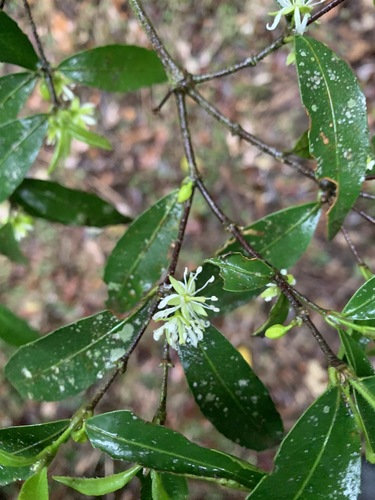
iNaturalist· cc-by-nc
(c) Clément Barbier, some rights reserved (CC BY-NC)
iNaturalist· cc-by-nc
(c) Clément Barbier, some rights reserved (CC BY-NC)
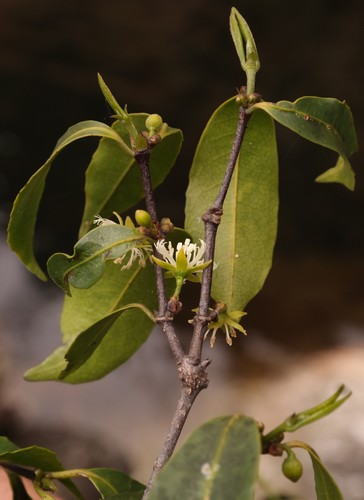
iNaturalist· cc-by-nc
(c) probreviceps, some rights reserved (CC BY-NC)
Summary
Source: WikipediaRhizophora racemosa is a species of mangrove tree in the family Rhizophoraceae. It has a patchy distribution on the Pacific coast of Central and South America, occurs in places on the Atlantic coast of that continent, and has a more widespread range on the Atlantic coast of West Africa.
Description
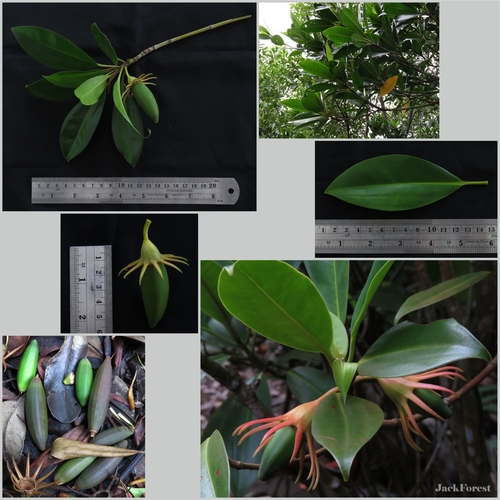
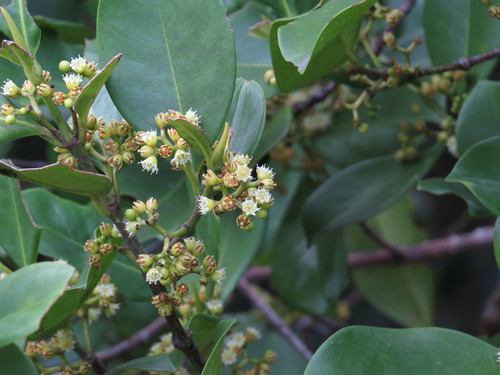
A tree. It grows 10 m tall. The leaves are opposite and simple. They are 10-15 cm long by 4-6 cm wide. The flowers occur as many in a compact arrangement 5-7 cm long. The fruit is 4 cm long by 1.6 cm wide. There is usually one seed. It forms a tube shaped young root up to 40 cm long. This is 1 cm thick.
Edible Uses
The fruit is edible.
Distribution
A tropical plant. It grows in brackish and fresh water silt along rivers near the coast.
Where It Grows
Africa, Angola, Benin, Brazil, Cameroon, Central Africa, Central African Republic, CAR, Central America, Colombia, Congo DR, Congo R, Côte d'Ivoire, Ecuador, El Salvador, French Guiana, Gabon, Ghana, Guatemala, Guianas, Guinea, Guinée, Guinea-Bissau, Guyana, Honduras, Ivory Coast, Liberia, Mauritania, Nicaragua, Nigeria, Panama, Peru, Sao Tome and Principe, Senegal, Sierra Leone, South America, Suriname, Togo, Trinidad-Tobago, Venezuela, West Africa,
Synonyms
Also Known As
Cobaca, Codega, Egba, Iranga, Ntan, Odo nowe, Tanda, Tarafe, Tarrafe, Uba
References (6)
- Elevitch, C.R.(ed.), 2006, Traditional Trees of the Pacific Islands: Their Culture, Environment and Use. Permanent Agriculture Resources, Holualoa, Hawaii. p 623
- Jardin, C., 1970, List of Foods Used In Africa, FAO Nutrition Information Document Series No 2.p 158
- Kew Plants of the World Online
- van Roosmalen, M.G.M., 1985, Fruits of the Guianan Flora. Utrecht Univ. & Wageningen Univ. p 372
- Vivien, J. & Faure, J.J., 1985, Abres des forets dense d'Afrique Centrale. Agence de Cooperation Culturelle et Technique. Paris. p 370
Show all 6 references Hide references
- World Checklist of Useful Plant Species 2020. Royal Botanic Gardens, Kew