Podocarpus spinulosus
(Sm.) R. Br. ex Mirb.
Plum Pine
iNaturalist· cc-by-nc
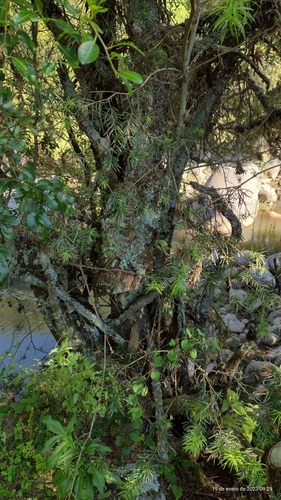
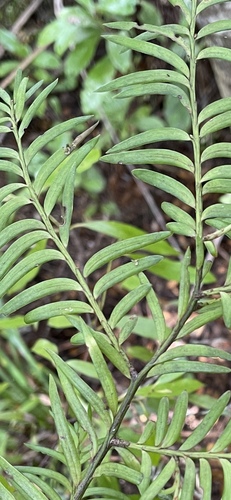
(c) David, some rights reserved (CC BY-NC), uploaded by David
iNaturalist· cc-by-sa
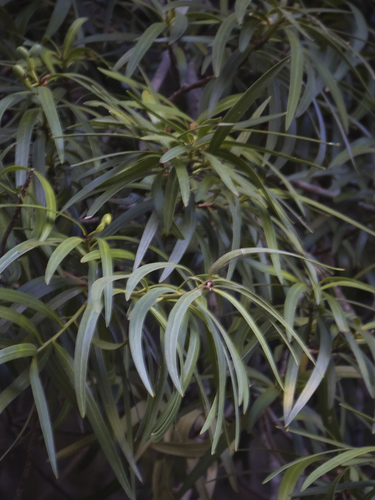
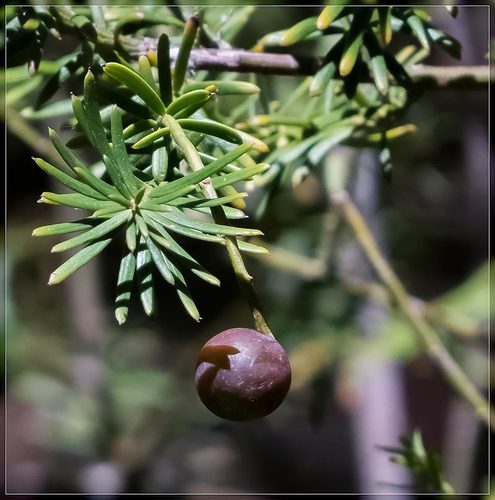
(c) Greg Tasney, some rights reserved (CC BY-SA), uploaded by Greg Tasney
iNaturalist· cc-by-sa
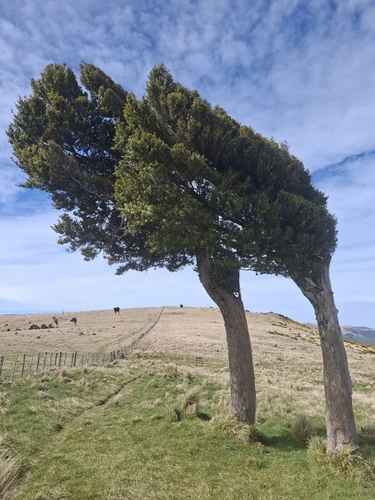
(c) Greg Tasney, some rights reserved (CC BY-SA), uploaded by Greg Tasney
Summary
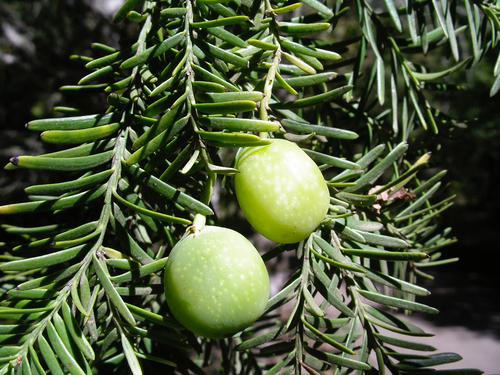
Source: WikipediaPodocarpus spinulosus, the dwarf plum pine or spiny-leaf podocarp, is a species of podocarp native to the warm-temperate coastal regions of New South Wales and southern Queensland. It is generally an understorey shrub, rarely growing more than 2 m tall. It was first described by James Edward Smith in 1817 as Taxus spinulosa. It was reclassified 'as Podocarpus spinulosus in 1825. The leaves are needle-like, 2–8 cm (0.79–3.15 in) long, sharply pointed, green above and with glaucous stomatal bands beneath. The cones are berry-like, with a fleshy, edible purple-black aril 1–2 cm (0.39–0.79 in) long and one (rarely two) apical seed 1 cm (0.5 in) long.
Description
A pine. It is a medium sized shrub. It grows 0.7-3 m high and spreads 1.5-4 m wide. The branches can lie along the ground. They sometimes root at the nodes. They are often long and slender. The leaves are thick textured and dark green and glossy above but paler underneath. They are 1.5-8 cm long by 0.2-0.4 cm wide. They are alternate and spreading. The new leaves are pale. The leaves have sharp points. The male cones are 0.4-0.8 cm long and in the axils of leaves. They are in clusters. The female cone usually occurs singly. It has one or two seeds. These are on the end of bluish-black fleshy stems.
Edible Uses
The fruit are eaten raw and used to make jams and preserves.
Traditional Uses
Fruit are used for jams and preserves. They are also eaten.
This uses section is brief — help expand it
Distribution
It grows in sheltered sites amongst rocks and in sandy soils. It suits subtropical and temperate regions. It needs well drained acid soils. It grows best in light shade. It is hardy to frost and suits coastal locations. Coffs Harbour Botanical Gardens.
Where It Grows
Australia*,
Cultivation
Plants can be grown from seed or cuttings of firm young growth.
Notes
There are about 100 Podocarpus species. They are mostly in the tropics and subtropics.
References (7)
- Abdillahi, H. S., 2009, Ethnobotany, phytochemistry and pharmacology of Podocarpus sensu latissimo (s.l.). South African Journal of Botany 76 (2010) 1–24
- Bodkin, F., 1991, Encyclopedia Botanica. Cornstalk publishing, p 815
- Caton, J.M. & Hardwick, R. J., 2016, Field Guide to Useful Native Plants from Temperate Australia. Harbour Publishing House. p 74
- Cribb, A.B. & J.W., 1976, Wild Food in Australia, Fontana. p 51
- Elliot, W.R., & Jones, D.L., 1997, Encyclopedia of Australian Plants suitable for cultivation. Vol 7. Lothian. p 396
Show all 7 references Hide references
- Leiper, G & Houser, J., Mutooroo. Plant Use by Australian Aboriginal People. Assembly press, Queensland.
- Ratcliffe D & P., 1987, Australian Native Plants for Indoors. Little Hills press. p 118