Podocarpus latifolius
(Thunb.) R. Br. ex Mirb.
True yellowwood
iNaturalist· cc-by-nc
(c) dianastromberg, some rights reserved (CC BY-NC)
iNaturalist· cc-by-nc-sa
(c) Penelope Price, some rights reserved (CC BY-NC-SA), uploaded by Penelope Price
iNaturalist· cc-by
(c) Eric Knight, some rights reserved (CC BY), uploaded by Eric Knight
Summary
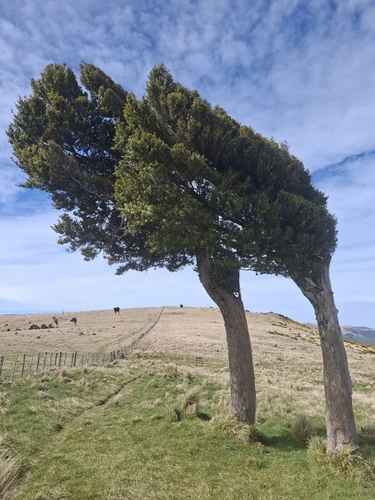
Source: WikipediaPodocarpus latifolius (real yellowwood, broad-leaved yellowwood, or South African yellowwood, Afrikaans: Opregte-geelhout, Northern Sotho: Mogôbagôba, Xhosa: Umcheya, Zulu: Umkhoba) is a large evergreen tree up to 35 m high and 3 m trunk diameter, in the conifer family Podocarpaceae; it is the type species of the genus Podocarpus. The real yellowwood has been declared the national tree of South Africa and is protected there.
Description
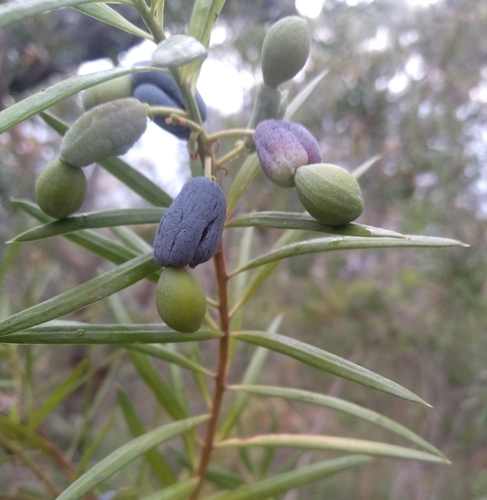
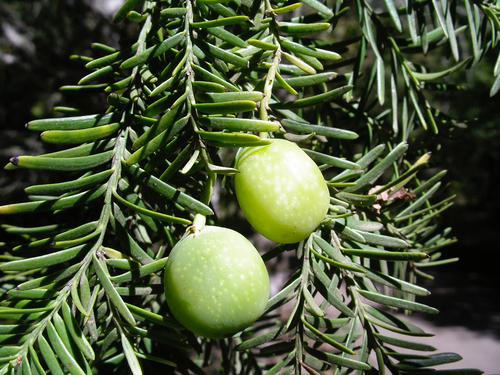
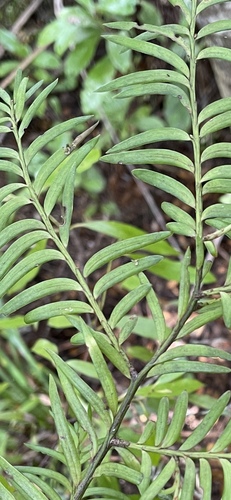
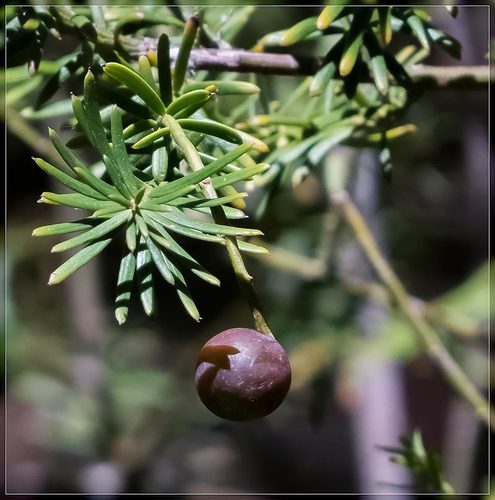
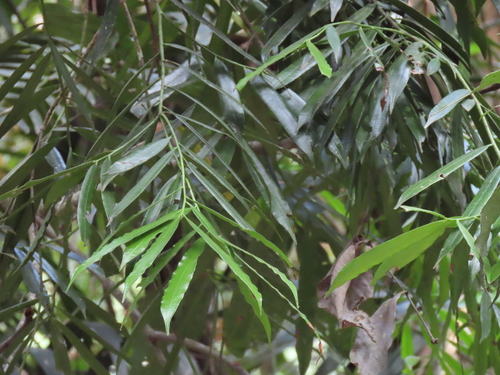
A large tree. It grows 25 m high and taller. The trunk is up to 1.2 m across. The crown is dark green. The bark is smooth when young but becomes split and peels when mature. The leaves are long and narrow. They can be 9 cm long by 1 cm wide. They are glossy green. The leaves are arranged in spirals. The leaves on young trees are always larger than on mature trees. The male trees has cones which are 2.5 cm long. The female tree develops a fleshy receptacle on which one or 2 round blue seeds develop. The receptacle swells and is pink when ripe. It is edible.
Edible Uses
The fleshy receptacle surrounding the seeds is eaten fresh from ripe fruit. The leaves are used for flavouring and as a preservative.
Traditional Uses
The fleshy receptacle near the seeds is eaten fresh from ripe fruit. The leaves are used for flavouring and as a preservative.
This uses section is brief — help expand it
Distribution
A tropical plant. In South Africa it grows from sea level up to 1800 m altitude. It grows in mountain forests. They can withstand frost. It suits hardiness zones 10-11. Arboretum Tasmania. Mt Lofty Botanical Gardens.
Where It Grows
Africa, Angola, Australia, Botswana, Cameroon, Central Africa, Congo, East Africa, Eswatini, Malawi, Mozambique, Nigeria, South Africa, Southern Africa, Sudan, Swaziland, Tanzania, Tasmania, Uganda, West Africa, Zambia, Zimbabwe,
Cultivation
Seed should be sown when fresh. It is best to pick seed off the trees when ripe and plant them in a nursery. Seeds once they have dried out only germinate slowly.
Propagation
Seed - fresh seeds should be cleaned and sown within 4 days in a mixture of well-rotted compost and washed sand. They germinate in 1 - 2 months, and the germination rate is up to 80%. Cracking of the seed coat has been recommended to speed up germination. When transplanting, care should be taken not to damage the taproot. The seedlings should be well watered. It is usually recommended to plant in shade and not in the full light, but in a test in South Africa seedlings grown without shade showed the best growth. Wildlings are sometimes also collected for planting. Seeds can be stored in a cold store for up to 1 year without losing much of their germination capacity, but moisture loss should be avoided. Seeds stored in perforated polyethylene bags with damp sawdust showed a germination rate of 72% after one year.
Other Uses
The heartwood is pale yellowish brown, and not demarcated from the sapwood. The grain is straight, occasionally spirally; the texture fine and even. Reddish streaks of compression wood may be present. Resin is absent, and the wood has no distinctive odour. The wood is moderately lightweight; resistant to acids but not durable; easy to saw and work with machine and hand tools, having little dulling effects on cutting edges. It can be planed to a smooth finish; has a tendency to split upon nailing and so pre-boring is recommended; it holds screws well but requires support in drilling and mortising because of its brittleness. The gluing, painting, varnishing and staining properties are moderately good. Steam bending gives moderate results, but turning properties are good. The peeling and slicing properties are good; good-quality but brittle veneer can be produced from the wood. The wood of trees from Sudan has a high lignin content and was found difficult to pulp. The wood, often traded as ‘podo’, is highly valued for furniture and ship building, but it is also used for poles, panelling, boxes, veneer and plywood. It is popular for making butchers’ blocks because it is fairly hard, without scent, and does not chip easily. It is suitable for construction, flooring, joinery, interior trim, vehicle bodies, railway sleepers, toys, novelties, agricultural implements, musical instruments, coffins, food containers, vats, carving, pattern making, matches, turnery, hardboard and particle board, and is considered a high-quality pulpwood. The wood is used for fuel.
Production
Trees are rather slow growing.
Notes
There are about 100 Podocarpus species. They are mostly in the tropics and subtropics.
Synonyms
Also Known As
Broad-leaved yellowwood, Mogobagoba, Monyaunyau, Mufhoho, Opregte geelhout, Real yellowwood, Rough-barked yellowwood, Umboka, Umgeya, Umkhobi, Umsonti, Upright yellowwood
References (15)
- Chapman, J. D. & Chapman, H. M., 2001, The Forest Flora of Taraba and Andamawa States, Nigeria. WWF & University of Canterbury. p 215
- Cundall, P., (ed.), 2004, Gardening Australia: flora: the gardener's bible. ABC Books. p 1064
- Fox, F. W. & Young, M. E. N., 1982, Food from the Veld. Delta Books. p 302
- https://growwild.co.za Edible Indigenous plants
- Mbuya, L.P., Msanga, H.P., Ruffo, C.K., Birnie, A & Tengnas, B., 1994, Useful Trees and Shrubs for Tanzania. Regional Soil Conservation Unit. Technical Handbook No 6. p 402
Show all 15 references Hide references
- Mem. Mus. Hist. Nat. 13:75. 1825
- Palgrave, K.C., 1996, Trees of Southern Africa. Struik Publishers. p 56
- Palmer, E and Pitman, N., 1972, Trees of Southern Africa. Vol. 1. A.A. Balkema, Cape Town p 331
- Ruiters-Welcome, A. K., 2019, Food plants of southern Africa. Ph.D. thesis. Univ. of Johannesburg p 91
- Swaziland's Flora Database http://www.sntc.org.sz/flora
- von Breitenbach, F., 1985, Southern Cape Tree Guide. Department of Environment Affairs, Forestry Branch. Pamphlet 360 Pretoria p 1
- van Wyk, B, van Wyk, P, and van Wyk B., 2000, Photographic guide to Trees of Southern Africa. Briza. p 241
- Welcome, A. K. & Van Wyk, B.-E., 2019, An inventory and analysis of the food plants of southern Africa. South African Journal of Botany 122 (2019) 136–179
- White, F., Dowsett-Lemaire, F. and Chapman, J. D., 2001, Evergreen Forest Flora of Malawi. Kew. p 88
- World Checklist of Useful Plant Species 2020. Royal Botanic Gardens, Kew