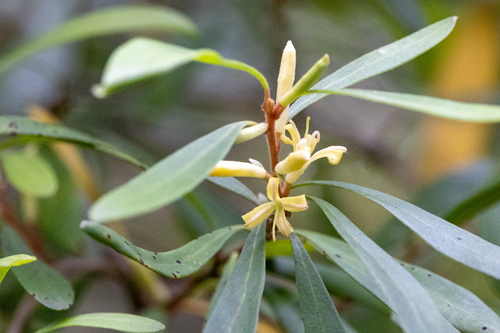
Persoonia longifolia
R. Br.
Snottygobble, Snotty Gobble, Long-leaved Persoonia
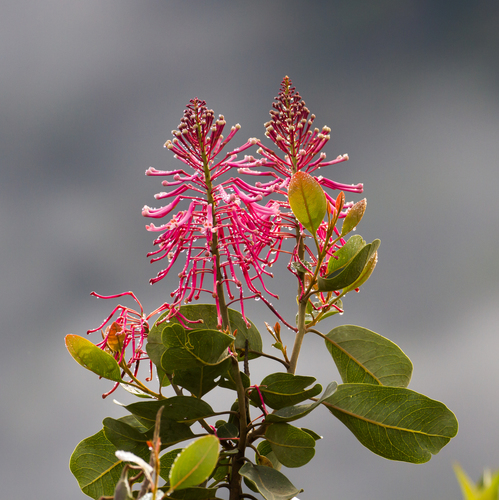
iNaturalist· cc-by
(c) Ann Bentley, some rights reserved (CC BY), uploaded by Ann Bentley
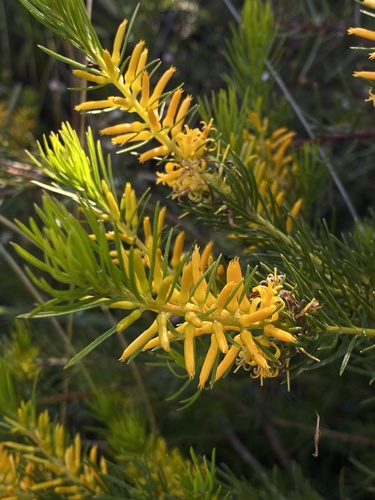
iNaturalist· cc-by-nc
(c) Izzyseizeit, some rights reserved (CC BY-NC), uploaded by Izzyseizeit
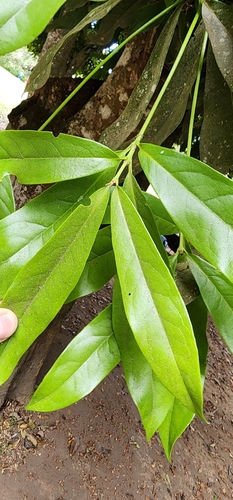
iNaturalist· cc-by-nc
(c) Caro Telfer, some rights reserved (CC BY-NC), uploaded by Caro Telfer
Summary
Source: WikipediaPersoonia longifolia, commonly known as snottygobble, is a species of flowering plant in the family Proteaceae and is endemic to the southwest of Western Australia. It is a shrub or small tree characterised by its weeping foliage, yellow flowers and distinctive flaky bark.
Description
A small tree. It grows 1.5-6 m high and spreads 1-3.5 m wide. It has a woody underground tuber. The young growth has rusty brown hairs. The trunk usually occurs singly but can have suckers at the base. The bark is flaky and brown. It is reddish-purple underneath. The branches start being angular and hairy but become round and smooth. They often hang down. The leaves are 2.5-20 cm long by 0.2-1.6 cm wide. They are alternate and deep green. They are flexible and can be slightly twisted. The flowers are 0.7 cm across and yellow. Their stalks are hairy and 1.2 cm long. They are in clusters in the axils of leaves or at the ends of branches. The fruit is fleshy with a hard stone inside. They are 1.2 cm long by 1 cm wide. They become purple when ripe.
Edible Uses
In addition to being used for minesite restoration, P. longifolia is used in the cut-flower trade, being valued for its weeping appearance and durability. It also has potential in the nursery trade for its symmetrical habit, weeping foliage and textured, flaky bark, but studies have suggested that at least eighteen months of soil burial is required for seed germination.
Traditional Uses
The gell around the seeds is edible.
This uses section is brief — help expand it
Distribution
It is a temperate plant. It grows in woodland and dry forest. It grows on sandy soils. It needs freely draining acid soils. They can tolerate frost.
Where It Grows
Australia*, Britain, Europe,
Cultivation
Plants can be grown from seed or cuttings of very young growth.
Notes
There are about 90 Persoonia species. They grow in Australia. Many have fruit which are edible.
Synonyms
References (5)
- Daw, B., Walley, T. & Keighery, G., 2001, Bush Tucker. Plants of the South-West. Department of Conservation and Land Management. Western Australia. p 44
- Elliot, W.R., & Jones, D.L., 1997, Encyclopedia of Australian Plants suitable for cultivation. Vol 7. Lothian. p 221
- Flora of Australia Volume 16, Elaeagnaceae, Proteaceae 1. Melbourne: CSIRO Australia (1995) p 65
- Paczkowska, G . & Chapman, A.R., 2000, The Western Australian Flora. A Descriptive Calatogue. Western Australian Herbarium. p 499
- Smith, K & I., 1999, Grow your own bushfoods. New Holland. Australia. p 41