Hakea suberea
S. Moore
Long Leaf Corkwood, Corkwood Hakea, Corkbark
gbif· cc-by
Royal Botanic Gardens, Kew
gbif· cc-by
Royal Botanic Gardens, Kew
gbif· cc0
Conveyor Belt
Summary
Hakea suberea is a tree growing to 5 m tall. The species is hermaphroditic. It adapts to light sandy, medium loamy, and heavy clay soils, tolerating mildly acidic, neutral, and mildly alkaline pH levels. It grows in semi-shade to full sun and prefers moist soil conditions.
Description
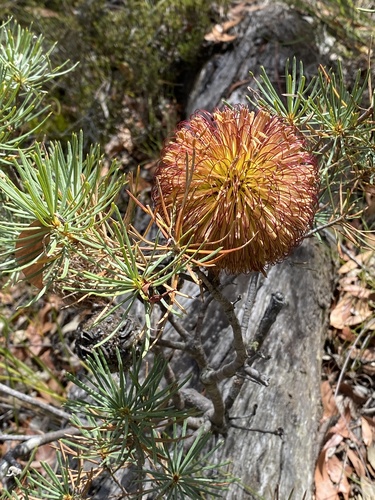
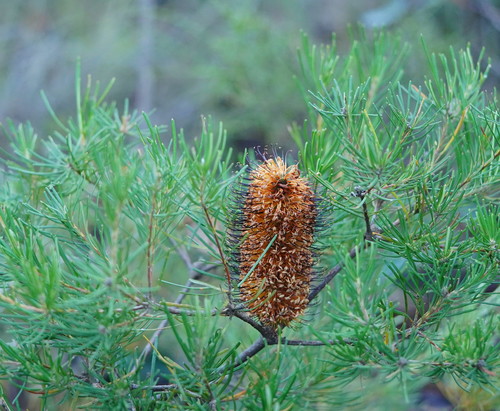
A small tree. It grows 3-9 m tall and spreads 2-5 m wide. The bark is dark and cracked and thick and corky. The trunk is often twisted. The leaves are thin and needle like. They are 12-60 cm long by 0.2-0.3 cm wide. They can have 2-5 segments 30 cm long. The flowering stalks are 4-15 cm long and hang down. The flowers are yellow and clustered on long stalks. They have a honey scent. The fruit are 3-4.5 cm long by 1.7-2 cm wide. They are smooth and have a long curved beak. The seeds are shed each year.
Edible Uses
A sweet drink can be made by crushing the nectar-rich flowers.
Traditional Uses
The nectar is sucked from the flowers. The flowers can also be steeped in water to prepare a drink.
This uses section is brief — help expand it
Medicinal Uses
None known
Distribution
A tropical plant. It grows in central Australia. Often it is among rocks on ridges. It suits semiarid climates. The soils must be well drained. They can tolerate light frosts. It can grow in arid places. It suits hardiness zones 9-11.
Where It Grows
Australia*,
Cultivation
Plants are grown from seed.
Propagation
Seed.
Other Uses
None known Special Uses
Production
Seed grown slowly.
Notes
There are about 130 Hakea species.
Also Known As
Honey hakea, Untjiya
References (15)
- Bindon, P., 1996, Useful Bush Plants. Western Australian Museum. p 157
- Boomsma, C.D., 1972, Native Tree of South Australia. Woods & Forests Department South Australia, Bulletin No.19. p 203
- Cherikoff V. & Isaacs, J., The Bush Food Handbook. How to gather, grow, process and cook Australian Wild Foods. Ti Tree Press, Australia p 190
- Elliot, W.R., & Jones, D.L., 1990, Encyclopedia of Australian Plants suitable for cultivation. Vol 5. Lothian. p 233
- Etherington, K., & Imwold, D., (Eds), 2001, Botanica's Trees & Shrubs. The illustrated A-Z of over 8500 trees and shrubs. Random House, Australia. p 365
Show all 15 references Hide references
- Facciola, S., 1998, Cornucopia 2: a Source Book of Edible Plants. Kampong Publications, p 189
- Hardwick, G., 2001, Economically Useful Plants for Northern Australia: Master Species List. Crusader eBooks.
- Holliday, I., 1989, A Field Guide to Australian Trees. Hamlyn. p 226
- Latz, P.K., 1996, Bushfires and Bushtucker: Aboriginal plant use in Central Australia. IAD Press Alice Springs p 208
- Lazarides, M. & Hince, B., 1993, Handbook of Economic Plants of Australia, CSIRO. p 127
- Low, T., 1991, Wild Food Plants of Australia. Australian Nature FieldGuide, Angus & Robertson. p 184
- Milson. J., 2000, Trees and Shrubs of north-west Queensland. DPI p 268
- Smith, K & I., 1999, Grow your own bushfoods. New Holland. Australia. p 115
- Townsend, K., 1999, Field Guide to Plants of the Dry Tropics. Society for Growing Australian Plants, Townsville Branch Inc. p 62
- Wheeler, J.R.(ed.), 1992, Flora of the Kimberley Region. CALM, Western Australian Herbarium, p 477