Hakea sericea
Schrad. & J. C. Wendl.
Silky hakea
iNaturalist· cc-by
(c) David Lochlin, some rights reserved (CC BY)
iNaturalist· cc-by-nc
(c) donovank, some rights reserved (CC BY-NC)
Summary
Source: WikipediaHakea sericea, commonly known as bushy needlewood or silky hakea, is a shrub with a profusion of mainly white flowers from July for several months. It is endemic to eastern Australia. It has become an environmental weed in some countries.
Description
Hakea sericea is an evergreen shrub growing to 3 m tall, remaining in leaf year-round and flowering from June to July. This hermaphroditic plant is bee-pollinated and hardy to UK zone 9. It adapts to light sandy, medium loamy, and heavy clay soils with good drainage, preferring mildly acidic to neutral pH. Tolerates semi-shade to full sun and both dry and moist soils. It withstands strong winds but cannot tolerate maritime exposure.
Edible Uses
No edible uses are known, though a gum is obtainable from the stems (see Other Uses).
Medicinal Uses
None known
Distribution
It is a temperate plant.
Where It Grows
Australia*,
Cultivation
Succeeds in a hot dry position, requiring a lime-free soil. Requires plenty of moisture in the growing season but a very well-drained soil. Wind tolerant. This species is not very hardy in Britain, but it succeeds outdoors in S.W. England. Plants are hardy to about -7°c in Australian gardens but this cannot be translated directly to British gardens due to our cooler summers and longer, colder wetter winters. They grow well in a Mediterranean climate, with cool wet winters and hot dry summers. Some forms of this species are lower growing with a tendency to sucker. Sometimes confused with H. lissosperma, some plants grown as H. acicularis are H. lissosperma. A good bee plant. Plants in this genus are notably resistant to honey fungus.
Propagation
Sow seed in March in a greenhouse; germination is usually good. Once seedlings are large enough to handle, prick them out into individual pots and grow on in the greenhouse for at least their first winter. Plant out into permanent positions in late spring or early summer, after the last expected frosts. Can also be propagated from cuttings of mature wood.
Other Uses
A gum somewhat similar to gum tragacanth — obtained from various Astragalus species — can be extracted from the stems. Shrubs are planted for arid land reclamation in Spain and Portugal, and plants are also used for screening and hedging purposes in Australia.
Other Information
It is cultivated.
Synonyms
References (2)
- www.fsd.monash.edu.au/files/bethgottpamphley_po.pdf (As Hakea decurrens)
- Zeven, A. C. & de West, J. M. J., 1982, Dictionary of cultivated plants and their regions of diversity. Wageningen. p 69
More from Proteaceae
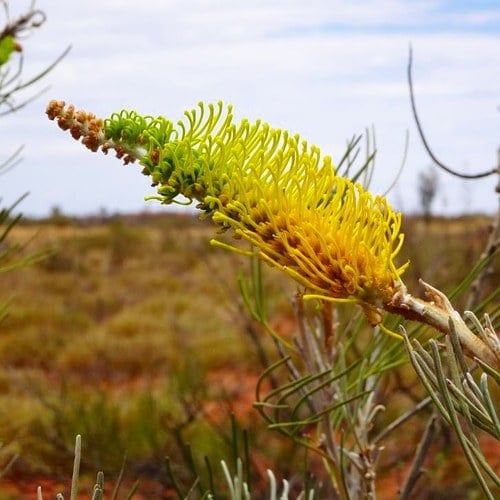
Grevillea eriostachya
Honey Grevillea, Orange Grevillea, Flame Grevillea, Pine Grevillea, Wama, Kaliny kalinypa, Galigiri
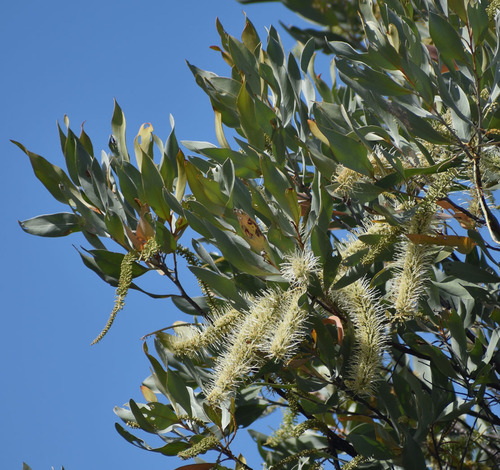
Grevillea glauca
Bushmans' clothes-peg, Nut Wood
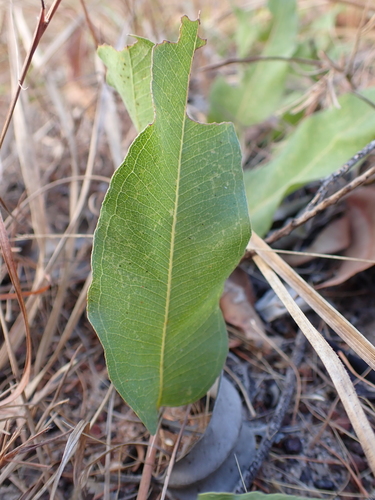
Grevillea goodii subsp. goodii
Good's Grevillea, Burrun burrun
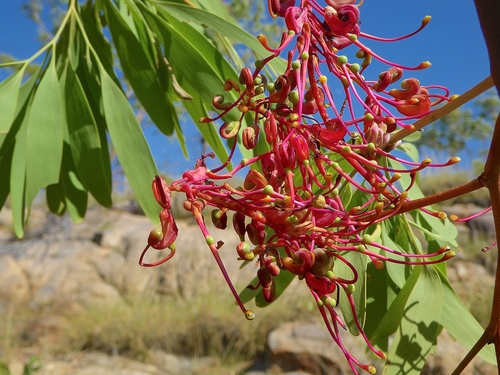
Grevillea heliosperma
Rock Grevillea
Grevillea juncifolia
Desert Grevillea, Honeysuckle Grevillea
Grevillea kennedyana
Flame Spider Flower