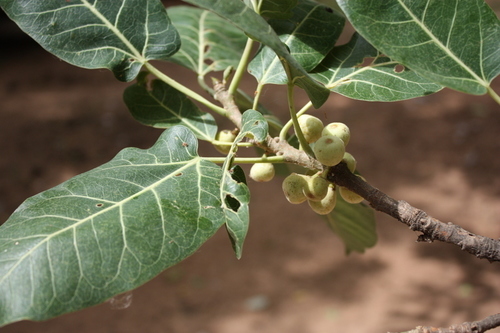
Ficus auriculata
Lour.
Eve's apron, Roxburgh fig
iNaturalist· cc-by-nc
(c) 王颖, some rights reserved (CC BY-NC)
iNaturalist· cc-by-nc
(c) 王颖, some rights reserved (CC BY-NC)
iNaturalist· cc-by-nc
(c) 王颖, some rights reserved (CC BY-NC)
Summary
Source: WikipediaFicus auriculata is a species of flowering plant in the family Moraceae. This fig tree is sometimes referred to by the common names Roxburgh fig and Elephant ear tree and is noted for its big and round leaves and edible fruit. It is native to subtropical and tropical Assam, Bangladesh, Cambodia, South-Central and Southeast China, East and West Himalaya, Hainan, India, Laos, Malaysia, Myanmar, Nepal, Pakistan, Thailand, Tibet, and Vietnam.
Description
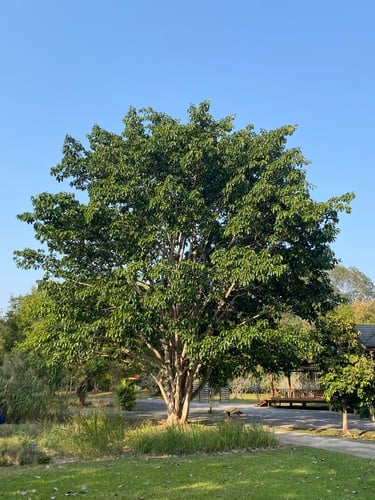
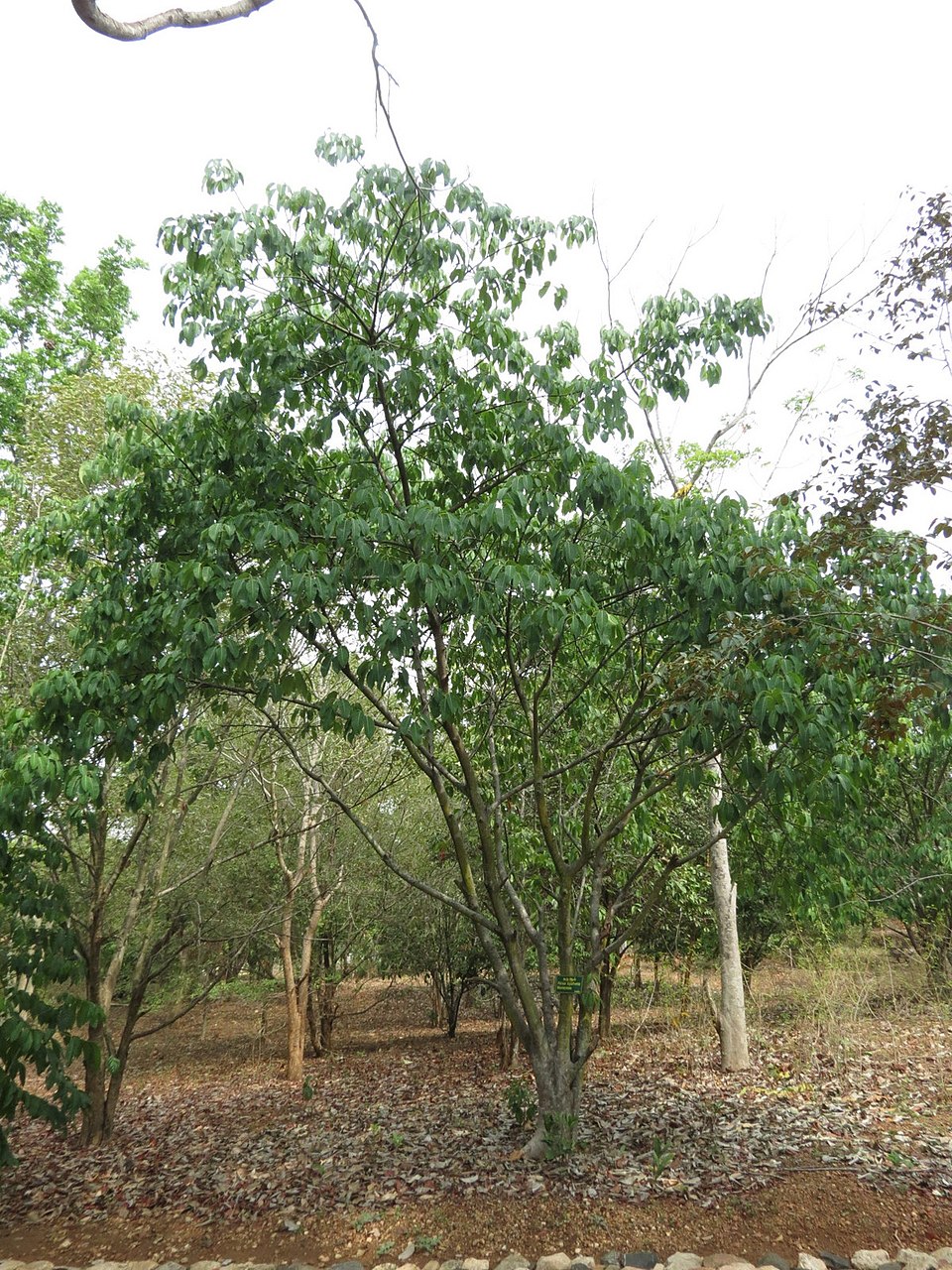
A fig. It is a small tree. It grows 5-10 m high. The trunk is 30-50 cm across but often less. The crown is broadly spreading. The trunk is usually not straight. The bark is warty and grey. Young shoots are hollow. The young shoots are reddish brown. They are 1-1.5 cm across. The leafy structure at the base of the leaf is triangle shaped and reddish brown. It is 1.5-2 cm long. The leaves are alternate and 10-25-55 cm long by 7-23-27 cm wide. They are rounded and softly hairy underneath. The base is normally deeply heart shaped. There can be small teeth along the leaf edge. The figs grow on the base of the trunk and on short branches of old stems. The fruit is 5-7 cm across. It is green when young and dark red when ripe. The fruit is sweet and with a sweet smell. There are ribs along the fruit.
Edible Uses
Ripe fruits are eaten raw or made into jams and curries; green fruits are used as a vegetable. Young leaves can be eaten raw or boiled as a vegetable. Flowers are also edible.
Traditional Uses
The ripe fruit are eaten raw. They are sweet. They are also made into jams and used in curries. Green fruit are used as a vegetable. The young leaves can be eaten raw. They are also boiled and used as a vegetable.
Medicinal Uses
The fresh fruit of this plant is consumed as food, and has diuretic, laxative and digestive regulating properties. Ficus auriculata is used as fodder in Nepal. It is least resistant to fire, but likes good sunlight. The large leaves, often up to 21 in (533.4 mm) long and 12 in (304.8 mm) wide are used as plates.
Distribution
A tropical plant. It needs light and humidity. It grows up to 700-800 m altitude. It is most common about 100-400 m altitude. It often grows along rivers. In Nepal it grows up to 2000 m altitude. In China it grows in moist valleys in forests between 100-1700 m altitude and sometimes to 2100 m in S China. It suits hardiness zones 10-12. In XTBG Yunnan.
Where It Grows
Asia, Bangladesh, Bhutan, Cambodia, China, Himalayas, India, Indochina, Laos, Malaysia, Myanmar, Nepal, Northeastern India, NW India, Pakistan, SE Asia, Sikkim, Singapore, Thailand, Tibet, Vietnam,
Cultivation
Plants can be grown from seed or cuttings. It can be cut back and regrow. Hand pollination can probably increase fruit size. It can be grown by marcottage.
Propagation
Seed - germinates best at a temperature around 20°c. Air layering. Tip cuttings around 4 - 12cm long, taken from lateral branches.
Other Uses
The leaves are used as plates. Although small, the wood is hard and is used to make household utensils. The wood is used for fuel. The tree is planted in erosion control programmes.
Production
It is fast growing. In Nagaland fruit are available June to August.
Other Information
It is a cultivated plant. Leaves and fruit are sold in local markets.
Notes
There are about 800-1000 Ficus species. They are mostly in the tropics. There are 120 Ficus species in tropical America.
Nutrition
| Part | Moisture | kJ | kcal | Protein | Vit A | Vit C | Iron | Zinc |
|---|---|---|---|---|---|---|---|---|
| Fruit | 83.3 | — | — | — | — | 4.1 | — | — |
Synonyms
Also Known As
Anjoora, Ara, Athi, Beliblo, Chidoshi, Chodoshi, Choma, Dabgo, Da guo rong, Dhusi, Doshi, Dusi, Elephant ear fig, Fagoora, Ghider thaikhro, Gopa, Heibong, Hider thaikhro, Hute, Kaitak, Kakbal-takukasing, Ka-ohn, Kaung-oat-tee, Kelebok, Khavu, Kukbal takuk, Lagum, Long o biu, Lothepi, Mamojang, Mangtan, Mon dimoru, Mu gua cai, Na-gum, Na sha er zi, Nebaro, Nebharo, Nee ri, Nevaro, Newaro, Ngoa, Nimaro, Nuoge biu, Pak wa, Papaya fig, Pawa, Pha-owl, Phak-ohn, Phok, Saipho, Shupu, Sin-thahpan, Sipu, Taba, Takuk, Tapang, Thaibor, Tha-phan, Theiba, Thei-bal, Theichang, Theichong, Theipi, Thu-phak-lu-sang, Timal, Timila, Timilo, Timla, Timli, Timlo, Timlu, Tirmal, Toubu dhu, Tramble, Trembal, Triambal, Trimbal, Txiv ncuav pias, Va, Va', Wuwa, Xiang er rong, Xi bu, Xibuabo, Xibulao
References (102)
- Agarwal, R. & Chandra, V., 2019, Diversity of wild edible plants in the Mandal-Chopta forest, Uttarakhand. Journal of Medicinal Plants Studies 2019; 7(1): 89-92
- Ambasta, S.P. (Ed.), 2000, The Useful Plants of India. CSIR India. p 221
- Anderson, E. F., 1993, Plants and people of the Golden Triangle. Dioscorides Press. p 211
- Arora, R. K., 2014, Diversity in Underutilized Plant Species - An Asia-Pacific Perspective. Bioversity International. p 71
- Aryal, K. P. et al, 2009, Uncultivated Plants and Livehood Support - A case study from the Chepang people of Nepal. Ethnobotany Research and Applications. 7:409-422
Show all 102 references Hide references
- Aryal, K. P., et al, 2018, Diversity and use of wild and non-cultivated edible plants in the Western Himalaya. Journal of Ethnobiology and Ethnomedicine (2018) 14:10
- Bajpai, O., et al, 2015, Tree species of the Himalayan Terai region of Uttar Pradesh, India: a checklist. Check List 11(4): 1718
- Baro, D., Baruah, S. and Borthukar, S. K. 2015, Documentation on wild vegetables of Baksa district, BTAD (Assam). Scholars Research Library. Archives of Applied Science Research, 2015, 7 (9):19-2
- Barwick, M., 2004, Tropical and Subtropical Trees. A Worldwide Encyclopedic Guide. Thames and Hudson p 183
- Behera K. K., et al, 2008, Wild Edible Plants of Mayurbhanj District, Orissa, India. J. Econ. Taxon. Bot. Vol. 32 (Suppl.) pp 305-314
- Bhatia, H., et al, 2018, Traditionally used wild edible plants of district Udhampur, J&K, India. Journal of Ethnobiology and Ethnomedicine (2018) 14:73
- Burkill, I.H., 1966, A Dictionary of the Economic Products of the Malay Peninsula. Ministry of Agriculture and Cooperatives, Kuala Lumpur, Malaysia. Vol 1 (A-H) p 1031 (As Ficus roxburghii)
- Cao, Y., et al, 2020, Ethnobotanical study on wild edible plants used by three trans-boundary ethnic groups in Jiangcheng County, Pu’er, Southwest China. Journal of Ethnobiology and Ethnomedicine (2020) 16:66
- Chase, P. & Singh, O. P., 2016, Bioresources of Nagaland: A Case of Wild 4 Edible Fruits in Khonoma Village Forest. in J. Purkayastha (ed.), Bioprospecting of Indigenous Bioresources of North-East India. p 50
- Cheng, Z., et al, 2022, Ethnobotanical study on wild edible plants used by Dulong people in northwestern Yunnan, China. Journal of Ethnobiology and Ethnomedicine (2022) 18:3
- Chin, H.F., & Yong, H.S., 1996, Malaysian Fruits in Colour. Tropical press, Kuala Lumpur p 81 (As Ficus roxburghii)
- Dangol, D. R. et al, 2017, Wild Edible Plants in Nepal. Proceedings of 2nd National Workshop on CUAOGR, 2017.
- Delang, C. O., 2007, Ecological Succession of Usable Plants in an Eleven-Year Fallow Cycle in North Lao P.D.R., Ethnobotany Research and Applications. Vol. 5:331-350
- Dobriyal, M. J. R. & Dobriyal, R., 2014, Non Wood Forestt Produce an Option for Ethnic Food and Nutritional Security in India. Int. J. of Usuf. Mngt. 15(1):17-37
- Etherington, K., & Imwold, D., (Eds), 2001, Botanica's Trees & Shrubs. The illustrated A-Z of over 8500 trees and shrubs. Random House, Australia. p 325
- Facciola, S., 1998, Cornucopia 2: a Source Book of Edible Plants. Kampong Publications, p 155
- Fl. cochinch. 2:666. 1790
- Flora of China. Vol. 5 p 48 and Flora of China. www.eFloras.org
- Flora of Pakistan. www.eFloras.org
- Forestt Inventory and Planning Institute, 1996, Vietnam Forestt Trees. Agriculture Publishing House p 537
- Fu, Yongneng, et al, 2003, Relocating Plants from Swidden Fallows to Gardens in Southwestern China. Economic Botany, 57(3): 389-402
- Gamble, J. S., 1878, List of trees, shrubs and climbers from Darjeeling. (As Ficus regia)
- Gangwar, A. K. & Ramakrishnan, P. S., 1990, Ethnobotanical Notes on Some Tribes of Arunachal Pradesh, Northeastern India. Economic Botany, Vol. 44, No. 1 pp. 94-105
- Gangte, H. E., et al, 2013, Wild Edible Plants used by the Zou Tribe in Manipur, India. International Journal of Scientific and Research Publications, Volume 3, Issue 5 (As Ficus roxburghii)
- Gautam, R. S., et al, 2020, Wild Edible Fruits of Nepal. Int. J. Appl. Sci. Biotechnol. Vol 8(3): 289-304
- Ghorbani, A., et al, 2012, A comparison of the wild food plant use knowledge of ethnic minorities in Naban River Watershed Nature Reserve, Yunnan, SW China. Journal of Ethnobiology and Ethnomedicine; 8:17
- Guite, C., 2016, A study of wild edible plants associated with the Paite tribe of Manipur, India, International Journal of Current Research. Vol. 8, Issue, 11, pp. 40927-40932 (As Ficus roxburghii)
- Hedrick, U.P., 1919, (Ed.), Sturtevant's edible plants of the world. p 309 (As Ficus roxburghii)
- Hibbert, M., 2002, The Aussie Plant Finder 2002, Florilegium. p 102 (As Ficus roxburghii)
- Hu, Shiu-ying, 2005, Food Plants of China. The Chinese University Press. p 357
- Jabeen, A., et al, 2009, Indigenous uses of economically important flora of Margallah Hills National Park, Islamabad, Pakistan. African Journal of Biotechnology Vol. 8 (5), pp. 763-784
- Jan, M., et al, 2018, Ethnobotanical Study of Plants Used By Ethnic People of Karbari Grant Village Dehradun, Uttarakhand. SERBD-International Journal of Multidisciplinary Sciences
- Jeeva, S., 2009, Horticultural potential of wild edible fruits used by the Khasi tribes of Meghalaya. Journal or Horticulture and Foresttry Vol. 1(9) pp. 182-192 (Also as Ficus pomifera)
- Jin, Chen et al, 1999, Ethnobotanical studies on Wild Edible Fruits in Southern Yunnan: Folk Names: Nutritional Value and Uses. Economic Botany 53(1) pp 2-14
- Joshi, N., et al, 2007, Traditional neglected vegetables of Nepal: Their sustainable utilization for meeting human needs. Tropentag 2007. Conference on International Agricultural Research for Development.
- Kala, C. P., 2007, Prioritization of cultivated and wild edibles by local people in the Uttaranchal hills of Indian Himalaya. Indian Journal of Traditional Knowledge. 6(1) pp 239-244
- Kar, A., et al, 2013, Wild Edible Plant Resources used by the Mizos of Mizoram, India. Kathmandu University Journal of Science, Engineering and Technology. Vol. 9, No. 1, July, 2013, 106-126
- Khakurel, D., et al, 2021, Foods from the wild: Local knowledge, use pattern and distribution in Western Nepal. PLOS ONE.
- Khan, D. & Shaukat, S.S., 2006, The Fruits of Pakistan: Diversity, Distribution, Trends of Production and Use. Int. J. Biol. Biotech., 3(3):463-499
- Khan, M. & Hussain, S., 2014, Diversity of wild edible plants and flowering phenology of district Poonch (J & K) in the northwest Himalaya. Indian Journal of Sci, Res. 9(1): 032-038
- Kumar, A., et al, 2012, Ethnobotanical Edible Plant Biodiversity of Lepcha Tribes. Indian Forester, 138 (9):798-803 (As Ficus roxburghii)
- Kumar, P. D., et al, 2015, Ethnobotanical Knowledge and Usage of Wild Plants in Theog Forest Division, Himachal Pradesh, North Western Himalaya. The Journal of Ethnobiology and Traditional Medicine. Photon 124(2015) 922-935
- Kunwar, R. M., & Bussmann, R. W., 2006, Ficus (Fig) species in Nepal: a review of diversity and indigenous uses. Lyonia, Volume 11(1), Pages [85-97], June 2006
- Li, S., et al, 2020, Monpa, memory, and change: an ethnobotanical study of plant use in Mêdog County, South-east Tibet, China. Journal of Ethnobiology and Ethnomedicine. (2020) 16:5 p 20
- Liu, Yi-tao, & Long, Chun-Lin, 2002, Studies on Edible Flowers Consumed by Ethnic Groups in Yunnan. Acta Botanica Yunnanica. 24(1):41-56
- Lungphi, P., Wangpan, T. & Tangjang, S., 2018, Wild edible plants and their additional uses by the Tangsa community living in the Changlang district of Arunachal Pradesh, India. Pleione 12(2): 151 - 164. 2018.
- Luo, B., et al, 2019, Wild edible plants collected by Hani from terraced rice paddy agroecosystem in Honghe Prefecture, Yunnan, China. Journal of Ethnobiology and Ethnomedicine 15:56
- Lyle, S., 2006, Discovering fruit and nuts. Land Links. p 207 (As Ficus roxburghii)
- Manandhar, N.P., 2002, Plants and People of Nepal. Timber Press. Portland, Oregon. p 232
- Masoodi, H. U. R. & Sundriyal, R. C., 2020, Richness of non-timber forest products in Himalayan communities—diversity, distribution, use pattern and conservation status. Journal of Ethnobiology and Ethnomedicine 16:56
- Meitei, L. R., et al, 2022, An ethnobotanical study on the wild edible plants used by forest dwellers in Yangoupokpi Lokchao Wildlife Sanctuary, Manipur, India. Ethnobotany Research and Application 23:15
- Misra S. & Misra M., 2016, Ethnobotanical and Nutritional Evaluation of Some Edible Fruit Plants of Southern Odisha, India. International Journal of Advances in Agricultural Science and Technology, Vol.3 Issue.1, March- 2016, pg. 1-30
- Mon, A. M., 2020, The uses of fig (Ficus) by five ethnic minority communities in Southern Shan State, Myanmar. Journal of Ethnobiology and Ethnomedicine (2020) 16:55
- Mot So Rau Dai an Duoc O Vietnam. Wild edible Vegetables. Ha Noi 1994, p 172
- Mozhui, R., et al, 2011, Wild edible fruits used by the tribals of Dimapur district of Nagaland, India. Pleione 5(1): 56 - 64.
- Mukhia, P.K., et al, 2013, Wild plants as Non Wood Forestt Products used by the rural community of Dagana, a southern foothill district of Bhutan, SAARC Journal, 27 pages
- Murtem, G. & Chaudhrey, P., 2016, An ethnobotanical note on wild edible plants of Upper Eastern Himalaya, India. Brazilian Journal of Biological Sciences, 2016, v. 3, no. 5, p. 63-81
- Namrata, et al, 2011, Wild Edible Plants of Uttarakhand Himalaya: A Potential Nutraceutical Source. Research Journal of Medicinal Plant. (5) 6: 670-684
- Nathan, A., & Wong Y Chee, 1987, A Guide to Fruits and Seeds, Singapore Science Centre. p 102 (As Ficus roxburghii)
- Pandey, K. C. & Pande, N., 2016, Ethnobotanical Documentation of Wild Edible Plants used by Gujjar Community of Tarai West Forest Division Ramnagar, Nainital, India, Current World Environment. Vol. 11(3), 808-818
- Pandey, Y., Upadhyay, S. & Bhatt, S. S., 2018, Phyto-chemical constituent os some wild edible fruits of Sikkim Himalaya. Journal of Pharmacognosy and Phytochemistry 2018; 7(3): 1045-1047 (As Ficus roxburghii)
- Pasha, M. K. & Uddin, S. B., 2019, Minor Edible Fruits of Bangladesh. Bangladesh J. Plant Taxon. 26(2): 299–313
- Patiri, B. & Borah, A., 2007, Wild Edible Plants of Assam. Geethaki Publishers. p 134
- Pegu, R., et al, 2013, Ethnobotanical study of Wild Edible Plants in Poba Reserved Forest, Assam, India. Research Journal of Agriculture and Forestry Sciences 1(3):1-10
- Pfoze, N. L., et al, 2012, Assessment of Local Dependency on Selected Wild Edible Plants and fruits from Senapati district, Manipur, Northeast India. Ethnobotany Research & Applications 10:357-367
- Pfoze, N. L., et al, 2012, Survey and assessment of floral diversity on wild edible plants from Senapati district of Manipur, Northeast India. Journal of Biodiversity and Environmental Sciences. 1(6):50-52
- Polunin, O., & Stainton, A., 2006, Flowers of the Himalaya, Oxford India Paperbacks. p 370
- Pradheep, K., et al, 2016, Wild edible plants used by Konyak tribe in Mon district of Nagaland: Survey and inventorisation. Indian Journal of Natural Products and Resources. Vol 7(1) pp 74-81
- PROSEA (Plant Resources of South East Asia) handbook, Volume 2, 1991, Edible fruits and nuts.
- Radha, B., et al, 2013, Wild Edible Plant Resources of the Lohba Range of Kedarnath Forest Division (KFD), Garhwal Himalaya, India. Int. Res J. Biological Sci. Vol. 2 (11), 65-73
- Ramachandran, V.S. and Nair, V.J., 1981, Ethnobotanical studies in Cannanore District, Kerala State (India). J Econ. Tax. Bot. Vol 2 pp 65-72
- Ramachandran, V.S. and Nair, V.J., 1981, Ethnobotanical studies in Cannanore District, Kerala State (India). J Econ. Tax. Bot. Vol 2 pp 65-72 (As Ficus roxburghii)
- Samy, J., Sugumaran, M., Lee, K. L. W., 2009, Herbs of Malaysia, Marshall Cavendish. p 106
- Sarma, H., et al, 2010, Updated Estimates of Wild Edible and Threatened Plants of Assam: A Meta-analysis. International Journal of Botany 6(4): 414-423
- Savita, et al, 2006, Studies on wild edible plants of ethnic people in east Sikkim. Asian J. of Bio Sci. (2006) Vol. 1 No. 2 : 117-125
- Sawian, J. T., et al, 2007, Wild edible plants of Meghalaya, North-east India. Natural Product Radiance Vol. 6(5): p 417
- Sharma, G., et al, 2016, Agrobiodiversity in the Sikkim Himalaya. International Centre for Integrated Mountain Development, ICIMOD Working Paper 2016/5 p 20
- Shi, Y. et al, 2014, An ethnobotanical study of the less known wild edible figs (genus Ficus) native to Xishuangbanna Southwest China. Journal of Ethnobiology and Ethnomedicine. 10:68
- Shin, T., et al, 2018, Traditional knowledge of wild edible plants with special emphasis on medicinal uses in Southern Shan State, Myanmar. Journal of Ethnobiology and Ethnomedicine (2018) 14:48
- Singh, B., et al, 2012, Wild edible plants used by Garo tribes of Nokrek Biosphere Reserve in Meghalaya, India. Indian Journal of Traditional Knowledge. 11(1) pp 166-171
- Singh, H.B., Arora R.K.,1978, Wild edible Plants of India. Indian Council of Agricultural Research, New Delhi. p 60, 76
- Singh, V. B., et al, (Ed.) Horticulture for Sustainable Income and Environmental Protection. Vol. 1 p 216
- Sundriyal, M., et al, 2004, Dietary Use of Wild Plant Resources in the Sikkim Himalaya, India. Economic Botany 58(4) pp 626-638 (As Ficus roxburghii)
- Tanaka, Y & Van Ke, N., 2007, Edible Wild Plants of Vietnam. Orchid Press. p 96
- Taram, M., et al, 2018, Wild Food Plant Resources of Komkar Adi Tribe of Upper Siang District in Arunachal Pradesh, India. Bulletin of Arunachal Forest Research, Vol. 33(2), 27-35
- Thapa, L. B., et al, 2014, Wild Edible Plants used by endangered and Indigenous Raji Tribe in Western Nepal. International Journal of Applied Sciences and Biotechnology. Vol 2(3):243-252
- Tsering, J., et al, 2017, Ethnobotanical appraisal on wild edible plants used by the Monpa community of Arunchal Pradesh. Indian Journal of Traditional Knowledge. Vol 16(4), October 2017, pp 626-637
- Upreti, K., et al, 2010, Diversity and Distribution of Wild Edible Fruit Plants of Uttarakhand. Bioversity Potentials of the Himalaya. p 170
- Uprety, Y., et al, 2012, Diversity of use and local knowledge of wild edible plant resources in Nepal. Journal of Ethnobotany and Ethnomedicine 8:16
- Van Sam, H. et al, 2008, Uses and Conservation of Plant Species in a National Park. A case study of Ben En, Vietnam. Economic Botany 62:574-593
- Ravikrishna, S., 2011, Ethno-medico-botanical survey on Wild Edible fruits of Udupi Taluq, Udupi p 71
- Whitney, C. W., et al, 2014, Conservation and Ethnobotanical Knowledge of a Hmong Community in Long Lan, Luang Prabang, Lao People’s Democratic Republic. Ethnobotany Research and Applications 12:643-658
- Wiersema, J. H. & Leon, B., 2013, World Economic Plants. A Standard Reference CRC Press. 2nd Ed. p 304
- World Checklist of Useful Plant Species 2020. Royal Botanic Gardens, Kew
- www.eFloras.org Flora of China
- Xu, You-Kai, et al, 2004, Wild Vegetable Resources and Market Survey in Xishuangbanna, Southwest China. Economic Botany. 58(4): 647-667.
- Zawiah, N. & Othaman, H., 2012, 99 Spesies Buah di FRIM. Institut Penyelidikan Perhutanan Malaysia. p 114