Artocarpus lacucha
(Roxb.) Buch.-Ham. ex D.Don
Monkey Jack, Lakoocha
iNaturalist· cc-by-nc
(c) Dinesh Valke, some rights reserved (CC BY-NC)
iNaturalist· cc-by-nc
(c) Dinesh Valke, some rights reserved (CC BY-NC)
iNaturalist· cc-by-nc-sa
(c) Reuben C. J. Lim, some rights reserved (CC BY-NC-SA)
Summary
Source: WikipediaArtocarpus lacucha, also known as monkey jack or monkey fruit, is a tropical evergreen tree species of the family Moraceae. It is distributed throughout the Indian subcontinent and Southeast Asia. The tree is valued for its wood; its fruit is edible and is believed to have medicinal value. In Northeastern Thailand, the wood is used to make pong lang, a local traditional instrument. The stilbenoid oxyresveratrol can be isolated from the heartwood of Artocarpus lacucha as well as in Puag Haad, the light brown powder obtained from the aqueous extract of the wood chips of A. lakoocha by boiling, then slow evaporation, followed by cooling. This traditional drug is effective against the intestinal fluke Haplorchis taichui or against taeniasis. This tree is mentioned in the Arthashastra.
Description
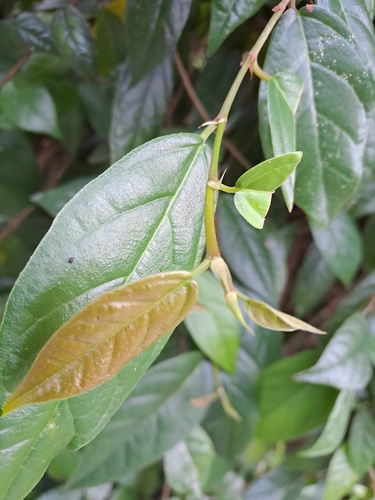
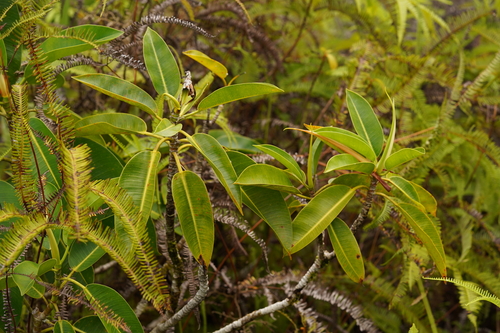
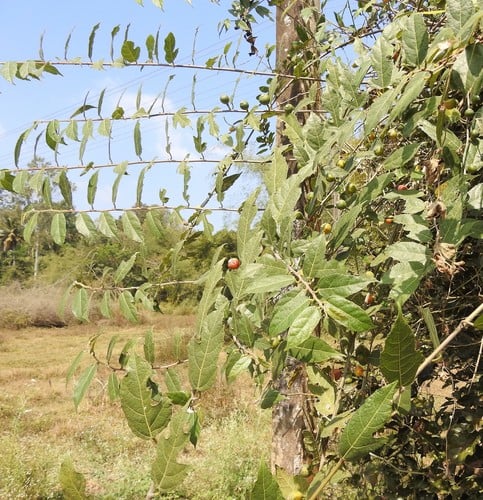
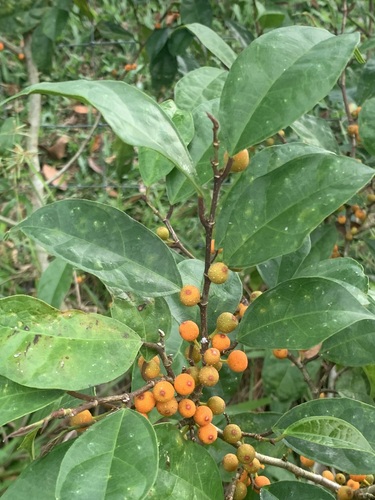
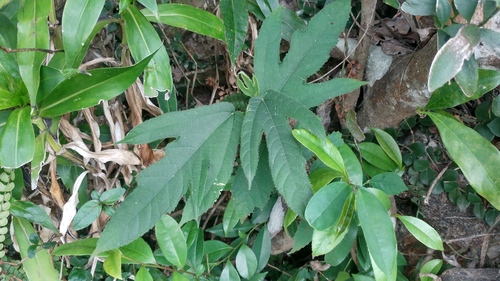
A large tree which loses its leaves during the year. The tree grows to 10-50 m high. The trunk is short and erect but is can be bent. The crown is rounded and spreading. The bark is reddish-brown and rough and scaly in old trees. The young branches are densely covered with stiff, pale brown hairs. The leaves are alternate. The leaf stalk is 2-3 cm long. The leaves are oblong and 20-30 cm long and 2-16 cm wide. Sometimes the leaves have lobes. They are dark green and smooth above but softly hairy underneath. Male and female flowers occur on the same tree. They are clustered together in the outer surface of rounded heads. These grow at the base of the leaves. The male flower head is yellow. They are 0.8-5 cm long but fall off. The fruit have a fleshy receptacle. The fruit are velvety and yellow when ripe. They are 7-13 cm across. The fruit contains 20-30 seeds. The seeds are oblong.
Edible Uses
The flat broad seeds and ripe sweet-sour fruit are eaten raw. Immature fruit are cooked in curry, chutney, or pickles. Male flowers are pickled. Young shoots are cooked as a vegetable, and young leaves provide a sour taste.
Traditional Uses
The flat broad seeds are eaten. The ripe fruit are eaten raw. They have a sweet-sour taste. The immature fruit are cooked in curry or used in chutney and pickles. The male flowers are pickled. The bark is chewed as a substitute for betel nut. The young shoots are cooked as a vegetable. The young leaves are used for a sour taste.
Medicinal Uses
The bark is chewed as a substitute for betel nut.
Distribution
It is a tropical plant. It suits a warm, humid climate. It grows in Nepal from sea level to 900 m altitude. In China it grows in forests in limestone mountains between 100-700 m altitude in Yunnan. In India it grows up to 1,500 m altitude. It is sensitive to frost, but is hardier than jackfruit. It can grow in arid places.
Where It Grows
Africa, Andamans, Asia, Australia, Bangladesh, Bhutan, Cambodia, China, Egypt, Guyana, Himalayas, India*, Indochina, Indonesia, Laos, Malaysia, Myanmar, Nepal, North Africa, Northeastern India, Pacific, Pakistan, Papua New Guinea, PNG, SE Asia, Sikkim, Solomon Islands, South America, Sri Lanka, Thailand, Vietnam,
Cultivation
Plants are grown from seed. Fresh seed should be used as seed do not store well. Seedlings do not transplant well.
Propagation
Seed - it has a very short viability and so is best sown as soon as it is ripe. The seedcoat is very thin - the seeds need to be handled carefully to avoid damaging them. Sow seeds in a nursery seedbed, or sow 2 seeds per individual container - any surplus seedlings can be moved to another pot. The seed germinates best at a temperature of 24 - 27°c. The seed germinates quite quickly and, when 2 - 3 weeks old, are robust enough to withstand full sun and rain. Seedlings are planted out when about 20 - 25cm tall. Root cuttings. Air layering.
Other Uses
A fibre obtained from the inner bark is used for cordage. A yellow colouring matter is obtained from the wood and roots. It is used for dyeing textiles. A sticky latex is present in all parts of the tree and has many uses. The yellow wood is durable, hard and suitable for polishing. It is resistant to termites. It is used for timber, heavy construction, furniture and boat building. The wood is an important local source of fuel. The tree is an important component of traditional agroforestry systems, being integrated into mixed cropping systems with other crops.
Production
Trees start bearing after 6-7 years. Yields per tree can be 80 kg. In India fruit are available from June to August.
Other Information
The ripe fruit are sold in markets. It is cultivated.
Notes
There are about 50 Artocarpus species. They are in the tropics and subtropics of Asia and the Pacific.
Nutrition
| Part | Moisture | kJ | kcal | Protein | Vit A | Vit C | Iron | Zinc |
|---|---|---|---|---|---|---|---|---|
| Fruit | 72.3 | 435 | 103 | 1.2 | 310 | 65.6 | 0.8 | 1.7 |
| Seeds | — | — | — | — | — | — | — | — |
| Flowers | — | — | — | — | — | — | — | — |
| Bark | — | — | — | — | — | — | — | — |
Synonyms
Also Known As
A niao niao bei, Arimu, Armu, Badahar, Badhal, Badhar, Bak haad, Barahar, Barar, Barhal, Bartah, Belang, Berhal, Borhar, Borta, Dahua, Daowa, Dehu ja, Deophal, Dephal, Dephul, Deua, Dewa chali, Dewachaam, Dhaun, Dhawa, Dhemphal, Dheu, Etothi, Had, Heirukothong, Ingtat arong, Jram thai gidiba, Kammaregu, Kan-yae, Kathal, Keledang berok, Lakooch, Lakuch, Lirang, Lokhat, Lusuk salia, Ma haat, Maak haad, Mahad, Mai haat, Mai-mak-hat, Mayauklok-ni, Meik-mahot, Myauk-laung, Myauk-lok, Pohon nangka keledang, Pohon nangka parasmanis, Rilang, Sangyen-kung, Taeoo, Tampang ambong, Tampang gelugor, Tampang manis, Tampang nangka, Tampang, Tan-pae, Tat thei, Theitat, Vatehuli, Wotomba
References (96)
- Ali, R. M., et al, (Eds.), 2010, ASEAN Herbal and Medicinal Plants. Forestry research Institute Malaysia. p 267
- Ambasta S.P. (Ed.), 2000, The Useful Plants of India. CSIR India. p 57
- Angami, A., et al, 2006, Status and potential of wild edible plants of Arunachal Pradesh. Indian Journal of Traditional Knowledge 5(4) October 2006, pp 541-550 (As lakoocha)
- Arora, K., Indigenous Forest Management in the Andaman and Nicobar Islands, India.
- Arora, R. K., 2014, Diversity in Underutilized Plant Species - An Asia-Pacific Perspective. Bioversity International. p 59
Show all 96 references Hide references
- Aryal, K. P. et al, 2009, Uncultivated Plants and Livehood Support - A case study from the Chepang people of Nepal. Ethnobotany Research and Applications. 7:409-422 (As lakoocha)
- Bajpai, O., et al, 2015, Tree species of the Himalayan Terai region of Uttar Pradesh, India: a checklist. Check List 11(4): 1718 (As lakoocha)
- Bandyopadhyay, S. et al, 2009, Wild edible plants of Koch Bihar district, West Bengal. Natural Products Radiance 8(1) 64-72
- Bandyopadhyay, S., et al, 2012, A Census of Wild Edible Plants from Howrah District, West Bengal, India. Proceedings of UGC sponsored National Seminar 2012
- BARC, 2016, State of Biodiversity for Food and Agriculture in Bangladesh. Bangladesh Agricultural Research Council.
- Bhatia, H., et al, 2018, Traditionally used wild edible plants of district Udhampur, J&K, India. Journal of Ethnobiology and Ethnomedicine (2018) 14:73
- Bircher, A. G. & Bircher, W. H., 2000, Encyclopedia of Fruit Trees and Edible Flowering Plants in Egypt and the Subtropics. AUC Press. p 43
- Brahma, S., et al, 2013, Wild edible fruits of Kokrajhar district of Assam, North-East India, Asian Journal of Plant Science and Research 3(6):95-100
- Burkill, I.H., 1966, A Dictionary of the Economic Products of the Malay Peninsula. Ministry of Agriculture and Cooperatives, Kuala Lumpur, Malaysia. Vol 1 (A-H) p 259
- Chakraborty, S. & Chaturbedi, H. P., 2014, Some Wild Edible Fruits of Tripura- A Survey. Indian Journal of Applied research. (4) 9
- Chowdery, T., et al, 2014, Wild edible plants of Uttar Dinajpur District, West Bengal. Life Science Leaflets. 47:pp 20-36 http://lifesciencesleaflets.ning.com
- Chowdhury, M. & Mukherjee, R., 2012, Wild Edible Plants Consumed by Local Communities of Maldah of West Bengal, India. Indian J.Sci.Res.3(2) : 163-170
- Cruz-Garcia, G. S., & Price, L. L., 2011, Ethnobotanical investigation of 'wild' food plants used by rice farmers in Kalasin, Northeast Thailand. Journal of Ethnobiology and Ethnomedicine 7:33
- Dobriyal, M. J. R. & Dobriyal, R., 2014, Non Wood Forest Produce an Option for Ethnic Food and Nutritional Security in India. Int. J. of Usuf. Mngt. 15(1):17-37
- Das, T. & Das, A. K., 2005, Inventorying plant biodiversity in homegardens: A case study in Barak Valley, Assam, North East India. CURRENT SCIENCE, VOL. 89, NO. 1, 10 JULY 2005
- Ethnobotany of Karbis. Chapter 4 in p 103
- Facciola, S., 1998, Cornucopia 2: a Source Book of Edible Plants. Kampong Publications, p 154 (As Artocarpus lakoocha)
- Fl. ind. ed. 1832, 3:524. 1832 (As Artocarpus lakoocha Roxb.)
- Gautim, R. S., et al, 2020, Wild Edible Fruits of Nepal. Int. J. Appl. Sci. Biotechnol. Vol 8(3): 289-304
- Ghimeray, A. K., Lamsal, K., et al, 2010, Wild edible angiospermic plants of the Illam Hills (Eastern Nepal) and their mode of use by local community. Korean J. Pl. Taxon. 40(1)
- Ghosh, C. & Das A. P., 2011, Some useful and poisonous tea garden weeds from the Darjiling District of West Bengal, India. Pleione 5(1): 91 - 114
- Guite, C., 2016, A study of wild edible plants associated with the Paite tribe of Manipur, India, International Journal of Current Research. Vol. 8, Issue, 11, pp. 40927-40932
- Hazarika, T. K., et al, 2012, Studies on wild fruits of Mizoram, India used as ethno-medicines. Genetic Resources and Crop Evolution. Published on line 03 February, 2012 (As Artocarpus lakoocha)
- Hazarika, B. et al. (2020). An overview of the unexplored underutilized fruit crops of Assam, India. Journal of Applied and Natural Science, 12(3): 442 - 453 (As Artocarpus lakoocha)
- Hedrick, U.P., 1919, (Ed.), Sturtevant's edible plants of the world. p 77
- Hibbert, M., 2002, The Aussie Plant Finder 2002, Florilegium. p 33
- INFOODSUpdatedFGU-list.xls
- Jahan, S. et al, 2011, Nutritional Profile of Some Tropical Fruits in Bangladesh: Specially Anti-Oxidant Vitamins and Minerals. Bangladesh Journal of Medical Science Vol. 10 No. 2
- Jeeva, S., 2009, Horticultural potential of wild edible fruits used by the Khasi tribes of Meghalaya. Journal or Horticulture and Forestry Vol. 1(9) pp. 182-192
- Kachenchart, B., et al, 2008, Phenology of Edible Plants at Sakaerat Forest. In Proceedings of the FORTROP II: Tropical Forestry Change in a Changing World. Bangkok, Thailand.
- Kar, A., & Borthakur, S. K., 2008, Wild edible fruits of Karbi's of Karbi Anglong district of Assam, India, Pleione 2(2): 175-181
- Kar, A., et al, 2013, Wild Edible Plant Resources used by the Mizos of Mizoram, India. Kathmandu University Journal of Science, Engineering and Technology. Vol. 9, No. 1, July, 2013, 106-126
- Khan, D. & Shaukat, S.S., 2006, The Fruits of Pakistan: Diversity, Distribution, Trends of Production and Use. Int. J. Biol. Biotech., 3(3):463-499
- Krishen P., 2006, Trees of Delhi, A Field Guide. DK Books. p 50 (As Artocarpus lacucha)
- Kumar, R., et al, 2013, Ethnoboptany of Tharus or Dudhwa National Park, India. Mintage journal of Pharmaceutical & Medical Science 6-11 (As lakoocha)
- Kunkel,
- Lalfakzuala, R., 2007, Ethnobotanical usages of plants in western Mizoram. Indian Journal of Traditional Knowledge. Vol 6(3) pp 480-493
- Lorenzi, H., Bacher, L., Lacerda, M. & Sartori, S., 2006, Brazilian Fruits & Cultivated Exotics. Sao Paulo, Instituto Plantarum de Estuados da Flora Ltda. p 437 (As Artocarpus lakoocha)
- Luo, B., et al, 2019, Wild edible plants collected by Hani from terraced rice paddy agroecosystem in Honghe Prefecture, Yunnan, China. Journal of Ethnobiology and Ethnomedicine 15:56
- Lyle, S., 2006, Discovering fruit and nuts. Land Links. p 81
- Majumdar, K and Datta, N., 2009, Traditional wild edible fruits for the forest dwellers of Tripura, India. Pleione 3(2) 167-178
- Manju, S., and Sundriyal, R. C., 2001, Wild Edible Plants of the Sikkim Himalaya: Nutritive Values of Selected Species. Economic Botany 55(3): 377-390
- Medhi, P., Sarma, A and Borthakur, S. K., 2014, Wild edible plants from the Dima Hasao district of Assam, India. Pleione 8(1): 133-148
- Meitei, L. R., et al, 2022, An ethnobotanical study on the wild edible plants used by forest dwellers in Yangoupokpi Lokchao Wildlife Sanctuary, Manipur, India. Ethnobotany Research and Application 23:15
- Mem. Wern. Nat. Hist. Soc. 5:333. 1826
- Milow, P., et al, 2013, Malaysian species of plants with edible fruits or seeds and their evaluation. International Journal of Fruit Science. 14:1, 1-27
- Mukhia, P.K., et al, 2013, Wild plants as Non Wood Forest Products used by the rural community of Dagana, a southern foothill district of Bhutan, SAARC Journal, 27 pages
- Murtem, G. & Chaudhrey, P., 2016, An ethnobotanical note on wild edible plants of Upper Eastern Himalaya, India. Brazilian Journal of Biological Sciences, 2016, v. 3, no. 5, p. 63-81
- Omawale, 1973, Guyana's edible plants. Guyana University, Georgetown p 4
- Macmillan, H.F. (Revised Barlow, H.S., et al) 1991, Tropical Planting and Gardening. Sixth edition. Malayan Nature Society. Kuala Lumpur. p 292
- Manandhar, N.P., 2002, Plants and People of Nepal. Timber Press. Portland, Oregon. p 98
- Mozhui, R., et al, 2011, Wild edible fruits used by the tribals of Dimapur district of Nagaland, India. Pleione 5(1): 56 - 64. (As lakoocha)
- Morton,
- Partha, P., 2014, Ethnobotany of the Laleng (Patra) Community in Bangladesh. Journal of Pharmacognosy and Phytochemistry. 2(6):173-184
- Pasha, M. K. & Uddin, S. B., 2019, Minor Edible Fruits of Bangladesh. Bangladesh J. Plant Taxon. 26(2): 299–313
- Patiri, B. & Borah, A., 2007, Wild Edible Plants of Assam. Geethaki Publishers. p 133
- Pegu, R., et al, 2013, Ethnobotanical study of Wild Edible Plants in Poba Reserved Forest, Assam, India. Research Journal of Agriculture and Forestry Sciences 1(3):1-10
- Phangchopi, U., et al, 2015, Diversity of wild edible plants in Marat Longri Wildlife Sanctuary, Assam. Indian Journal of Natural Products and Resources Vol. 6(4), December 2015 pp. 305-313
- Prixar, S., et al, 2006, Species composition, distribution and management of trees in paddy fields in central Laos. p 24
- Rashid, H. E., 1977, Geography of Bangladesh. Westview. p 347 (As Artocarpus lakoocha)
- Ray, A., et al, 2020, How many Wild Edible Plants do we Use. Frontiers in Sustainable Food Systems. 4:56 p 12
- Recher, P, 2001, Fruit Spirit Botanical Gardens Plant Index. www.nrg.com.au/~recher/ seedlist.html p 1 (As Artocarpus lakoocha)
- Royal Botanic Gardens, Kew (1999). Survey of Economic Plants for Arid and Semi-Arid Lands (SEPASAL) database. Published on the Internet; http://www.rbgkew.org.uk/ceb/sepasal/internet [Accessed 4th May 2011] (As Artocarpus lakoocha)
- Sangma, A. j. T., 2018, Non-timber forest products (NTFPs) used by Garo tribe of Rongram block in West Garo Hills, Meghalaya. Indian Journal of Traditional Knowledge Vol 18 (1), pp 151-161
- Sarma, H., et al, 2010, Updated Estimates of Wild Edible and Threatened Plants of Assam: A Meta-analysis. International Journal of Botany 6(4): 414-423
- Savita, et al, 2006, Studies on wild edible plants of ethnic people in east Sikkim. Asian J. of Bio Sci. (2006) Vol. 1 No. 2 : 117-125
- Sawian, J. T., et al, 2007, Wild edible plants of Meghalaya, North-east India. Natural Product Radiance Vol. 6(5): p 413
- Seidemann J., 2005, World Spice Plants. Economic Usage, Botany, Taxonomy. Springer. p 57
- Shah, S. K., 2014, Dietary contribution of underutilized minor crops and indigenous plants collected from uncultivated lands and forests in Nepal. in Promotion of Underutilized Indigenous Food Resources for Food Security and Nutrition in Asia and Pacific. FAO. Bangkok p 64
- Shrestha, S., 2021, Wild Edible Plants of Dhankuta, Eastern Nepal. Rupantaran : A Multidisciplinary Journal Vol. V : pp 100-109, September, 2021 p 102
- Singh, H.B., Arora R.K.,1978, Wild edible Plants of India. Indian Council of Agricultural Research, New Delhi. p 50
- Singh, P.K., Singh, N.I., and Singh, L.J., 1988, Ethnobotanical Studies on Wild Edible Plants in the Markets of Manipur - 2. J. Econ. Tax. Bot. Vol. 12 No. 1 pp 113-119
- Slik, F., www.asianplant.net
- Sukarya, D. G., (Ed.) 2013, 3,500 Plant Species of the Botanic Gardens of Indonesia. LIPI p 138
- Sundriyal, M., et al, 1998, Wild edibles and other useful plants from the Sikkim Himalaya, India. Oecologia Montana 7:43-54 (As Artocarpus lakoocha)
- Sundriyal, M. & Sundriyal, R. C., 2004, Structure, Phenology, Fruit Yield, and Future Prospects of some Prominent Wild Edible Plant Species of the Sikkim Himalaya, India. Journal of Ethnobiology 24(1): 113-138
- Sundriyal, M., et al, 2004, Dietary Use of Wild Plant Resources in the Sikkim Himalaya, India. Economic Botany 58(4) pp 626-638 (As Artocarpus lakoocha)
- Swaminathan, M.S., and Kochnar, S.L., 2007, An Atlas of major Flowering Trees in India. Macmillan. p 245
- Tanaka,
- Taram, M., et al, 2018, Wild Food Plant Resources of Komkar Adi Tribe of Upper Siang District in Arunachal Pradesh, India. Bulletin of Arunachal Forest Research, Vol. 33(2), 27-35
- Teron, R. & Borthakur, S. K., 2016, Edible Medicines: An Exploration of Medicinal Plants in Dietary Practices of Karbi Tribal Population of Assam, Northeast India. In Mondal, N. & Sen, J.(Ed.) Nutrition and Health among tribal populations of India. p 153
- Terra, G.J.A., 1973, Tropical Vegetables. Communication 54e Royal Tropical Institute, Amsterdam, p 26
- Thapa, L. B., et al, 2014, Wild Edible Plants used by endangered and Indigenous Raji Tribe in Western Nepal. International Journal of Applied Sciences and Biotechnology. Vol 2(3):243-252
- Tomar, A., Kumar, A., & Dubey, K., 2002, Underutilized Wild Edible fruits of Nutritional and Medicinal Value. J. Res. Educ. Indian Med., Vol XX1
- Upreti, K., et al, 2010, Diversity and Distribution of Wild Edible Fruit Plants of Uttarakhand. Bioversity Potentials of the Himalaya. p 161
- Uprety, Y., et al, 2012, Diversity of use and local knowledge of wild edible plant resources in Nepal. Journal of Ethnobotany and Ethnomedicine 8:16
- USDA, ARS, National Genetic Resources Program. Germplasm Resources Information Network - (GRIN). [Online Database] National Germplasm Resources Laboratory, Beltsville, Maryland. Available: www.ars-grin.gov/cgi-bin/npgs/html/econ.pl (10 April 2000)
- Wiersema, J. H. & Leon, B., 2013, World Economic Plants. A Standard Reference CRC Press. 2nd Ed. p 74
- World Checklist of Useful Plant Species 2020. Royal Botanic Gardens, Kew
- www.eFloras.org Flora of China
- www.worldagroforestrycentre.org/treedb/ (As lakoocha)