Endospermum medullosum
L.S. Sm.
Tower Pine, PNG basswood, Whitewood
wikimedia· cc-by-sa
Wikimedia Commons - K-spring
wikimedia· cc-by
Wikimedia Commons - C. Mangion
gbif· cc0
President and Fellows of Harvard College
Description
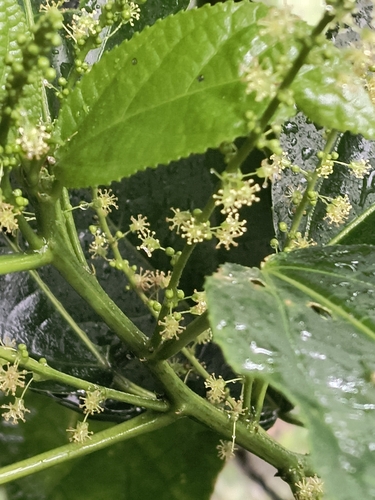
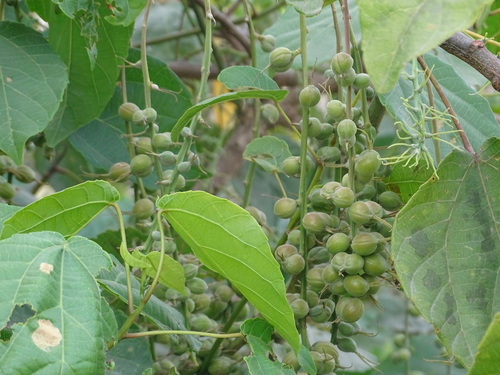
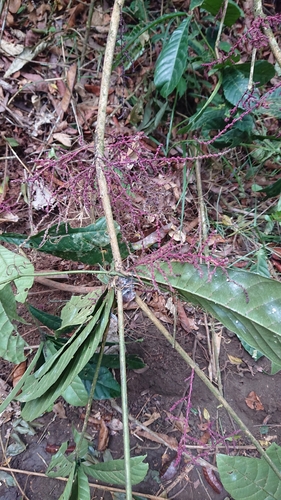
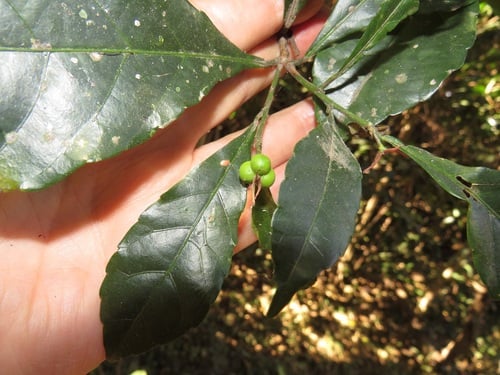
A large tree. It grows 20-40 m tall. The trunk is long, straight and with buttresses. The crown is flat and spreading with few leaves. The bark is light grey with pink blotches. The leaves are large and have the leaf stalk attached to the middle of the under surface of the leaf. The leaf shape varies from round to heart shaped. The leaf blade is 29 cm long by 22 cm wide. The leaves are clustered near the ends of branches. There are 2 pairs of veins near the base running around the edge of the leaf. The young leaves have golden hairs. The flowers are small and sexes occur separately. The flowers have a sweet smell. The fruit is a small yellow green berry with one hard black seed.
Edible Uses
The young leaves are eaten cooked.
Traditional Uses
The young leaves are eaten cooked.
This uses section is brief — help expand it
Medicinal Uses
There are many uses of Endospermum myrmecophilum. The whitewood is commonly used for canoes and can also be used for firewood. However the main use of the wood is for timber. It is highly priced in Japan, where it is widely selected. Whitewood timber is commonly used for furniture, shingles, moldings as well as other decorative purposes in the islands. The whitewood is efficient for such uses since it has even texture and dries fairly quickly. The immature leaves of this species are often utilized as a vegetable. The plant also has medicinal uses; in Vanuatu the bark is used to treat rheumatism and is also used to relieve stomachaches, as is the sap of the tree.
Distribution
A tropical plant. It grows in lowland rainforest in Papua New Guinea. It grows between sea level and 350 m altitude. It grows in areas with a mean annual temperature of 22-28°C. It is also in areas with an annual rainfall of 1500-5600 mm. The rainfall is uniformly distributed. It grows in a range of soils including ones that are occasionally flooded. It can grow in soils with a pH or 4.0-7.4.
Where It Grows
Asia, Indonesia, Pacific, Papua New Guinea, PNG, SE Asia, Solomon Islands, Vanuatu,
Cultivation
Plants are grown from seed. Seed should be sown while fresh. Seeds germinate in 2-5 weeks. Seedlings can be planted in the field after 14-16 weeks. Plants can be grown from cuttings.
Propagation
Seed - best sown as soon as it is ripe. Germination rates can be variable due to predation of the seeds by wasps, and is often very low. The seed can be sown with the fresh fruit pulp still attached. Sow in a nursery bed or in containers, either in full sun or with up to 25% shade. Germination takes 2 - 5 weeks. Young plants are very fast-growing, and are ready for planting out when 25cm tall, which can be in as little as 14 - 16 weeks after germination. Cuttings of long terminal shoots 20 - 25cm long, placed in containers until well-rooted.
Other Uses
The heartwood is creamy white to bright yellow; it is not demarcated from the sapwood. The texture is coarse; the grain straight or interlocked, sometimes wavy; the surface lustrous. The wood is very soft; very light in weight; not durable, being susceptible to fungi, dry wood borers and termites. It seasons quickly, with only a slight risk of checking or distortion; once dry it is stable in service. The wood works well with ordinary tools, though the presence of tension wood can cause overheating and blunting of sawblades; there is a risk of woolly surfaces so tools need to be kept sharp; nailing and screwing are poor; gluing is correct. It is an important source of the timber sesendok and is one of the favourite timbers for clogs, pattern making, trays, furniture parts, plywood chests, low grade coffins, disposable chop-sticks and other small articles; and is also used for matchboxes, match splints, drawing boards, black boards and toys. Traditionally, the tree was sometimes used to make canoes. The wood is used for fuel. The plant has some pioneer characteristics, usually invading secondary forest in the early stages of development. Natural regeneration after logging or extensive storm damage is often prolific, especially where this is accompanied by soil disturbance. Young trees may be shaded out by other faster-growing pioneers or smothered by climbers. The tree plays an important environmental role in the revegetation of various types of disturbed sites. The tree has extensive lateral surace roots and is a very good stabilizer. Its fallen leaves break down quite quickly and raise organic matter levels in the soil, thus improving soil fertility. The tree provides moderately heavy shade and so can be grown above shade-bearing crops such as cardamon, cocoa and taro. With its ability to tolerate very strong winds, the plant can be grown as part of a shelterbelt.
Production
It grows very quickly. It can grow 2-3 m each year.
Other Information
It is a useful timber tree.
Notes
There are 13 Endospermum species.
Synonyms
Also Known As
A'asa, Gaimaita, Gaimet, Kakadikana, Kamite, Kumaro, Napasa
References (9)
- Borrell, O.W., 1989, An Annotated Checklist of the Flora of Kairiru Island, New Guinea. Marcellin College, Victoria Australia. p 74, 188
- Cabalion, P. and Morat, P., 1983, Introduction le vegetation, la flore et aux noms vernaculaires de l'ile de Pentcoste (Vanuatu), In: Journal d'agriculture traditionnelle et de botanique appliquee JATBA Vol. 30, 3-4
- Cooper, W. and Cooper, W., 2004, Fruits of the Australian Tropical Rainforest. Nokomis Editions, Victoria, Australia. p 183 (Possibly synonym Endospermum myrmecophilum)
- Elevitch, C.R.(ed.), 2006, Traditional Trees of the Pacific Islands: Their Culture, Environment and Use. Permanent Agriculture Resources, Holualoa, Hawaii. p 317
- Foreman, D. B., 1971, A checklist of the Vascular Plants of Bougainville with Descriptions of some Common Forest Trees. Botany Bulletin No. 5. Department of Botany. p 114
Show all 9 references Hide references
- French, B.R., 2010, Food Plants of Solomon Islands. A Compendium. Food Plants International Inc. p 327
- Havel, J.J., 1975, Forest Botany, Volume 3 Part 2 Botanical taxonomy. Papua New Guinea Department of Forests, p 144
- Johns, R.J., 1976, Common Forest Trees of Papua New Guinea. Part 5 Angiospermae, Forestry College Bulolo, PNG p 226
- World Checklist of Useful Plant Species 2020. Royal Botanic Gardens, Kew