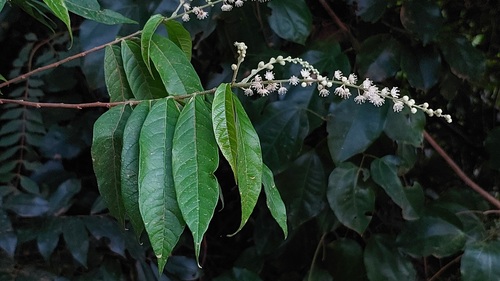
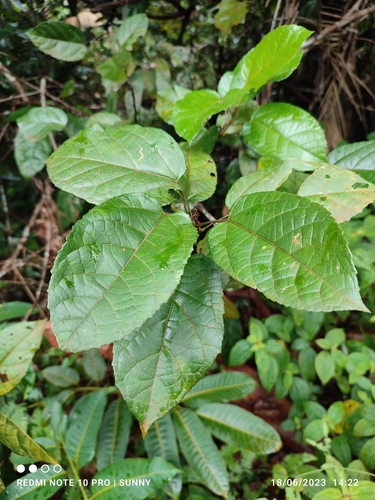
Suregada multiflora
(Juss.) Baill.
False lime shrub
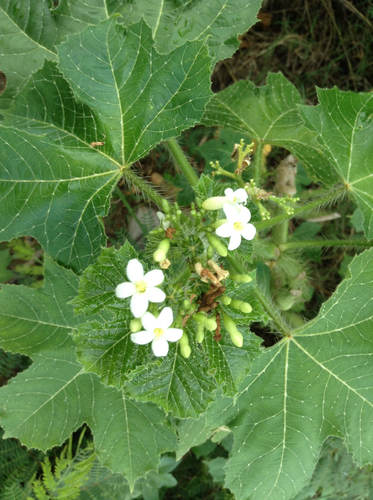
iNaturalist· cc-by-nc
(c) ps_t, some rights reserved (CC BY-NC)
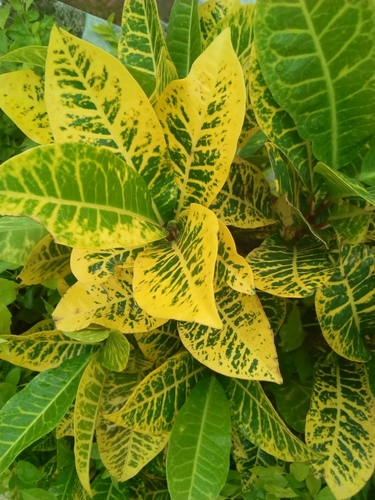
iNaturalist· cc-by-nc
(c) Tan Jun Nian, some rights reserved (CC BY-NC)
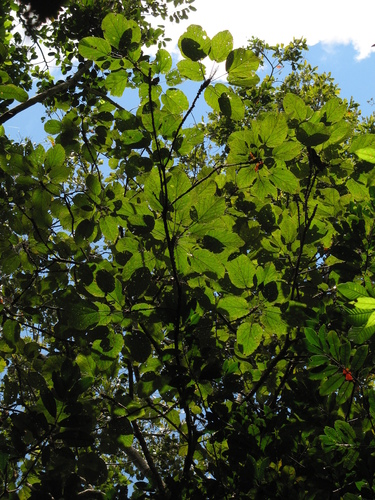
iNaturalist· cc-by-nc
(c) ben-valentine, some rights reserved (CC BY-NC)
Summary
Source: WikipediaSuregada multiflora, sometimes called the "false lime tree", is a species in the family Euphorbiaceae. The Catalogue of Life lists no subspecies. It is found in tropical Asia: names include kén or mân mây in Viet Nam.
Description
A tree. The bark cracks along its length. The leaves are oval and smooth but with clear dots. The base of the leaf is wedge shaped. The flowers are yellowish and have a scent. The flowers are of separate sexes. The fruit is round and has 3 lobes. They are blackish when ripe. They are 11-15 mm across and have 3 seeds.
Edible Uses
The ripe fruit are eaten raw.
Traditional Uses
The ripe fruit are eaten raw.
This uses section is brief — help expand it
Distribution
It is a subtropical plant. In southern China it grows in the lowlands below 100-600 m above sea level. In Yunnan.
Where It Grows
Asia, Bangladesh, Cambodia, China, India, Indochina, Indonesia, Laos, Malaysia, Myanmar, Northeastern India, SE Asia, Thailand, Vietnam,
Cultivation
Plants are grown from seeds.
Production
In NE Thailand the fruit are available May to June.
Synonyms
Also Known As
Ban naranga, Ban-naringa, Buah punai mengatok, Cheremai hutan, Duk sai, Ganari, Khakra, Khantang payabat, Markdaok, Mar-tu-kelok-arong, Midoumabaphang, Modouma biphang, Perdu limau hantu, Pindemaredu, Ruas-ruas, Suragata, Theng chek te, Theng chek-te, Yai pluak
References (11)
- Ambasta, S.P. (Ed.), 2000, The Useful Plants of India. CSIR India. p 233 (As Gelonium multiflorum)
- Burkill, I.H., 1966, A Dictionary of the Economic Products of the Malay Peninsula. Ministry of Agriculture and Cooperatives, Kuala Lumpur, Malaysia. Vol 1 (A-H) p 1082 (As Gelonium multiflorum)
- Euphorb. gen. 111, t. 10, fig. 31a. 1824 (As Gelonium multiflorum)
- Pasha, M. K. & Uddin, S. B., 2019, Minor Edible Fruits of Bangladesh. Bangladesh J. Plant Taxon. 26(2): 299–313
- Patiri, B. & Borah, A., 2007, Wild Edible Plants of Assam. Geethaki Publishers. p 130
Show all 11 references Hide references
- Pullaiah, T., et al, Ethnobotany of India, Volume 1: Eastern Ghats and Deccan.
- Singh, H.B., Arora R.K.,1978, Wild edible Plants of India. Indian Council of Agricultural Research, New Delhi. p 62 (As Gelonium multiflorum)
- Singh, V. B., et al, (Ed.) Horticulture for Sustainable Income and Environmental Protection. Vol. 1 p 217 (As Gelonium multiflorum)
- Sukarya, D. G., (Ed.) 2013, 3,500 Plant Species of the Botanic Gardens of Indonesia. LIPI p 720
- Suksri, S., et al, 2005, Ethnobotany in Bung Khong Long Non-Hunting Area, Northeast Thailand. Kasetsart J., (Nat. Sci) 39: 519-533
- Turreira Garcia, N., et al, 2017, Ethnobotanical knowledgeof the Kuy and Khmer people in Prey Lang, Cambodia. Cambodian Journal of Natural History 2017 (1): 76-101