Tetrorchidium didymostemon
(Baill.) Pax. et K. Hoffm.
iNaturalist· cc-by-nc
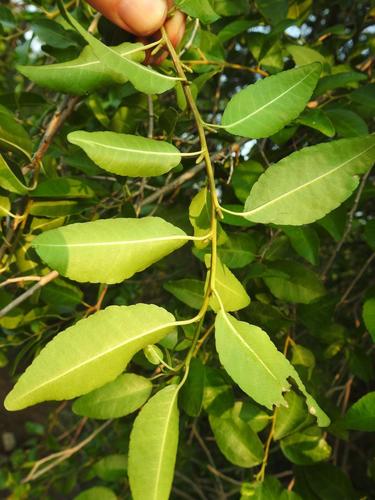
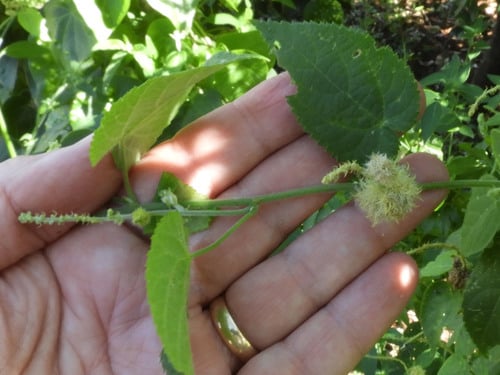
(c) Bart Wursten, some rights reserved (CC BY-NC), uploaded by Bart Wursten
iNaturalist· cc-by-nc
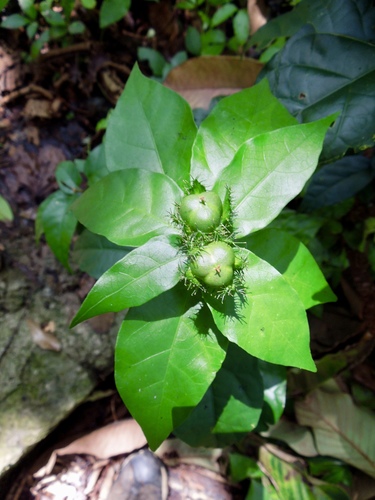
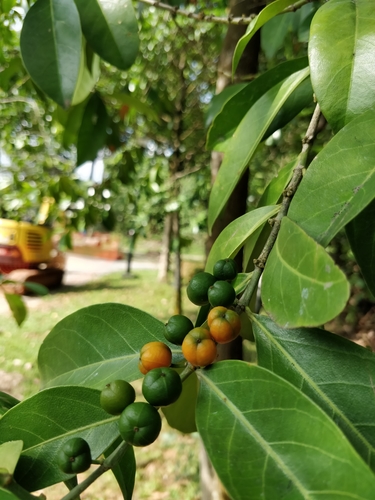
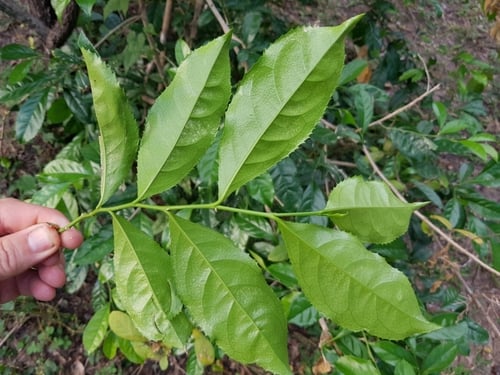
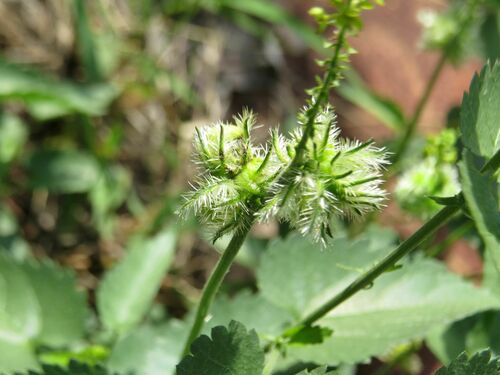
(c) Bart Wursten, some rights reserved (CC BY-NC)
Description
A small tree. It grows 8-12 m high. The trunk is 1 m around. It can grow to 24 m high. The trunk is sometimes fluted. The bark is grey and finely cracked. The branches are zigzag shaped because they bend at each node. Branches are often opposite. The leaves are 7.5-21 cm long by 3.5-11 cm wide. The leaves are thin and papery. The flowers are separately male and female. Male occur in single spikes opposite the leaves. Female flowers are very small and in clusters of 3-5. The fruit have 3 lobes. They are 6 mm across. They contain 3 red seeds.
Edible Uses
Leaves - cooked and eaten as a vegetable, but mainly for its beneficial medicinal action on the digestive system. The twigs are sucked for the sweet sap in the bark.
Traditional Uses
The stem is sucked for the sweet sap in the bark.
This uses section is brief — help expand it
Medicinal Uses
Throughout its distribution area, the latex from the stem bark is used as eye drops to treat filariasis, and is also applied to abscesses, leprous sores and glandular swellings. The bark latex is applied to snakebites. The latex from the stem bark, sometimes combined with banana or mixed in palm wine, is taken to treat stomach-ache, gonorrhoea, intestinal worms, coughing fits and food poisoning. The twig or root bark latex mixed with palm oil is applied as a lotion to treat measles. The bark is antidote, diuretic, emetic, febrifuge, parasiticide and purgative. A stem bark infusion is used to treat oedema. It is soaked in water or rum when taken as a purgative. Bark scrapings are applied as an enema to treat malaria and backache. A bark-decoction is given, either by draught or by enema, to young children who are not eating properly, who cry a lot and have distended stomachs due to constipation: the reaction is said to be immediate, soothing and purgative. A stem bark decoction is drunk as a remedy for Erythrophleum suaveolens poisoning. A stem bark infusion is rubbed on to rheumatic and painful limbs, painful kidney and to rid the body of fleass. The beaten stem bark is taken as a mouth wash to treat toothache and is applied as a poultice on swellings, abscesses, furuncles, buboes etc. A maceration of the stem bark is applied as a wash to treat hernia and urinary infections. The ash from the stem bark or root bark, mixed with palm oil, is applied to the hair to kill lice. The leaf sap. in water or rum, is commonly taken as a purgative and to treat fever. Young leaves are cut and cooked with fish and eaten to treat an enlarged spleen. The leaf sap, sometime swith banana or mixed in palm wine, is taken to treat stomach-ache, gonorrhoea, intestinal worms, coughing fits and food poisoning. To treat constipation or enlarged spleen in babies, the leaf sap is applied to the nipples of nursing mothers. The leaf sap is applied to wounds as a haemostatic. The leaves, crushed together with the stem bark of Cola ballayi, are applied to broken limbs as an embrocation to treat swellings. The leaves are applied hot as a poultice to limbs that are painful due to rheumatism or yaws, they are also used as a dressing on limbs that are becoming enlarged as symptoms of certain illnesses. A root decoction is drunk as an emetic. A trace of alkaloid has been detected in the leaves and bark.
Distribution
It is a tropical plant. It grows in secondary rainforest. It suits humid locations.
Where It Grows
Africa, Angola, Benin, Cameron, Central Africa, Central African Republic, CAR, Congo DR, Gabon, Ghana, Guinea, Guinée, Guinea-Bissau, Nigeria, Sao Tome and Principe, Senegal, Sierra Leone, Tanzania, Uganda, West Africa,
Cultivation
A dioecious species, both male and female forms need to be grown if fruit and seed are required.
Other Uses
A bark extract is rubbed on the body as a mosquito repellent. The twigs are used as chew sticks. The stem bark contains saponins. It is beaten and used as a soap for washing clothes. The heartwood is pinkish; the sapwood yellowish white to colourless. The wood is soft to moderately hard and perishable. Of very limited use, though the stems are used traditionally as poles for making huts and sometimes also in carpentry. The wood is also sometimes used for plywood production. The wood is used as firewood and for charcoal making. The tree is considered a weed species of managed forestry in Sierra Leone. Given the trees natural habitat of secondary forest formations, this implies that it could be a suitable species for use as a pioneer when restoring native woodland.
Production
In Central African Republic plants have been recorded flowering in May, June and October and fruiting May to July.
Synonyms
Also Known As
Iheni, Kambilangwa, Nsusu, Ofun-oke
References (8)
- Codjia, J. T. C., et al, 2003, Diversity and local valorisation of vegetal edible products in Benin. Cahiers Agricultures 12:1-12
- Dalziel, J. M., 1937, The Useful plants of west tropical Africa. Crown Agents for the Colonies London.
- Jardin, C., 1970, List of Foods Used In Africa, FAO Nutrition Information Document Series No 2.p 165
- Keay, R.W.J., 1989, Trees of Nigeria. Clarendon Press, Oxford. p 167
- Latham, P., 2004, Useful Plants of Bas-Congo province. Salvation Army & DFID p 278
Show all 8 references Hide references
- Peters, C. R., O'Brien, E. M., and Drummond, R.B., 1992, Edible Wild plants of Sub-saharan Africa. Kew. p 112
- Terashima, H., et al, 1992, Ethnobotany of the Lega in the Tropical Rainforest of Eastern Zaire (Congo): Part Two, Zone de Walikale, African Study Monographs, Suppl. 19:1-60
- World Checklist of Useful Plant Species 2020. Royal Botanic Gardens, Kew