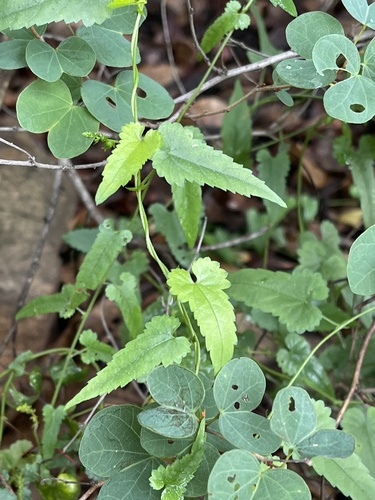
Spirostachys africana
Sond.
African mahogany tree, African sandalwood, Jumping bean
iNaturalist· cc-by-nc-sa
(c) Rob Palmer, some rights reserved (CC BY-NC-SA), uploaded by Rob Palmer
iNaturalist· cc0
no rights reserved, uploaded by Andrew Deacon
iNaturalist· cc0
no rights reserved, uploaded by Andrew Deacon
Summary
Source: WikipediaSpirostachys africana is a medium-sized (about 10 metres (33 ft) tall) deciduous tree with a straight, clear trunk, occurring in the warmer parts of Southern Africa. Its wood is known as tamboti, tambotie, tambootie or tambuti. It prefers growing in single-species copses in deciduous woodland, often along watercourses or on brackish flats and sandy soils.
Description
A shrub or tree. It loses its leaves during the year. It can grow 10-20 m high. The bark is grey and rough and cracks into squares. The leaves are small and narrowly oval. They have rounded teeth along the edge. The leaves turn red before falling. The leaf stalks have 2 small glands towards the end near the leaf. The flowers are in long groups and appear before the leaves. Male and female flowers are separate on the same tree. The fruit is a small capsule with 3 lobes. They split open into 3 segments suddenly and noisily. The seeds are round with a papery covering.
Edible Uses
None known.
Traditional Uses
Caution: The whole plant is poisonous. The resin is recorded as being eaten. It causes diarrhoea and is better not eaten.
This uses section is brief — help expand it
Medicinal Uses
Although the latex is very toxic to humans, it has traditional medicinal uses — a single drop of fresh latex is applied to a painful tooth as a painkiller. The bark is used to treat stomach pains, but large dosages will cause damage to the internal organs.
Known Hazards
Despite it being prone to heart-rot, it is prized in the furniture industry for its beautiful, dense and durable timber, which is reddish-brown with darker streaks, a satin-like lustre and extremely fragrant sweet, spicy smell. The underbark exudes a white, poisonous latex when freshly cut, and campfires that burn tamboti fuel give off noxious fumes contaminating meat or other food grilled on the open flames or coals. The latex is used as a fish poison, is applied to arrow-tips and is used as a purgative by indigenous tribes.
Distribution
It is a subtropical plant. It can grow in poor and salty soils. It grows between 60-1,370 m above sea level. It can grow in arid places.
Where It Grows
Africa, Angola, Botswana, Central Africa, East Africa, Eswatini, Kenya, Malawi, Mozambique, Namibia, South Africa, Southern Africa, Swaziland, Tanzania, Zimbabwe,
Cultivation
A plant of drier areas in the tropics and subtropics. The tree can tolerate at least some frost. Requires a moist soil for best growth. Succeeds in a wide range of soils. Established plants are fairly drought tolerant. A very slow-growing tree. The seeds often become infested with the larvae of a small grey moth which cause the seeds to spring several centimeters into the air similar to the 'jumping beans' of some South American Hippomaneae (Sebastiania spp., Colliguaya spp.).
Propagation
Seed must be harvested before it is fully ripe, as most seeds will otherwise be parasitized. Surface sow in a nursery seedbed or containers by gently pressing the seed into the top of the compost; do not allow it to dry out.
Other Uses
The heartwood is dark brown and the sapwood creamy white. The wood is hard, durable, easily worked, and stable, containing an oil that contributes to a beautiful finish. Its quality and scent resemble those of Indian sandalwood (Santalum album). The wood is highly ornamental and sought after for furniture making and is widely used for traditional carving and local crafts such as beads and decorative sticks. It has been suggested this may have been the 'algum' wood from 'Ophir' used in King Solomon's Palace and the Hebrew Temple. The wood is not suitable as fuel because its smoke is toxic; food roasted over it can cause diarrhoea if eaten.
Production
It grows slowly.
Other Information
Parts have been used as a famine food.
Synonyms
Also Known As
Chilangamacho, Morekhuri, Morukuru, Mushongo, N'kuni, Ohongo, Omuhongo, Omupapa, Shilati, Tamboti
References (4)
- Cheikhyoussef, A & Embashu, W., 2013, Ethnobotanical knowledge on Indigenous fruits in Ohangwena and Oshito regions in Northern Namibia. Journal of Ethnobiology and Ethnomedicine 9:34
- Grivetti, L. E., 1980, Agricultural development: present and potential role of edible wild plants. Part 2: Sub-Saharan Africa, Report to the Department of State Agency for International Development. p 80
- Royal Botanic Gardens, Kew (1999). Survey of Economic Plants for Arid and Semi-Arid Lands (SEPASAL) database. Published on the Internet; http://www.rbgkew.org.uk/ceb/sepasal/internet [Accessed 16th April 2011]
- World Checklist of Useful Plant Species 2020. Royal Botanic Gardens, Kew