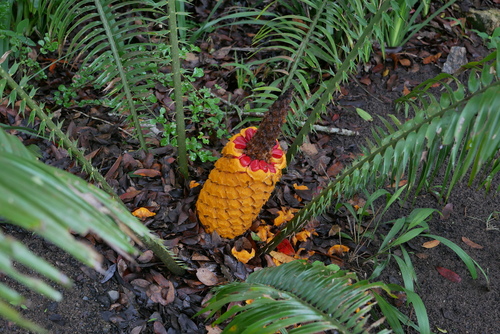
Encephalartos transvenosus
Stapf. & Burtt. Davy
Modjadji cycad
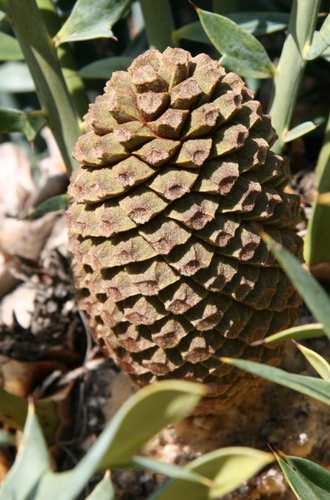
iNaturalist· cc-by-nc
(c) Troos van der Merwe, some rights reserved (CC BY-NC), uploaded by Troos van der Merwe
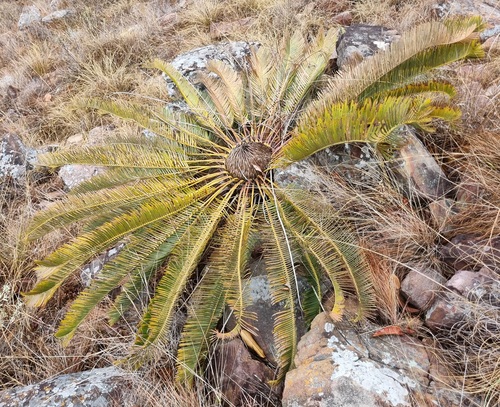
iNaturalist· cc-by-nc
(c) Simon Attwood, some rights reserved (CC BY-NC), uploaded by Simon Attwood
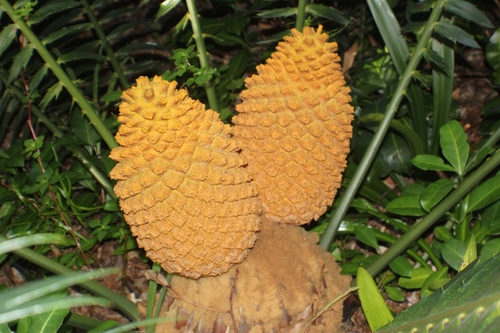
iNaturalist· cc-by-nc
(c) Simon Attwood, some rights reserved (CC BY-NC), uploaded by Simon Attwood
Summary
Source: WikipediaEncephalartos transvenosus is a palm-like cycad in the family Zamiaceae, with a localized distribution in Limpopo, South Africa. Its common names, Modjadji's cycad or Modjadji's palm, allude to the female dynasty of the Lobedu people, the Rain Queens, whose hereditary name is Modjadji. The queen resides near a valley (of late a nature reserve) which is densely forested with these cycads, which they protected and hold sacred. The species name transvenosus refers to the fine network of veins between the main veins. These can be seen when the leaf is held up to the light.
Description
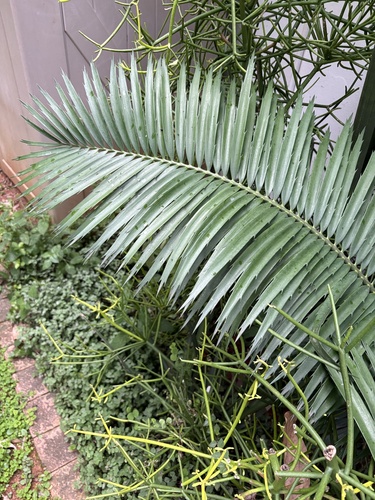
A tall plant. It grows to 12 m tall. The trunk is thick and scarred. It has a netted pattern. The crown is made up of shiny straight leaves. The leaves are spiny and up to 2.4 m long. The leaflets are broad; the middle one being 3 cm wide. They are often slightly curved and have teeth along the edges. The fruit occur as cones. 2 to 4 cones occur together. They are large and the female cones are the biggest. They can be 80 cm long and weigh 34 kg, They occur in the heart of the big green leaves. The seed are orange red. The thin fully ripe flesh around the seed is edible.
Edible Uses
The thin fully ripe flesh around the seeds is eaten fresh, especially by children. The stem is sliced and buried to partly ferment, then sliced, sun-dried, crushed into flour, and boiled before eating.
Traditional Uses
The fully ripe flesh around the seeds is eaten, especially by children. The stem is cut into slices and buried until it becomes partly fermented then it is sliced and sun dried before crushing into flour. This is eaten after boiling. CAUTION: The seed kernel is poisonous.
Known Hazards
The seed kernel is poisonous.
Distribution
A tropical plant. It grows in the mountains in South Africa. It grows in forests and on hillsides. In South Africa it grows in regions with warm to hot summers and mild but frost free winters. It grows between 600-1000 m altitude. The rainfall is 500-1000 mm with a summer maximum.
Where It Grows
Africa, Australia, East Africa, Mozambique, South Africa*, Southern Africa,
Cultivation
Plants are grown from seed. Seed germinate easily. Plants can be grown from suckers. Suckers transplant easily.
Production
It grows quickly. It can produce seeds 11 years after planting from seed.
Notes
There are 52 Encephalartos species.
Also Known As
Likobe, Modjadjibroodboom, Mtondolo, Mucovela, Mugobela
References (13)
- Brickell, C. (Ed.), 1999, The Royal Horticultural Society A-Z Encyclopedia of Garden Plants. Convent Garden Books. p 396
- J. Burtt Davy, Man. pl. Transvaal 1:40, 99, fig. 4B. 1926
- Fox, F. W. & Young, M. E. N., 1982, Food from the Veld. Delta Books. p 368
- Jones, D.L., 2000, Cycads of the world. Reed New Holland. p 216
- Marinelli, J. (Ed), 2004, Plant. DK. p 370
Show all 13 references Hide references
- Palgrave, K.C., 1996, Trees of Southern Africa. Struik Publishers. p 54
- Palmer, E and Pitman, N., 1972, Trees of Southern Africa. Vol. 1. A.A. Balkema, Cape Town p 321
- Plowes, N. J. & Taylor, F. W., 1997, The Processing of Indigenous Fruits and other Wildfoods of Southern Africa. in Smartt, L. & Haq. (Eds) Domestication, Production and Utilization of New Crops. ICUC p 190
- Ruiters-Welcome, A. K., 2019, Food plants of southern Africa. Ph.D. thesis. Univ. of Johannesburg p 108
- THIERET,
- van Wyk, B, van Wyk, P, and van Wyk B., 2000, Photographic guide to Trees of Southern Africa. Briza. p 130
- Van Wyk, Br. and van Wyk P., 2009, Field Guide to Trees of Southern Africa. Struik Nature. p 58
- Welcome, A. K. & Van Wyk, B.-E., 2019, An inventory and analysis of the food plants of southern Africa. South African Journal of Botany 122 (2019) 136–179