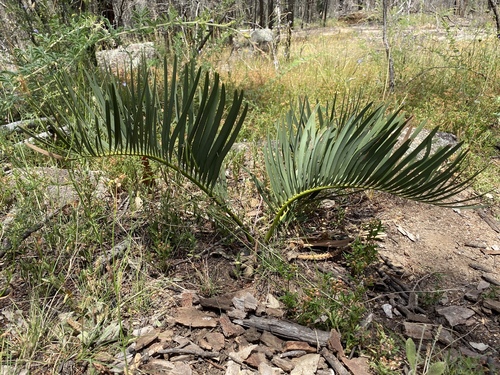
Zamia integrifolia
Lf. in Aiton
Florida arrowroot
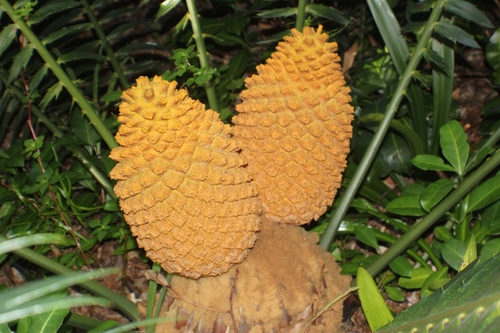
iNaturalist· cc-by-nc
(c) Jenny Evans, some rights reserved (CC BY-NC)
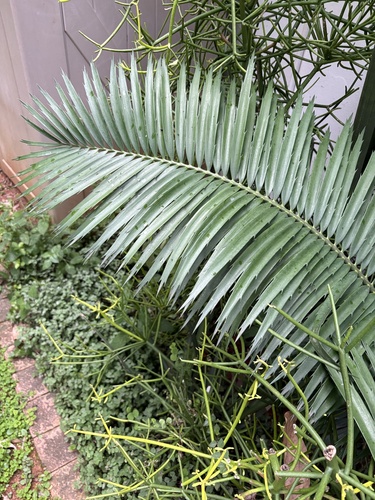
iNaturalist· cc-by-nc
(c) Jenny Evans, some rights reserved (CC BY-NC)
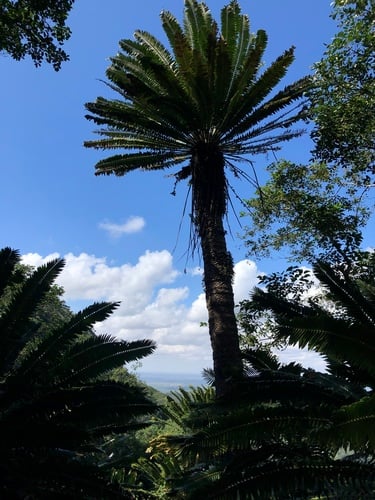
iNaturalist· cc-by-nc
(c) Jenny Evans, some rights reserved (CC BY-NC)
Summary
Source: WikipediaZamia integrifolia, also known as coontie, is a small, tough, woody cycad native to the southeastern United States (in Florida and formerly in Georgia), the Bahamas, Cuba, the Cayman Islands, and Puerto Rico. It is the only cycad native to the continental United States (the parts of the USA that exclude Hawaii and Alaska). Traditionally, it was used by Indigenous Americans to make starch.
Description
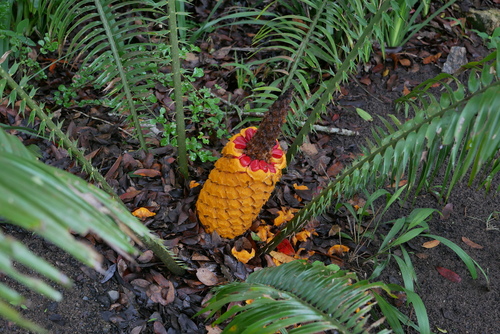
A small cycad. It has branched underground stems. Each stem is about 6 cm across. The young leaves are covered with short rusty hairs. The mature leaves are 0.6-1.5 m long. There are 4-10 leaves in each crown. They are dark green and stiff. The leaf stalk is 20-80 cm long. It does not have prickles. There are about 20-80 leaflets on each leaf. They are 8-30 cm long by 1-3 cm wide. They are oblong with parallel veins. They are dark green, stiff and leathery. The male cones are 6-10 cm long by 1-2.5 cm wide. They are red or brown. They have short hairs. The female cones are 8-12 cm long by 2-3 cm wide. They are oval and with a tail. They are reddish-brown. They have short hairs. The seeds are 1.5-2 cm long by 1-2 cm wide. They are oval and orange to red.
Edible Uses
The stems can be processed for starch extraction and, after suitable treatment, eaten as a source of starch.
Traditional Uses
The stems can be used for starch extraction and after suitable treatment, eaten.
This uses section is brief — help expand it
Known Hazards
The whole plant, except for the sarcotesta, the pulpy covering of the seeds, is very toxic, containing a toxin called cycasin which can cause liver failure that can lead to death, but if proper precautions are taken it can be leached with water due to it being a water-soluble molecule. The seeds also contain a toxic glycoside which causes headaches, vomiting, stomach pains and diarrhoea if ingested, and Beta-methylamino-alanine, which can cause central nervous system failure.
Distribution
They grow naturally in grassland and in dunes. It is hardy and adaptable and will grow in a range of situations and soils. It best suits temperate and subtropical climates. It is often on limestone or sandy soils.
Where It Grows
Australia, Bahamas, Caribbean, Central America, Cuba, Florida, Hawaii, North America, Pacific, Puerto Rico, USA, West Indies,
Cultivation
It is grown from seed. It can be grown by dividing the clump.
Propagation
Seed - remove the fleshy coating and surface sow on damp sand. Germination is best at around 23 - 29°c, but can take several months or even years. Pot up young seedlings into a rich, moist medium, as soon as they are large enough to handle and grow on at high temperatures without any check to growth until 2 - 3 leaves have been produced at one time, otherwise they may enter dormancy. Division.
Other Uses
A starch obtained from the stems has been used as a laundry starch. The plant forms clumps and, in time, can make a good ground cover.
Notes
There are about 55 Zamia species.
Synonyms
Also Known As
Coontie, Sago cycad
References (7)
- W. Aiton, Hort. kew. 3:478. 1789
- Hedrick, U.P., 1919, (Ed.), Sturtevant's edible plants of the world. p 692
- Hibbert, M., 2002, The Aussie Plant Finder 2002, Florilegium. p 310
- Jones, D.L., 2000, Cycads of the world. Reed New Holland. p 280
- Kiple, K.F. & Ornelas, K.C., (eds), 2000, The Cambridge World History of Food. CUP p 1886
Show all 7 references Hide references
- Menninger, E.A., 1977, Edible Nuts of the World. Horticultural Books. Florida p 164
- Staples, G.W. and Herbst, D.R., 2005, A tropical Garden Flora. Bishop Museum Press, Honolulu, Hawaii. p 77