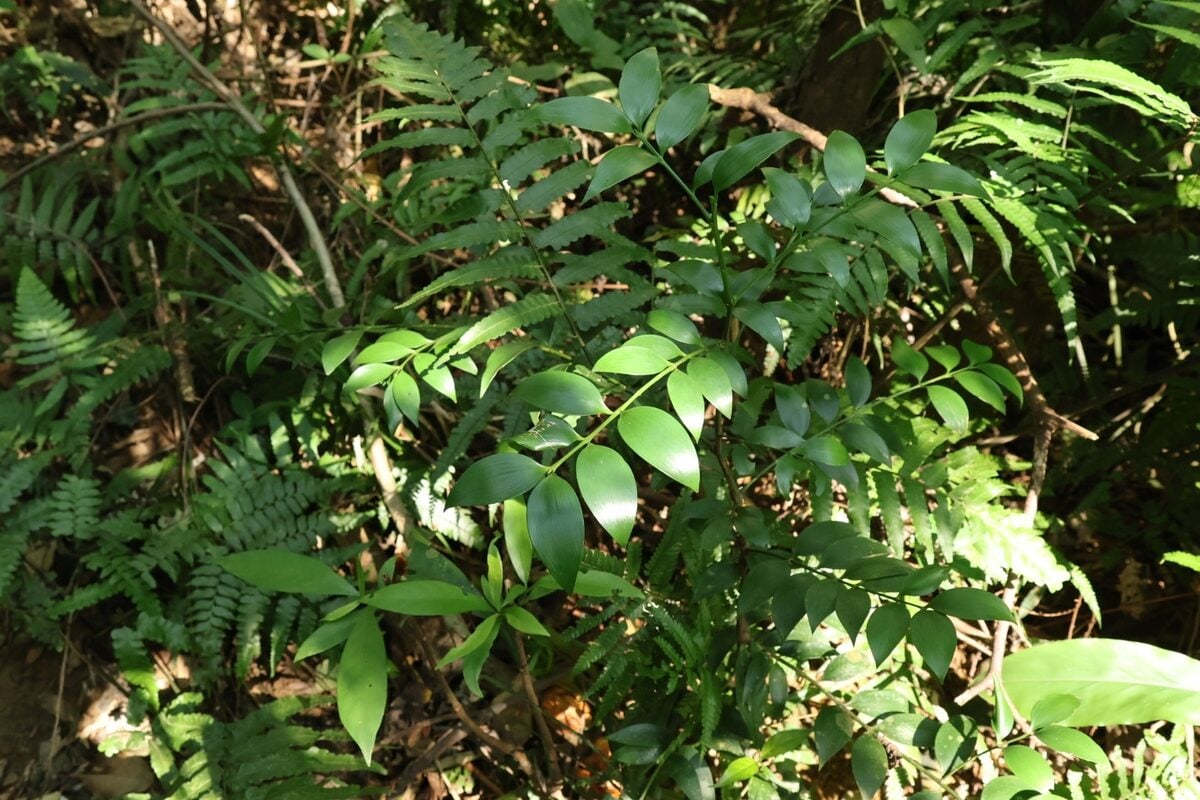
Afrocarpus falcatus
(Thunb.) C. N. Page
East African Yellowwood, Common Yellow Wood
iNaturalist· cc-by-nc
(c) gaynory, some rights reserved (CC BY-NC)
iNaturalist· cc-by-nc
(c) dianastromberg, some rights reserved (CC BY-NC)
iNaturalist· cc-by-nc
(c) Craig Peter, some rights reserved (CC BY-NC), uploaded by Craig Peter
Summary
Source: WikipediaAfrocarpus falcatus (syn. Podocarpus falcatus) is a species of tree in the family Podocarpaceae. It is native to the montane forests of southern Africa, where it is distributed in Malawi, Mozambique, South Africa, and Eswatini. Common names include common yellowwood, bastard yellowwood, outeniqua yellowwood, African pine tree, weeping yew, Afrikaans: outeniekwageelhout, kalander, Sotho: mogôbagôba, Xhosa: umkhoba and Zulu: umsonti. It is widespread, in some areas abundant, and not considered threatened, but it is a protected tree in South Africa. It is grown as an ornamental tree, especially in South Africa, and occasionally abroad.
Description
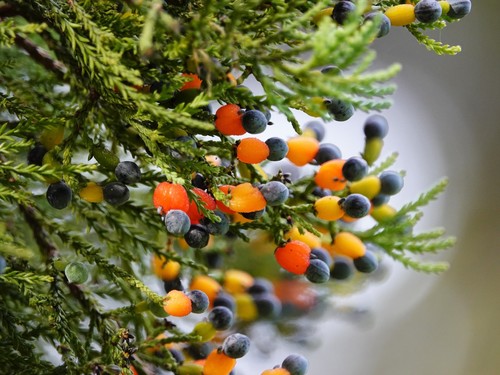
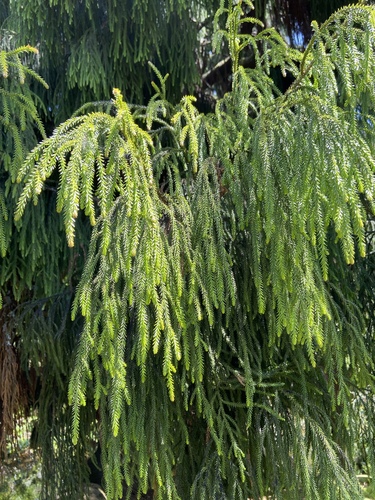
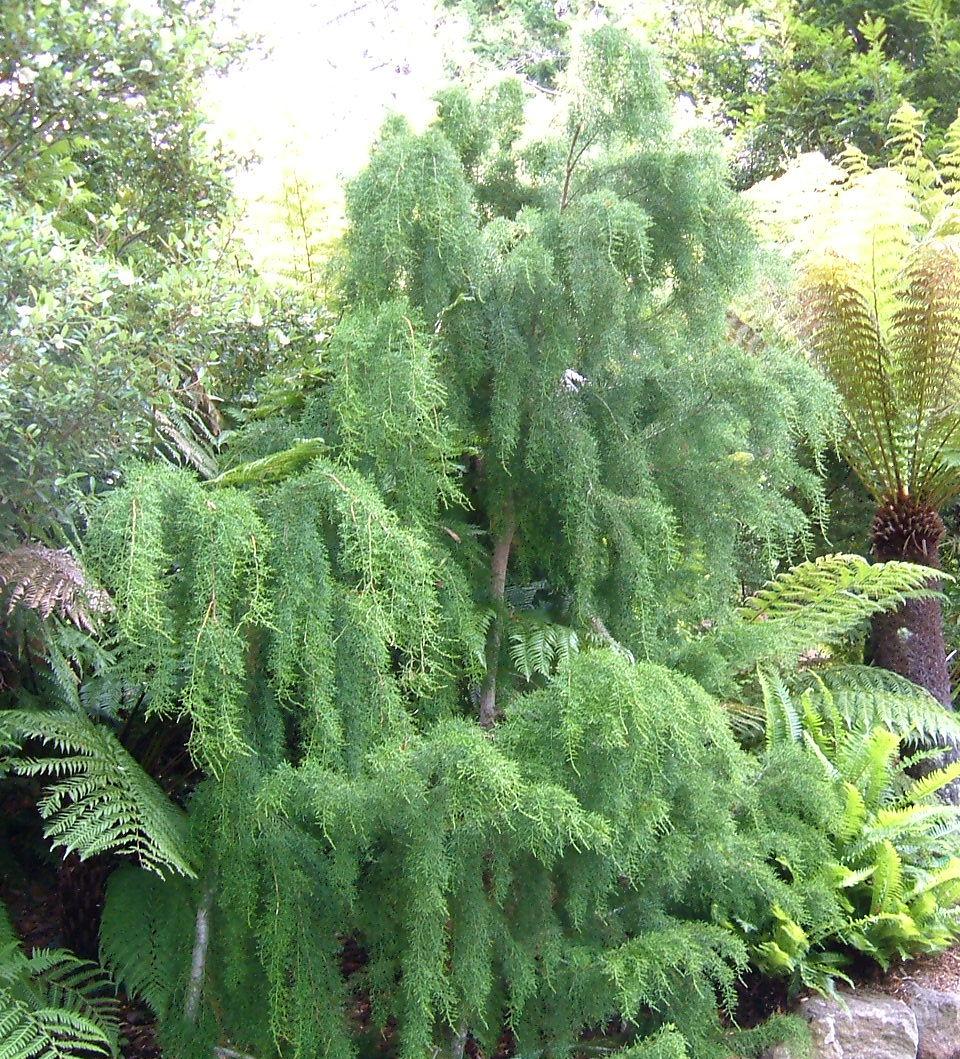
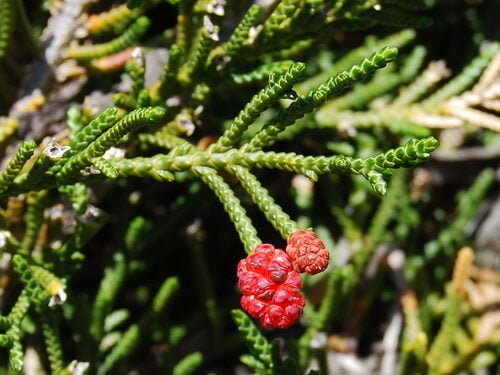
A large evergreen tree. It grows to 30 m tall. Often in cultivation it is 15 m high. The trunk is tall and straight. The crown is spreading and rounded. The bark is light brown tinged grey. It peels in fine plates. The leaves are spirally arranged around the stem. The leaves are alternate and simple. They are narrow and sickle shaped. They are 3-5 cm long by 3-5 mm wide. Trees are separately male and female. It has fleshy male and female cones carried on separate trees. The male cones are in the axils of leaves and 10 mm long by 3 mm wide. The female cones do not have a fleshy receptacle. The fruit are about 18 mm across. The seed are round and 15 mm across. They are yellow.
Edible Uses
The wood, often called podo or yellowwood, is good for construction, particularly shipbuilding. It is also made into plywood and used to make many products, including furniture, boxes, vats, toys, farm implements, musical instruments, and railroad ties. It is used in the construction of houses. It is also used as firewood. Some examples of South African yellowwood antique woodworking were created with the wood of this tree. The wood is also used for making floor boards and parquet blocks. The bark contains 3-4% tannin and is used for tanning leather. The wood is useful, but not very durable, as it is susceptible to blue stain fungus, powderpost beetles, longhorn beetles, and termites. The seed is edible, but resinous. The bark and seeds have been used in traditional African medicine. The tree is cultivated as an ornamental and a windbreak, and to prevent erosion. It has been used as a Christmas tree.
Traditional Uses
An edible oil is extracted from the seeds. The ripe fruit is eaten. They are resinous.
This uses section is brief — help expand it
Medicinal Uses
The bark and seeds are used in traditional medicine. Bark decoctions or infusions are used as anodyne, also to treat diarrhoea and stomach-ache. A bark decoction is also applied to itching rash. Pulverized seeds are applied to treat tuberculoid meningitis and sunburn. In Ethiopia the seed oil is used in the treatment of gonorrhoea. The sap is used as a remedy for chest complaints.
Distribution
It is a subtropical plant. It grows in mountain forest. It grows between 1,250-2,700 m above sea level. It can grow in arid places. It suits hardiness zones 9-11. Hobart Botanical gardens. Melbourne Botanical gardens. Wittunga Botanical Gardens. Arboretum Tasmania.
Where It Grows
Africa, Angola, Asia, Australia, Burundi, Central Africa, Congo DR, East Africa, Eritrea, Eswatini, Ethiopia, India, Kenya, Lesotho, Malawi, Mozambique, Rwanda, South Africa, Southern Africa, St Helena, Sudan, Swaziland, Tanzania, Tasmania, Uganda, Zambia, Zimbabwe,
Cultivation
Plants can be grown from fresh seed. The fleshy layer is removed. The fresh cones are collected and the flesh removed. The seed are sown into nursery bags. Seeds germinate erratically and can take 6 months. Seedlings need to be transplanted carefully to protect the taproot.
Propagation
Seed - remains viable for several years in normal storage. The seed has two types of dormancy; a chemical, which is overcome by removing the fleshy layer and a mechanical, imposed by the hard seedcoat. To ensure a high and even germination the seedcoat must be broken and removed. This can be done in a vice but it is very time-consuming. Freshly collected seeds will normally germinate well, up to 60% in nine weeks, even with seedcoat but once the seeds have been dried, germination can take more than six months unless the seedcoat is removed. Some reports say that soaking in saturated salt water just before sowing can improve germination. Others recommend stratification between two layers of compost for 3 - 5 days in order to weaken the seedcoat. The seeds are sown directly in nursery bags or in seedbeds in a mixture of compost and sand (1:1). The seed must be pushed into the mixture and covered with a fine layer of soil. The mixture must never be allowed to dry out. Cuttings taken from end shoots (as opposed to cuttings from lateral branches and shoots) in order to produce plants with upright growth.
Other Uses
The bark has been used for tanning, although it only contains 3 - 6% tannin. The leaves contain podolide, which is a main ingredient for an insecticide. The heartwood is pale yellow to pale yellowish brown, and not distinctly demarcated from the sapwood. The grain is straight, occasionally spirally, texture fine and even. The wood is moderately lightweight; easy to saw and work, both by machine and hand tools, with little dulling effects on cutting edges; it can be planed to a smooth finish; the wood has a tendency to split upon nailing, and pre-boring is recommended; the gluing, painting, varnishing and staining properties are moderately good. The wood is not durable, being susceptible to blue stain, powder-post beetle, pinhole borer, longhorn beetle, termite and marine borer attacks. The wood is highly valued for ship building, but it is also used for poles, panelling, furniture, boxes, veneer and plywood. It is suitable for construction, flooring, joinery, interior trim, mine props, vehicle bodies, railway sleepers, toys, novelties, agricultural implements, musical instruments, food containers, vats, turnery, hardboard and particle board. The wood is a good fuel. The tree is very useful for soil protection against water erosion. It is also planted to provide shade, shelter and as a windbreak.
Production
It is slow growing.
Notes
There are about 6 Afrocarpus species. They occur in Africa.
Synonyms
Also Known As
Birbirsa, Birbissa, Dagucho, Outeniqua yellowwood, Zigba
References (22)
- Abdillahi, H. S., 2009, Ethnobotany, phytochemistry and pharmacology of Podocarpus sensu latissimo (s.l.). South African Journal of Botany 76 (2010) 1–24 (As Podocarpus falcatus)
- Aerts, R., 2008. Afrocarpus falcatus (Thunb.) C.N.Page. [Internet] Record from Protabase. Louppe, D., Oteng-Amoako, A.A. & Brink, M. (Editors). PROTA (Plant Resources of Tropical Africa / Ressources végétales de l’Afrique tropicale), Wageningen, Netherlands. < http://database.prota.org/search.htm>. Accessed 13 October 2009.
- Cundall, P., (ed.), 2004, Gardening Australia: flora: the gardener's bible. ABC Books. p 108
- Etherington, K., & Imwold, D., (Eds), 2001, Botanica's Trees & Shrubs. The illustrated A-Z of over 8500 trees and shrubs. Random House, Australia. p 80
- Fox, F. W. & Young, M. E. N., 1982, Food from the Veld. Delta Books. p 303 (As Podocarpus falcatus)
Show all 22 references Hide references
- https://growwild.co.za Edible Indigenous plants (As Podocarpus falcatus)
- INFOODS:FAO/INFOODS Databases (As Podocarpus falcatus)
- Long, C., 2005, Swaziland's Flora - siSwati names and Uses http://www.sntc.org.sz/flora/
- Lulekal, E., et al, 2011, Wild edible plants in Ethiopia: a review on their potential to combat food insecurity. Afrika Focus - Vol. 24, No 2. pp 71-121 (As Podocarpus falcatus)
- Notes Roy. Bot. Gard. Edinburgh 45:383. 1989 ("1988") "falcata"
- Royal Botanic Gardens, Kew (1999). Survey of Economic Plants for Arid and Semi-Arid Lands (SEPASAL) database. Published on the Internet; http://www.rbgkew.org.uk/ceb/sepasal/internet [Accessed 4th June 2011]
- Ruiters-Welcome, A. K., 2019, Food plants of southern Africa. Ph.D. thesis. Univ. of Johannesburg p 91
- Senbeta, F., et al, 2013, Diversity of Useful Plants in the Coffee Forests of Ethiopia. Ethnobotany Research & Applications 11:049-069 (As Podocarpus falcatus)
- Seyoum, Y., et al, 2015, Edible Wild Fruit Trees and Shrubs and Their Socioeconomic Significance in Central Ethiopia. Ethnobotany Research & Applications. 14:183-197
- van Wyk, B, van Wyk, P, and van Wyk B., 2000, Photographic guide to Trees of Southern Africa. Briza. p 239 (As Podocarpus falcatus)
- Venter, F & J., 2009, Making the most of Indigenous Trees. Briza. p 238 (As Podocarpus falcatus)
- Wehmeyer, A. S, 1986, Edible Wild Plants of Southern Africa. Data on the Nutrient Contents of over 300 species (As Podocarpus falcatus)
- Welcome, A. K. & Van Wyk, B.-E., 2019, An inventory and analysis of the food plants of southern Africa. South African Journal of Botany 122 (2019) 136–179
- Wiersema, J. H. & Leon, B., 2013, World Economic Plants. A Standard Reference CRC Press. 2nd Ed. p 22
- White, F., Dowsett-Lemaire, F. and Chapman, J. D., 2001, Evergreen Forest Flora of Malawi. Kew. p 86 (As Podocarpus falcatus)
- World Checklist of Useful Plant Species 2020. Royal Botanic Gardens, Kew
- www.worldagroforestrycentre.org/treedb/ (As Podocarpus falcatus)