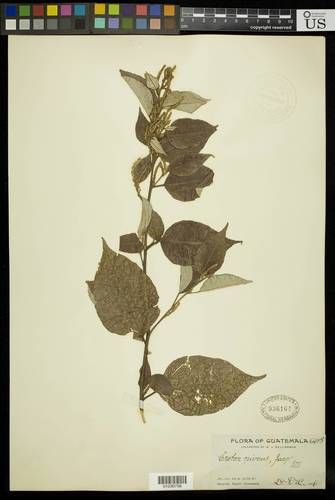
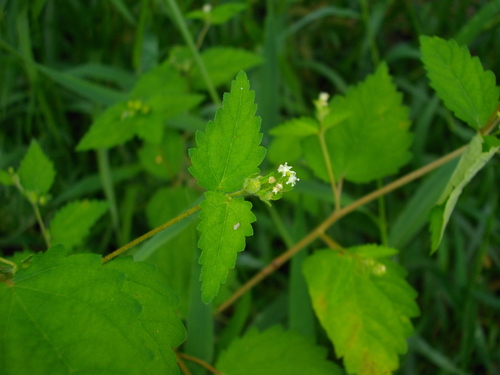
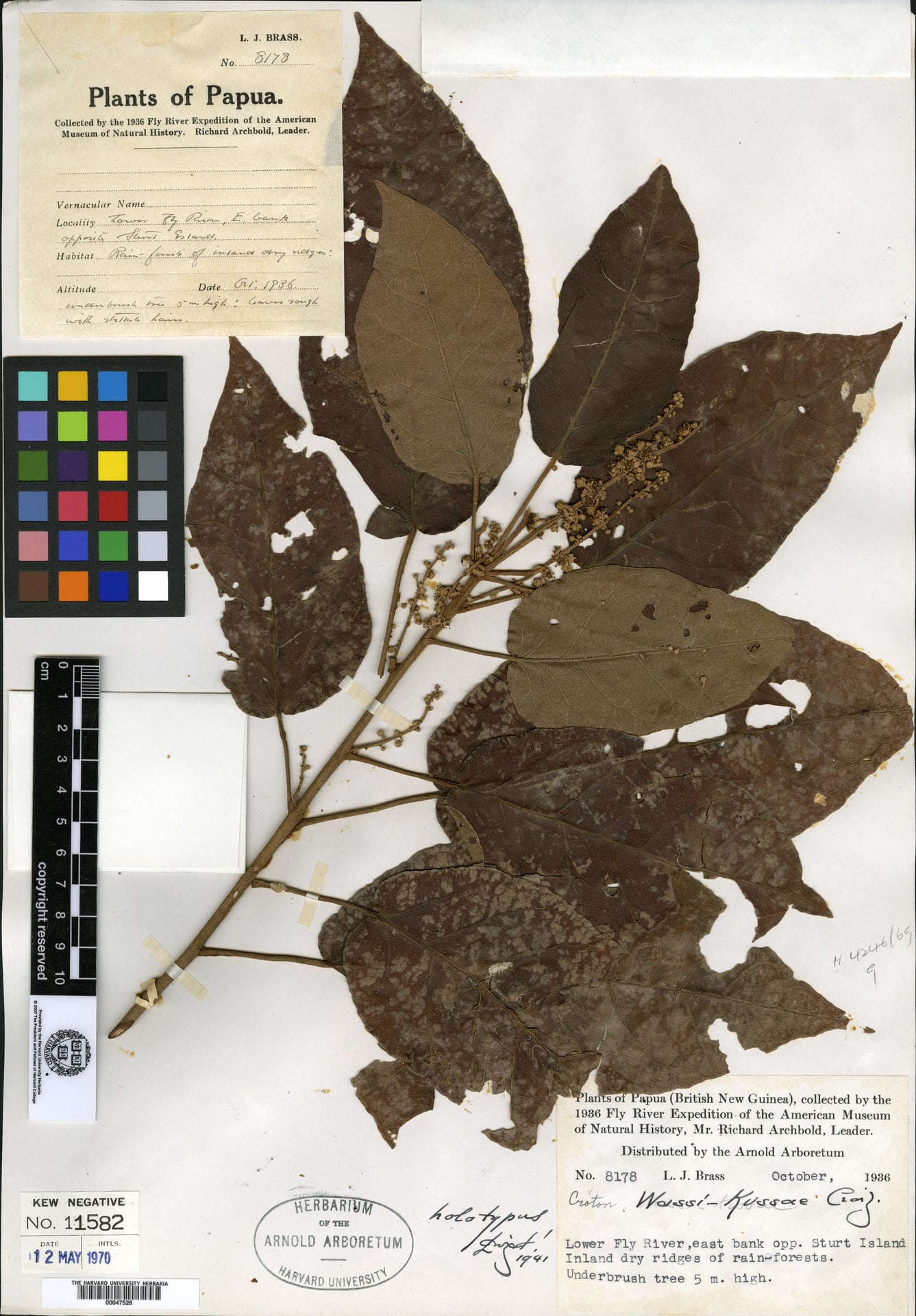
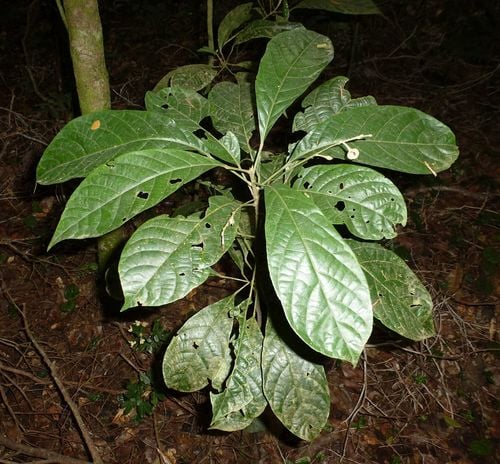
Croton urucurana
Baill.
Urucu croton
iNaturalist· cc-by-nc
(c) Laurent Quéno, some rights reserved (CC BY-NC), uploaded by Laurent Quéno
iNaturalist· cc-by-nc
(c) María Belén Dri, some rights reserved (CC BY-NC)
Description
A tropical tree from the spurge family producing latex.
This description is brief — help expand it
Edible Uses
The latex is edible.
Medicinal Uses
This is one of several Croton species that have the common name 'Sangre de Drago', or 'Dragon's Blood' in allusion to the red resin that exudes from various parts of the plant, but mainly from the bark. This resin has a number of useful medicinal properties, in particular it is astringent and vulnerary and is an effective healing agent that is commonly applied to wounds in order to speed the healing process. This red resin, obtained from various South American Croton species, contains a dihydrobenzofuran lignan that has been shown to inhibit cell proliferation, which may well explain its application in folk medicine. The bark is astringent and vulnerary. It is applied topically to heal wounds.
Distribution
It is a tropical plant.
Where It Grows
Argentina, Bolivia, Brazil, Ecuador, Paraguay, Peru, South America, Venezuela,
Cultivation
Requires a sunny position. Plants are tolerant of seasonal inundation of the soil. Most Croton species are relatively indifferent to their habitat and can grow on a wide range of soils in both disturbed and undisturbed vegetation. A fast-growing tree.
Propagation
Seed - best sown as soon as it is ripe in a partially shaded position in a nursery seedbed. A high germination rate can be expected, with the seed sprouting within 15 - 25 days. When the seedlings are 4 - 5cm tall, pot them up into individual containers and they should be ready to plant out 4 - 5 months later. The seed has a viability of less than 4 months.
Other Uses
The wood is hard, moderately heavy, of good mechanical resistance and with moderate durability when exposed to the elements. It can be used in boat construction, hydraulic work, carpentry and cabinet making; also for external purpose such as railway sleepers and stays. A fast-growing, pioneer species, well-adapted to wet and swampy terrains, it is an ideal choice for re-establishing woodland in riverine areas.
Synonyms
Also Known As
Capixin-gui, Evera-caa-bera, Ka'a ruru mi, Ku ruru'mi, Lan, Licurana, Lucurana, Sangra-d'agua, Urucu, Urucuana, Urucurana
References (1)
- Grandtner, M. M. & Chevrette, J., 2013, Dictionary of Trees, Volume 2: South America: Nomenclature, Taxonomy and Ecology. Academic Press p 181