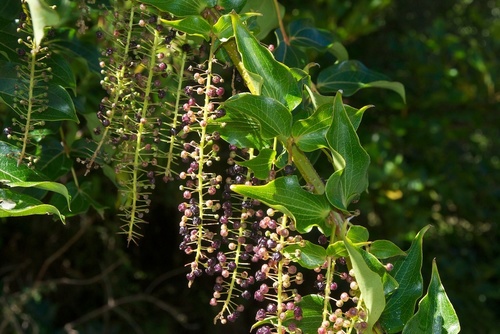
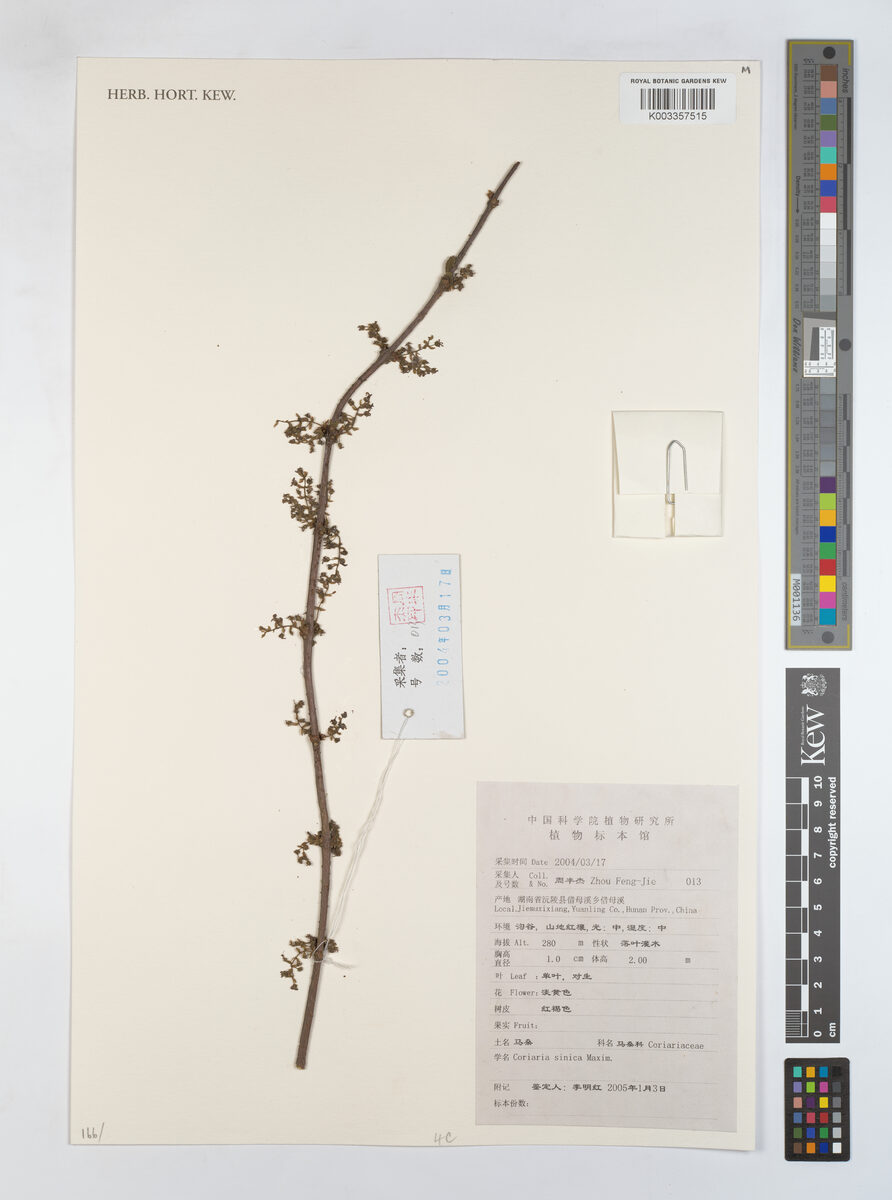
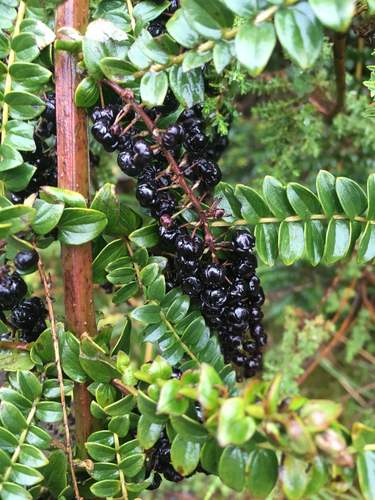
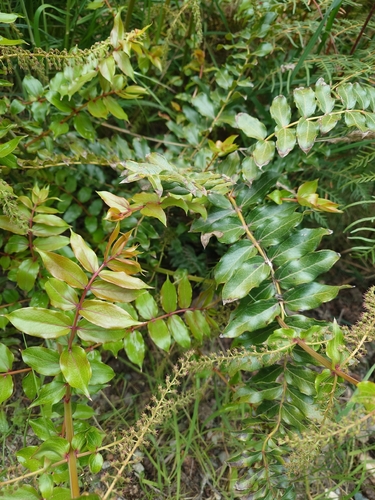
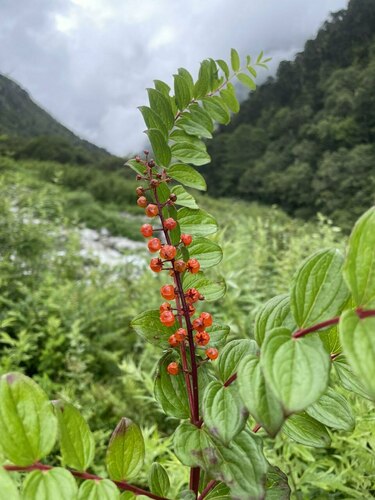
Coriaria sinica
Maxim.
wikimedia· cc0
Wikimedia Commons - Unknown authorUnknown author (illustrator not stated in source publication)
wikimedia· cc-by-sa
Wikimedia Commons - Salicyna
Summary
Source: WikipediaDeciduous shrub reaching 5 m tall, hardy to UK zone 8. Produces flowers from July to August. Hermaphrodite with nitrogen-fixing ability. Tolerates light sandy, medium loamy, and heavy clay soils with good drainage preference. Grows in mildly acid, neutral, or basic soils. Thrives in semi-shade or full sun and prefers consistently moist conditions.
Description
Deciduous shrub reaching 5 m tall, hardy to UK zone 8. Produces flowers from July to August. Hermaphrodite with nitrogen-fixing ability. Tolerates light sandy, medium loamy, and heavy clay soils with good drainage preference. Grows in mildly acid, neutral, or basic soils. Thrives in semi-shade or full sun and prefers consistently moist conditions.
Edible Uses
The fruit can be eaten raw or used as a beverage, and is said to be as pleasant as bilberries. Use with great caution, as most parts of the plant including the seed are probably very toxic, and some reports suggest the fruit should not be used at all. The roots are antirheumatic, and the plant is hallucinatory in small quantities.
Traditional Uses
CAUTION It is probably poisonous. The fruit are eaten raw or used as a drink.
This uses section is brief — help expand it
Medicinal Uses
The leaves are anodyne, antiphlogistic, febrifuge, depurative, and vermifuge, and can be used as a poultice.
Known Hazards
Most parts of the plant, including the seed, are probably very toxic. Hallucinogenic in small quantities.
Distribution
It is a temperate plant. It suits hardiness zone 8. Mt Lofty Botanical Gardens.
Where It Grows
Asia, Australia, Britain, China, Europe, Himalayas,
Cultivation
Prefers a fairly good loamy soil in a sunny sheltered position. Succeeds in light shade This species is not very hardy in Britain, tolerating temperatures down to about -5°c though it can resprout from the base if cut back by the cold. This new growth does not flower in its first year. The roots of plants in this genus bear nitrogen-fixing nodules. Whilst much of the nitrogen will be utilized by the growing plant, some of it will become available for other plants growing nearby.
Propagation
Sow seed in February or March in a greenhouse. Germination typically occurs within 1–3 months at 15°C. Once seedlings are large enough to handle, prick them out into individual pots and grow on in the greenhouse for at least their first winter. Plant out into permanent positions in late spring or early summer, after the last expected frosts. Alternatively, take half-ripe cuttings of 7cm with a heel in July or August and root in a frame. A fair percentage will take.
Other Uses
This plant is a nitrogen fixer.
Notes
There are about 30 Coriaria species.
References (4)
- Altschul, S.V.R., 1973, Drugs and Foods from Little-known Plants. Notes in Harvard University Herbaria. Harvard Univ. Press. Massachusetts. no. 2485
- Heywood, V.H., Brummitt, R.K., Culham, A., and Seberg, O. 2007, Flowering Plant Families of the World. Royal Botanical Gardens, Kew. p 110
- Mem. Acad. Imp. Sci. Saint Petersbourg, Ser. 7, 29(3):9. 1881
- Plants for a Future database, The Field, Penpol, Lostwithiel, Cornwall, PL22 0NG, UK. http://www.scs.leeds.ac.uk/pfaf/