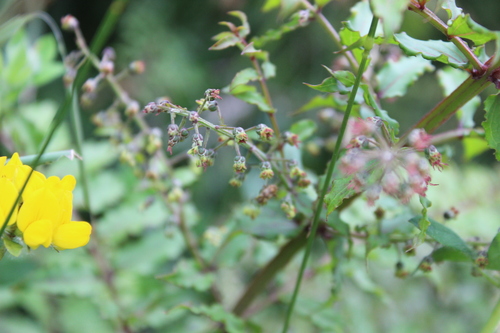
Coriaria ruscifolia
L.
Tutu, Deu, Dew
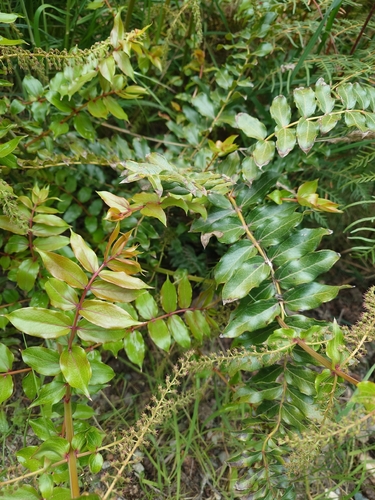
iNaturalist· cc-by-nc
(c) Susan Fawcett, some rights reserved (CC BY-NC), uploaded by Susan Fawcett
iNaturalist· cc-by-nc
(c) Bodo Nuñez Oberg, some rights reserved (CC BY-NC)
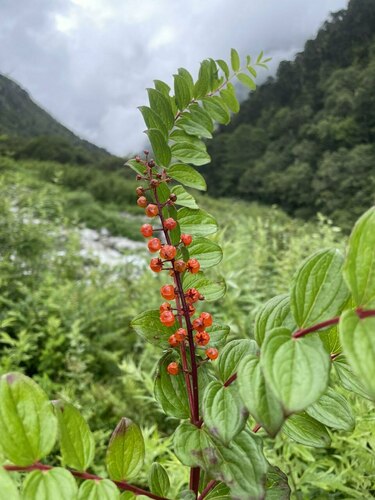
iNaturalist· cc-by-nc
(c) Greg Lasley, some rights reserved (CC BY-NC), uploaded by Greg Lasley
Summary
Source: WikipediaCoriaria ruscifolia is a plant of the Coriariaceae family. It is native to Mexico, Central America, and South America.
Description
A shrub or small tree. It grows 6 m tall and spreads 1.8-3 m wide. The leaves have a double row of leaflets. These are 8 cm long. They are usually in pairs. The flowers are on long stalks which hang over. They can be 25 cm long. The fruit is black when ripe.
Edible Uses
The fruit can be eaten raw or pressed to yield a palatable juice, which can be drunk fresh or fermented into wine. Use with great caution, as most parts of the plant — including the seed — are very toxic, and some reports advise against using the fruit at all.
Traditional Uses
CAUTION: All plant parts are poisonous except the envelope around the flower. The fruit are used to make wine.
This uses section is brief — help expand it
Medicinal Uses
None known.
Known Hazards
The fruits contain catechol derivatives and probably several sesquiterpenes. Sources state that a toxic substance coriamyrtine has been isolated from the plant. The effects are described as initially stimulating but then becoming less pleasant. Death from nervous exhaustion can result. Coriamyrtine is a sesquiterpene; other sesquiterpenes including coriatine, tutine, and pseudotutine have also been reported. Known in Chile as deu, dewü, huique, huiqui, and matarratones, it is reputed to be a toxic hallucinogen. The fruits are made into rat poison in Chile and are said to be lethal for small children. The Mapuche use a tea made from the leaves as an emetic.
Distribution
It is a temperate plant. In Argentina it grows between 500-1,600 m above sea level. It suits hardiness zones 8-10.
Where It Grows
Argentina, Australia, Central America, Chile, Colombia, Costa Rica, Ecuador, Fiji, Guatemala, Mexico, New Zealand, Panama, Peru, Samoa, Solomon Islands, South America, Vanuatu, Venezuela,
Cultivation
Prefers a fairly good loamy soil in a sunny sheltered position[11, 164, 200. Succeeds in light shade. This species is not very hardy in Britain, it tolerates temperatures down to about -5°c and succeeds outdoors from Sussex and westwards. There is some confusion over the name of this species, some botanists unite this species with the New Zealand C. sarmentosa whilst others maintain that they are distinct. The roots of plants in this genus bear nitrogen-fixing nodules. Whilst much of the nitrogen will be utilized by the growing plant, some of it will become available for other plants growing nearby.
Propagation
Sow seed in February/March in a greenhouse. Germination usually occurs within 1–3 months at 15°C. Prick seedlings into individual pots once large enough to handle and grow on in the greenhouse through at least their first winter. Plant out into permanent positions in late spring or early summer, after the last expected frosts. Cuttings of half-ripe wood, 7cm with a heel, can be taken in July/August in a frame, with a fair success rate.
Other Uses
A black ink obtained from the leaves can also be used as a dye. The bark is rich in tannin and can be used similarly.
Notes
There are about 30 Coriaria species.
Synonyms
Also Known As
Iwilan hembra, Munje, Pinanm Pinon, Shanshi
References (12)
- Cundall, P., (ed.), 2004, Gardening Australia: flora: the gardener's bible. ABC Books. p 414
- Hedrick, U.P., 1919, (Ed.), Sturtevant's edible plants of the world. p 218
- Kermath, B. M., et al, 2014, Food Plants in the Americas: A survey of the domesticated, cultivated and wild plants used for Human food in North, Central and South America and the Caribbean. On line draft. p 265
- Kew Plants of the World Online
- Kiple, K.F. & Ornelas, K.C., (eds), 2000, The Cambridge World History of Food. CUP p 1874
Show all 12 references Hide references
- Leon-Lobos, P., et al, 2022, Patterns of Traditional and Modern Uses of Wild Edible Native Plants of Chile: Challenges and Future Perspectives. Plants (Basel) v 11 (6) Table S1
- Martin, F. W., et al, 1987, Perennial Edible Fruits of the Tropics. USDA Handbook 642 p 92
- Plants for a Future database, The Field, Penpol, Lostwithiel, Cornwall, PL22 0NG, UK. http://www.scs.leeds.ac.uk/pfaf/
- Smith, N., Mori, S.A., et al, 2004, Flowering Plants of the Neotropics. Princeton. p 116
- Smith, N., Mori, S.A., et al, 2004, Flowering Plants of the Neotropics. Princeton. Plate 15 (Photo)
- Sp. pl. 2:1037. 1753
- Torre, de la, L., et al, 2008, Enciclopedia de las Plantas Útiles del Ecuador. Herbario QCA. Pontificia Universidad Católica del Ecuador. p 294