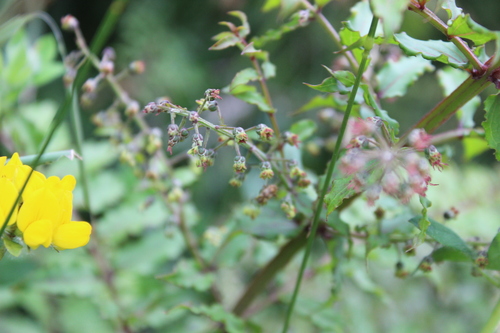
Coriaria arborea
Linds.
Tutu, Tree tutu
iNaturalist· cc-by
(c) Jon Sullivan, some rights reserved (CC BY)
iNaturalist· cc-by-nc
(c) Sahar Firoozkoohi, some rights reserved (CC BY-NC)
iNaturalist· cc-by-nc
(c) reinderw, some rights reserved (CC BY-NC)
Summary
Source: WikipediaCoriaria arborea is a highly poisonous and common native shrub or small tree of New Zealand. The common name for the plant is tree tutu, and it is one of the New Zealand species of Coriaria known by the name tutu. Coriaria arborea is found in scrub and open areas from the coast to the hills across the country. A straggling plant, it can grow to 20 feet (6.1 m) high. The leaves grow opposite on slender stems while flowers are arranged in drooping racemes. C. arborea is capable of nitrogen fixation.
Description
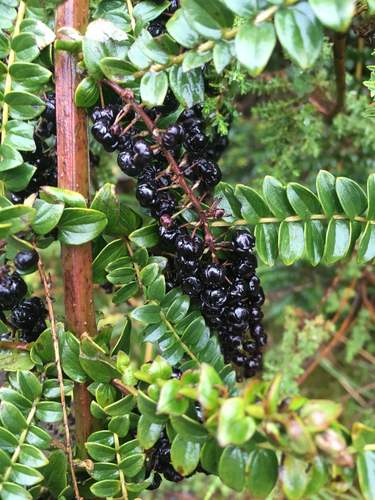
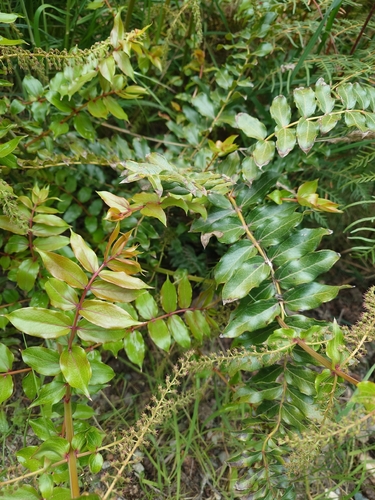
An evergreen plant. It is a large multi-trunked shrub. The leaves have leaflets along the stalk. The flowers are small and hang in racemes. The fruit are purple-black. The seeds are poisonous.
Edible Uses
The envelope around the flower can be eaten; the juice is squeezed out by wrapping it in fine cloth.
Traditional Uses
CAUTION: All plant parts are poisonous except the envelope around the flower. It contains a glucoside called "tutin". It can cause death. The juice can be squeezed out of the envelope of the flower by squeezing it in a fine cloth.
Known Hazards
The toxin tutin is found in all parts of the plant apart from the fleshy flower petals. Tutu has been responsible for the most cases of livestock poisoning by any New Zealand plant. Dogs and even two circus elephants have been poisoned by the plant. On occasion human poisoning has occurred through consuming honey where bees had interacted with the plant. In 2014, a hiker in Auckland, New Zealand looking to taste supplejack, mistakenly chewed the asparagus-looking young shoot of a tutu. He said he did not actually eat any of the plant because of the revolting taste, but within hours he had multiple tonic-clonic seizures (one of which dislocated his arm) along with labored breathing. Academic experts concluded he was lucky to survive the poisoning. A year later he had recovered fully apart from having some trouble with his memory. Honey becomes contaminated when bees collect honeydew secreted by the passionvine hopper insect that feeds off the tutu plant. People have occasionally been hospitalised or even killed by honey contaminated with tutin. 1974 was the last case of commercial honey poisoning where 13 people were poisoned. Since 1974 there have been nine other cases of honey poisoning, with the most recent occurring in 1991 in the Bay of Plenty and 2008 in the Coromandel. Periods of drought increase the risk of poisoning.
Distribution
It suits hardiness zones 8-10.
Where It Grows
New Zealand*,
Cultivation
Plants can be grown by seed, cuttings or root division.
Notes
There are about 12-16 Coriaria species, and only one Coriariaceae genus. It has invasive roots.
References (6)
- Brooker, 1986,
- Brooker, et al
- Contr. New Zealand bot. 84. 1868
- Crowe 1981,
- Etherington, K., & Imwold, D., (Eds), 2001, Botanica's Trees & Shrubs. The illustrated A-Z of over 8500 trees and shrubs. Random House, Australia. p 226
Show all 6 references Hide references
- Salmon, J.T., 1989, The Native Trees of New Zealand. Heinmann Reid p 128