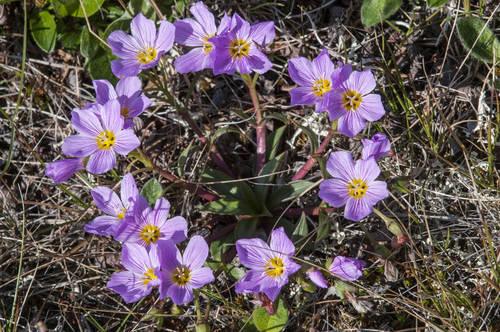
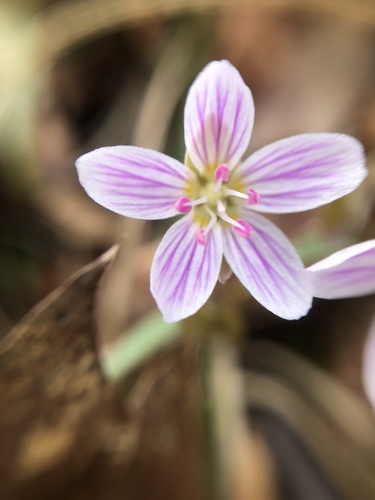
Claytonia tuberosa
Pallas ex Willdenow
Tuberous spring beauty
iNaturalist· cc-by-nc
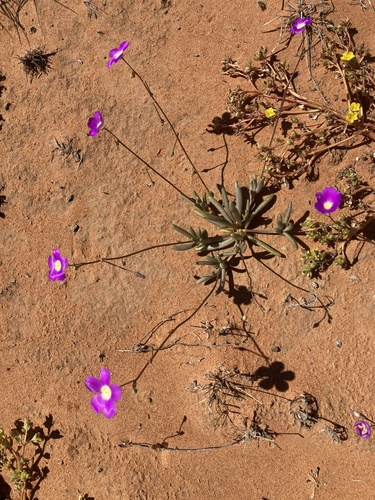
(c) Andy Fyon, some rights reserved (CC BY-NC), uploaded by Andy Fyon
iNaturalist· cc-by
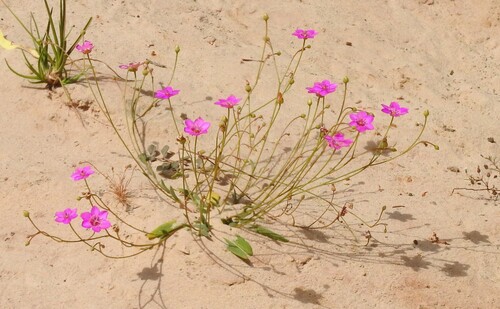
(c) Jason Grant, some rights reserved (CC BY), uploaded by Jason Grant
iNaturalist· cc-by-nc
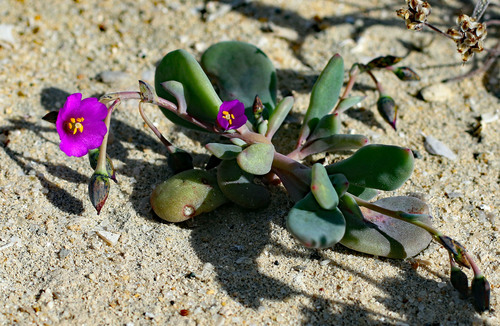
(c) Tommy Stoughton, some rights reserved (CC BY-NC), uploaded by Tommy Stoughton
Summary
Source: WikipediaClaytonia tuberosa, commonly known as Beringian springbeauty, Eskimo potato, or tuberous springbeauty, (Inupiaq: oatkuk, ulqit, utqiq, ulqiq) is a species of flowering plant in the family Montiaceae. It is a perennial herb indigenous to Alaska, British Columbia, Northwest Territories, and the Yukon of North America, westward to East Asia–Siberia. The perennial grows from a globose tuberous root to a height of 15 centimetres (6 in) and bears several hermaphrodite white flowers on stems bearing a single pair of petiolate cauline leaves. Its closest relative is probably Claytonia virginica.
Description
A herb that keeps growing from year to year. The tuberous root is 1-3 cm across. The tubers are small and deeply buried. The stems are 15-25 cm long. It is similar to Claytonia virginica. Each stem has one pair of narrow opposite leaves. There is also 1-3 thin stalked leaves near the base. The flowers are in groups of 2-7 at the top of the shoots. Each flower has 5 white petals.
Edible Uses
The root, though rather small, can be eaten raw or cooked and added to soups and stews. Leaves are a source of vitamins A and C and can be used raw or cooked as greens. Flowers are edible raw.
Traditional Uses
The tubers are eaten raw. It can be eaten alone or with seal oil. It is also added to soup. They are mostly cooked and eaten in stews. The leaves near the base are eaten raw or cooked along with other greens.
Medicinal Uses
None known
Distribution
It is a cold temperate plant. It grows in Kamchatka and eastern Siberia. In Alaska it grows in alpine regions in marshy, wet places.
Where It Grows
Alaska, Arctic, Canada, North America, Russia, Siberia, USA,
Cultivation
Prefers a damp peaty soil and a position in full sun. Requires a lime-free soil.
Propagation
Surface sow seed on a peat-based compost in spring in a cold frame. Germination usually takes place within 2–4 weeks at 10°C. When large enough to handle, prick seedlings out into individual pots and grow on in the cold frame for at least their first winter. Plant out in late spring or early summer after the last expected frosts. Offsets can also be divided in spring or autumn.
Other Uses
None known
Notes
They have also been put in the family Portulacaceae.
Also Known As
Eskimo potato, Oatkuk, Ul'kik, Ulqiq
References (10)
- Ager, T. A. & Ager, L. P., 1980, Ethnobotany of the eskimos of Nelson Island, Alaska. Arctic Anthropology Vol 17. No. 1 pp 26-48
- Ainana, L. & Zagrebin, I., 2014, Edible Plants Used by the Siberian Yupik Eskimos of Southeastern Chukotka Peninsula, Russia, (English translation). p 68
- Hedrick, U.P., 1919, (Ed.), Sturtevant's edible plants of the world. p 203
- Heller, C. A., 1962, Wild Edible and Poisonous Plants of Alaska. Univ. of Alaska Extension Service. p 55
- Jernigan, K. (Ed.), 2012, A Guide to the Ethnobotany of the Yukon-Kuskokwim Region. Draft.
Show all 10 references Hide references
- Jernigan, K. A., et al, 2017, Naukan ethnobotany in post-Soviet times: lost edibles and new medicinals. Journal of Ethnobiology and Ethnomedicine (2017) 13:61
- Kermath, B. M., et al, 2014, Food Plants in the Americas: A survey of the domesticated, cultivated and wild plants used for Human food in North, Central and South America and the Caribbean. On line draft. p 240
- Lim, T. K., 2015, Edible Medicinal and Non Medicinal Plants. Volume 9, Modified Stems, Roots, Bulbs. Springer p 24
- Plants for a Future database, The Field, Penpol, Lostwithiel, Cornwall, PL22 0NG, UK. http://www.scs.leeds.ac.uk/pfaf/
- Porsild, A.E., 1953, Edible Plants of the Arctic, Arctic 6:15-34, page 30