Cinnamomum iners
Reinw. ex Blume
Wild cinnamon tree
iNaturalist· cc-by-nc-sa
(c) Cerlin Ng, some rights reserved (CC BY-NC-SA)
iNaturalist· cc-by-nc-sa
(c) Cerlin Ng, some rights reserved (CC BY-NC-SA)
iNaturalist· cc-by-nc
(c) tansh91, some rights reserved (CC BY-NC), uploaded by tansh91
Summary
Source: WikipediaCinnamomum iners is a tree species in the family Lauraceae described by Reinwardt and Blume. No subspecies are listed in the Catalogue of Life. It occurs naturally in Myanmar, Thailand, Laos, Cambodia, Vietnam, Malaysia, Indonesia, Brunei, Singapore, the Philippines and southern China. In Malay C. iners is called pokok medang teja; in Vietnamese it may be called: quế rừng, quế giả, quế lá to, quế lợn, hậu phác, or hậu phác nam.
Description
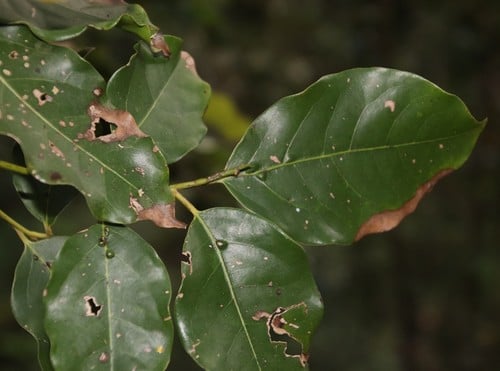
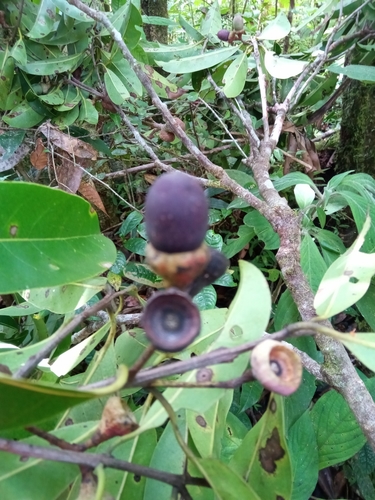
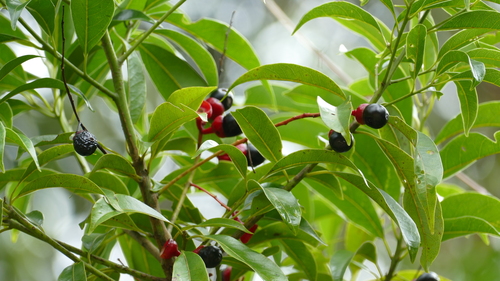
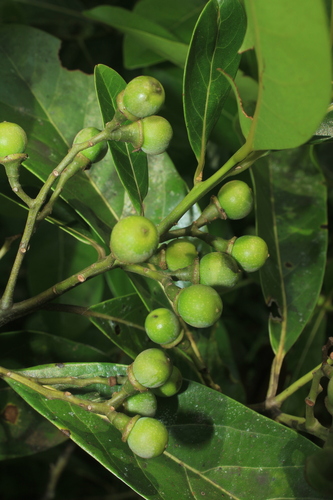
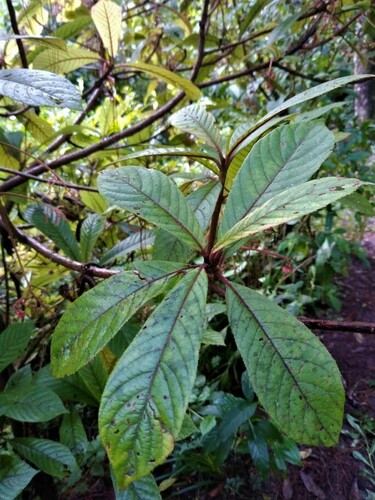
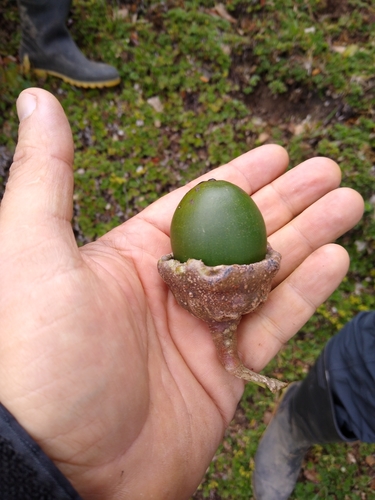
A large tree. It grows to 20 m high. The trunk can be 20 cm across. The leaves are opposite, smooth and leathery. The leaf blades are 12-35 cm long by 5.5-8.5 cm wide. New flushes of leaves follow rain and are reddish pink. They are rounded at the base and taper to the tip. The flowers are yellowish and borne in compound flower clusters. The fruit is oval. It is 10 cm long by 7 cm wide. It is greenish when fresh.
Edible Uses
The bark is used as a spice, the leaves are used as seasoning especially in curries, and an essential oil from the leaves flavors candy and sweetmeats. The fruit are eaten, particularly by children.
Traditional Uses
The bark is used as a spice. The leaves are used as seasoning especially in curries. An essential oil distilled from the leaves is used to flavour candy and sweetmeats. The fruit are recorded as eaten.
Medicinal Uses
The leaves (especially their essential oil) are carminative, deobstruent, diaphoretic, diuretic, lactagogue and stimulant. The oil distilled from the leaves is a powerful stimulant. The juice of the leaves, squeezed into the wound, is a Sakai rememdy for Antiaris poisoning. A poultice of leaves is used in the treatment of rheumatism. The roots (especially their essential oil) are carminative, deobstruent, diaphoretic, diuretic, lactagogue and stimulant. A root decoction is used after childbirth; and also in the treatment of fevers. The bark is sometimes traded and called 'mesni' in Sarawak; it is used as a medicine. The wood is used as a medicine against fever.
Distribution
It is a tropical plant. They occur in Mindanao, Tawi-tawi, Samar, Palawan and Mindanao in the Philippines. In southern China it grows between 140 and 1000 m altitude. In Yunnan.
Where It Grows
Africa, Asia, Cambodia, China, East Africa, Ethiopia, India, Indochina, Indonesia, Laos, Malaysia, Myanmar, Pacific, Philippines, SE Asia, Singapore, Sri Lanka, Thailand, Vietnam,
Cultivation
Plants can be grown by seeds.
Propagation
Seed - the seed of species in this genus generally has a short viability and is best sown as soon in containers as it is ripe. Remove the fruit pulp since this can inhibit germination. Soaking the seeds for 24 hours in lukewarm water hastens germination, which can take 1 - 6 months at 20°c. The germination rate of fresh seed is about 50%, falling to 25% for seed 6 months old, and zero for those 1 year old. Stored seed should be sown as soon as possible in containers. When they are large enough to handle, prick the seedlings out into individual pots and plant them out into their permanent positions when 10cm or more tall. The number of dry seed per kg is about 6,400. Cuttings of semi-ripe side shoots, 7cm with a heel, in a frame with bottom heat. Stumping of C. iners has been found to be rather successful: 85% of the stumps of 20 cm long and 0.5 cm in diameter developed into healthy plants.
Other Uses
The mucilage (from the bark?) has found technical applications, e.g. In the manufacture of mosquito coils, fragrant joss-sticks, plastic products, formica, glue, inner layering of tyres, coating of high-quality paper products, paints and fibre glass. An essential oil is distilled from the aromatic bark and the leaves. It is used as a flavouring and to produce incense. The essential oil from the roots yields eugenol, saffrol, benzaldehyde, and terpene. The yellowish-brown wood is moderately hard, smooth, scented and insect resistant. It is used as a medang timber for purposes such as house building, furniture making and cabinet making. The wood is used to make joss sticks. There are a number of tree species (including this one) from Peninsular Malaysia that are in the family Lauraceae and produce a useful timber that is either not distinct enough in itself, or is in insufficient supply, to warrant being traded individually. These various species have been lumped together under the trade name ‘medang’. We do not have a specific description of the wood from this species, but a general description of medang timber is as follows:- The heartwood is very variable, from light-straw to red-brown and olive brown; the sapwood is ill-defined. The texture is moderately fine but even; the grain interlocked or wavy; the surface dull. The wood is not durable. It is easy to slightly difficult to resaw, and easy to moderately easy to cross-cut; easy to plane and the surface produced is smooth to moderately smooth. It is suitable for decorative work such as interior finishing, panelling, furniture and cabinet making. It is also suitable for plywood manufacture, whilst the heavier species are suitable for medium construction under cover. The tree is planted as a pioneer species in northern Thailand in reforestation projects to restore native woodland - it is planted in degraded woodland and open areas in a mix with various other species that all have the ability to grow fast; produce dense, weed-suppressing crowns; and attract seed-dispersing wildlife, particularly birds and bats.
Production
In southern China plants flower in March and April and fruit in May and June.
Other Information
The fruit are eaten by children.
Notes
There are about 250 Cinnamomum species.
Synonyms
Also Known As
Adavi lavangapatte, Da ye gui, Jangli-darchini, Kattuk-karuvappattai, Kayu manis, Ki kacengal, Lavangam, Medang kalong, Medang kemangi, Ob choe khiat, Pohon kayumanis alam, Pohon medangteja, Que rung, Ranachadalchini, Teja badak, Teja lawang, Teja, Tikhi
References (23)
- Ambasta, S.P. (Ed.), 2000, The Useful Plants of India. CSIR India. p 125
- Barwick, M., 2004, Tropical and Subtropical Trees. A Worldwide Encyclopedic Guide. Thames and Hudson p 115
- Brown, D., 2002, The Royal Horticultural Society encyclopedia of Herbs and their uses. DK Books. p 169
- Brown, W.H., 1920, Wild Food Plants of the Philippines. Bureau of Forestry Bulletin No. 21 Manila. p 60
- Burkill, I.H., 1966, A Dictionary of the Economic Products of the Malay Peninsula. Ministry of Agriculture and Cooperatives, Kuala Lumpur, Malaysia. Vol 1 (A-H) p 558, 560 (As Cinnamomum paraneuron)
Show all 23 references Hide references
- Castillo, C., 2013, The Archaeobotany of Khao Sam Kaeo and Phu Khao Thong: The Agriculture of Late Prehistoric Southern Thailand. Ph. D. thesis University College, London p 379
- Facciola, S., 1998, Cornucopia 2: a Source Book of Edible Plants. Kampong Publications, p 138
- Hedrick, U.P., 1919, (Ed.), Sturtevant's edible plants of the world. p 193 (Also as Cinnamomum nitidum)
- Li Xi-wen, Li Jie, Huang Puhua, van der Werff, H., Lauraceae. Flora of China.
- Molla, A., Ethiopian Plant Names. http://www.ethiopic.com/aplants.htm
- Monsalud, M.R., Tongacan, A.L., Lopez, F.R., & Lagrimas, M.Q., 1966, Edible Wild Plants in Philippine Forests. Philippine Journal of Science. p 484
- Morton,
- Nurfadilah, S., et al, 2017, Species richness, conservation status, and potential uses of plants in Segara Anakan Area of Sempu Island, East Java, Indonesia. BIODIVERSITAS. Volume 18, Number 4
- Pham-Hoang Ho, 1999, An Illustrated Flora of Vietnam. Nha Xuat Ban Tre. p 352
- PROSEA handbook Volume 13 Spices. p 275
- Ramachandran,V. S., & Udhayavani, C., 2013, Knowledge and uses of wild edible plants by Paniyas and Kurumbas of Western Nilgiris, Tamil Nadu. Indian Journal of Natural Products and Resources. 4(4) December 2013, pp 412-418
- Sang, D. T., & Mizoue, K. O. N., 2012, Use of Edible Forest Plants among Indigenous Ethnic Minorities in Cat Tien Biosphere Reserve, Vietnam. Asian Journal of Biodiversity Vol. 3 (1), p 23-49
- Seidemann J., 2005, World Spice Plants. Economic Usage, Botany, Taxonomy. Springer. p 102
- Slik, F., www.asianplant.net
- Sukarya, D. G., (Ed.) 2013, 3,500 Plant Species of the Botanic Gardens of Indonesia. LIPI p 198
- Tanaka,
- Van Sam, H. et al, 2004, Trees of Laos and Vietnam: A Field Guide to 100 Economically or Ecologically Important Species. Blumea 29 (2004) 201-349
- World Checklist of Useful Plant Species 2020. Royal Botanic Gardens, Kew