Catalpa ovata
G. Don
Chinese catalpa
iNaturalist· cc-by-nc-nd
(c) Paul B., some rights reserved (CC BY-NC-ND), uploaded by Paul B.
iNaturalist· cc-by-nc
(c) András Schmotzer, some rights reserved (CC BY-NC)
Summary
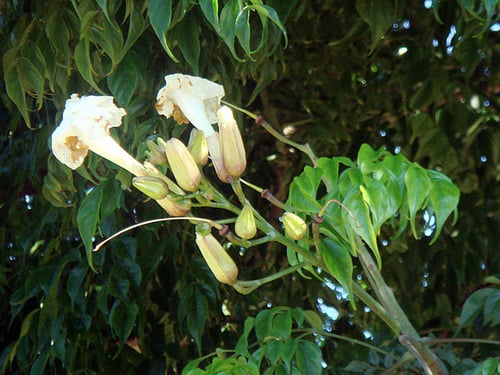
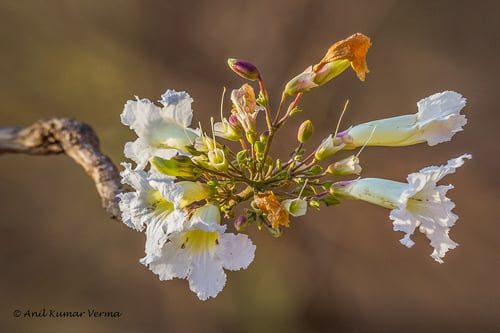
Source: WikipediaCatalpa ovata, the yellow catalpa or Chinese catalpa (Chinese: 梓; pinyin: zǐ), is a pod-bearing tree native to China. Compared to C. speciosa, it is much smaller, typically reaching heights between 20 and 30 feet (6 and 9 m). The inflorescences form 4–10-inch-long (100–250 mm) bunches of creamy white flowers with distinctly yellow tinging; individual flowers are about 1 inch (25 mm) wide. They bloom in July and August. The leaves are very similar in shape to those of Paulownia tomentosa, having three lobes (two are abruptly truncated on either edge, with a third, central, slightly acute, pointed lobe forming the leaf apex), and are darkly green. Fruits are very narrow, foot-long pods. Although native to the more temperate provinces within China (Anhui, Gansu, Hebei, Heilongjiang, Henan, Hubei, Jiangsu, Jilin, Liaoning, Nei Monggol, Ningxia, Qinghai, Shaanxi, Shandong, Shanxi, Sichuan, Xinjiang), C. ovata is also cultivated in North America and Europe, and has become a parent of Catalpa × erubescens with the American species Catalpa bignonioides. It is commonly used to make the undersides of qin.
Description
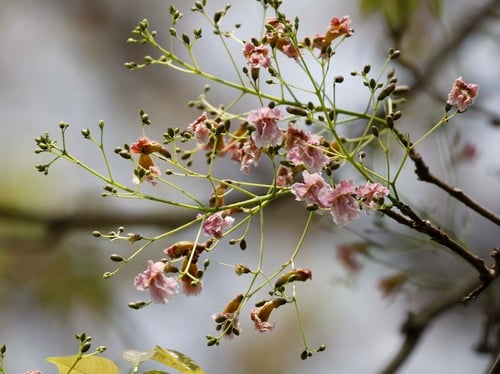
A tree. It loses its leaves during the year. It grows 9-13 m high. It has a spreading crown. The leaves are broadly oval and downy underneath. The flowers are small and dull white with yellow marks. The pods are long and slender. They grow 30 cm long.
Edible Uses
The flowers and young pods are eaten cooked — boiled and then washed, likely to remove bitterness.
Traditional Uses
The flowers and young pods are eaten. The young shoots are used as a potherb.
This uses section is brief — help expand it
Medicinal Uses
The stems are a strong diuretic.
Distribution
It is a temperate plant. It is native to central China. It grows on slopes between 1,900-2,500 m above sea level. It suits hardiness zones 5-10. In Arboretum Tasmania. In Sichuan and Yunnan.
Where It Grows
Asia, Australia, Britain, China*, Europe, India, Japan, Korea, Tasmania,
Cultivation
Prefers a good moist loamy soil and a sunny position that is not exposed. Tolerates heavy clay soils. Very resistant to atmospheric pollution. Plants are hardy to about -15°c, probably more in continental climates, they grow best in areas with hot summers. Protect plants from late frosts when they are young. Transplants easily. The flowers are very fragrant. The bruised foliage has an aromatic fragrance. The flowers are considered to be one of the best bee plants in Japan. Plants in this genus are notably resistant to honey fungus.
Propagation
Seed is best sown outdoors or in a cold frame as soon as it is ripe. Stored seed should be stratified for 3 weeks at 1°C before sowing in spring. Prick seedlings into individual pots when large enough to handle and grow on in a cold frame for at least their first winter. Plant out in late spring or early summer after the last expected frosts. Softwood cuttings, 10 cm long, can be taken in late spring to early summer before the leaves are fully developed, and rooted in a frame. Root cuttings can be taken in winter.
Other Uses
None known
Notes
There are 11 Catalpa species.
Synonyms
Also Known As
Azusa, Ki-sasage, Native-place tree, Yellow catalpa, Zishu
References (12)
- Etherington, K., & Imwold, D., (Eds), 2001, Botanica's Trees & Shrubs. The illustrated A-Z of over 8500 trees and shrubs. Random House, Australia. p 191
- Facciola, S., 1998, Cornucopia 2: a Source Book of Edible Plants. Kampong Publications, p 49
- Gen. hist. 4:230. 1837
- Heywood, V.H., Brummitt, R.K., Culham, A., and Seberg, O. 2007, Flowering Plant Families of the World. Royal Botanical Gardens, Kew. p 63
- Hibbert, M., 2002, The Aussie Plant Finder 2002, Florilegium. p 61
Show all 12 references Hide references
- Hu, Shiu-ying, 2005, Food Plants of China. The Chinese University Press. p 673
- Plants for a Future database, The Field, Penpol, Lostwithiel, Cornwall, PL22 0NG, UK. http://www.scs.leeds.ac.uk/pfaf/
- READ, (As Catalpa kaempferi)
- Recher, P, 2001, Fruit Spirit Botanical Gardens Plant Index. www.nrg.com.au/~recher/ seedlist.html p 5
- Ryan, S., 2008, Dicksonia. Rare Plants Manual. Hyland House. p 14
- Tanaka,
- Valder, P., 1999, The Garden Plants of China. Florilegium. p 270