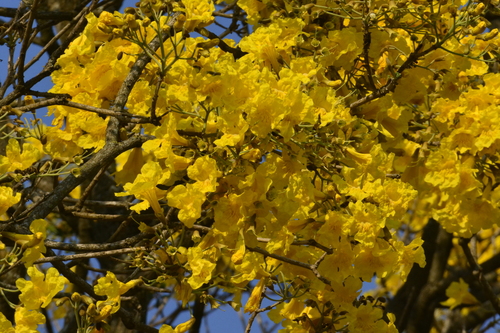
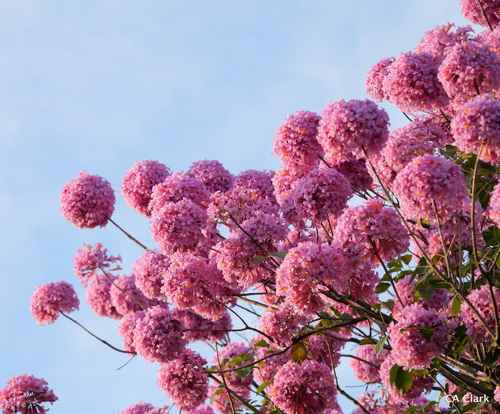
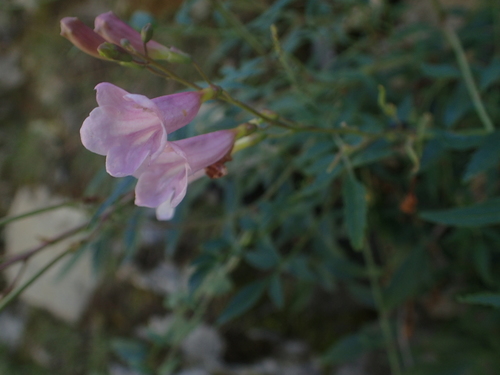
Markhamia stipulata
(Wallich) Seeman ex Schumann
Markhamia tree, Ma ye
iNaturalist· cc-by-nc-sa
(c) Tony Rodd, some rights reserved (CC BY-NC-SA)
iNaturalist· cc-by-nc
(c) christianchua, some rights reserved (CC BY-NC), uploaded by christianchua
Summary
Source: WikipediaMarkhamia stipulata (Thai: แคหัวหมู or แคป่า, khae hua mu or khae pa; Chinese: 西南猫尾木, pinyin: xī nán māo wěi mù, 'Southwest-China cat tail tree') is a species of plant in the family Bignoniaceae.
Description
A tree. It grows 5-15 m tall. Young plant parts have yellow hairs. The leaves are 30-55 cm long. There are 4-8 pairs of leaflets. These are narrowly oval and 12-23 cm long by 4-9 cm wide. They are broadly wedge shaped at the base and taper to the tip. There may be teeth along the edge. The flowering groups at the ends of branches have yellow hairs. The flowers are 10-14 cm across and yellow. The fruit is a narrow capsule 30-70 cm long by 2-3 cm wide. The seeds are 3-5 cm long. They have wings on both ends.
Edible Uses
The flower is edible and is part of both Lao cuisine and Thai cuisine, where it is known as dok khae hua mu or dok khae pa. The flowers are usually eaten sautéed or in kaeng som. The leaves are also used in traditional Thai medicine.
Traditional Uses
The flowers are boiled as a vegetable or cooked in stir-fried dishes. The young fruit are also cooked and eaten. The leaves are cooked and eaten as a vegetable.
Distribution
It is a tropical plant. It grows in sparse forests in humid places between 300-1,700 m above sea level. It grows in limestone mountains. In Yunnan.
Where It Grows
Andamans, Asia, Cambodia, China, India, Indochina, Indonesia, Laos, Myanmar, SE Asia, Thailand, Vietnam,
Cultivation
Plants can be grown by cuttings.
Other Uses
The heartwood is orange-red and beautifully mottled. The wood is close-grained, hard, heavy and resistant to insects, especially termites. It is used for construction and the manufacture of valuable furniture. The tree is planted as a pioneer species in northern Thailand in reforestation projects to restore native woodland - it is planted in degraded woodland and open areas in a mix with various other species that all have the ability to grow fast; produce dense, weed-suppressing crowns; and attract seed-dispersing wildlife, particularly birds and bats. It can also be used for the consolidation of terraces and slopes,
Production
In NE Thailand flowers and fruit are available October to December.
Other Information
The leaves are sold in local markets.
Synonyms
Also Known As
Dakpor, Dok khae, Khae hua moo, Kwe, Lao gei, Ma-hlwa, Mai-kye, Mao dei fan, Mayu-de, Pauk-kyan, Pohon markhamia, Xie xie a yi
References (11)
- Anderson, E. F., 1993, Plants and people of the Golden Triangle. Dioscorides Press. p 89, 215
- Cao, Y., et al, 2020, Ethnobotanical study on wild edible plants used by three trans-boundary ethnic groups in Jiangcheng County, Pu’er, Southwest China. Journal of Ethnobiology and Ethnomedicine (2020) 16:66 (Also as var. kerrii)
- Eiadthong, W., et al, 2010, Management of the Emerald Triangle Protected Forests Complex. Botanical Consultant Technical Report. p 50
- Fu, Yongneng, et al, 2003, Relocating Plants from Swidden Fallows to Gardens in Southwestern China. Economic Botany, 57(3): 389-402 (As Dolichandrone cauda-felina)
- Ghorbani, A., et al, 2012, A comparison of the wild food plant use knowledge of ethnic minorities in Naban River Watershed Nature Reserve, Yunnan, SW China. Journal of Ethnobiology and Ethnomedicine; 8:17
Show all 11 references Hide references
- Kachenchart, B., et al, 2008, Phenology of Edible Plants at Sakaerat Forest. In Proceedings of the FORTROP II: Tropical Forestry Change in a Changing World. Bangkok, Thailand.
- Luczaj, L., et al, 2021, Wild food plants and fungi sold in the markets of Luang Prabang, Lao PDR. Journal of Ethnobiology and Ethnomedicine (2021) 17:6
- Shin, T., et al, 2018, Traditional knowledge of wild edible plants with special emphasis on medicinal uses in Southern Shan State, Myanmar. Journal of Ethnobiology and Ethnomedicine (2018) 14:48
- Suksri, S., et al, 2005, Ethnobotany in Bung Khong Long Non-Hunting Area, Northeast Thailand. Kasetsart J., (Nat. Sci) 39: 519-533
- Sukarya, D. G., (Ed.) 2013, 3,500 Plant Species of the Botanic Gardens of Indonesia. LIPI p 387 (Also as Markhamia cauda-felina)
- Turreira Garcia, N., et al, 2017, Ethnobotanical knowledgeof the Kuy and Khmer people in Prey Lang, Cambodia. Cambodian Journal of Natural History 2017 (1): 76-101