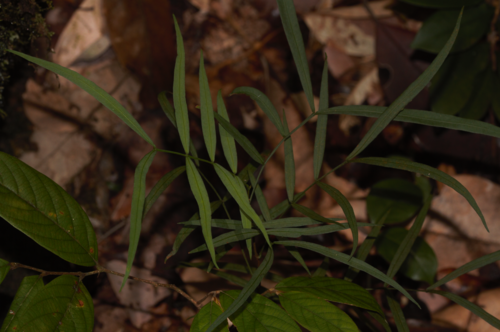
Lathyrus sylvestris
L.
Narrow-leafed everlasting pea
iNaturalist· cc-by-nc
(c) pattyw, some rights reserved (CC BY-NC)
iNaturalist· cc-by-nc
(c) jamie axall, some rights reserved (CC BY-NC)
iNaturalist· cc-by-nc
(c) jamie axall, some rights reserved (CC BY-NC)
Summary
Source: WikipediaLathyrus sylvestris, the flat pea or narrow-leaved everlasting-pea, is a species of flowering plant in the pea and bean family Fabaceae. It is native to parts of Africa, Europe, and Asia. The narrow-leaved everlasting-pea forms a mat of herbage. The stems are winged. Each leaf is made up of two elongated leaflets. The flowers are pink. The fruit is a legume pod about 2 inches (5 cm) long.
Description
A herb. It keeps growing from year to year. It can grow 2 m tall. The stems have broad wings. The leaves have a single pairs of leaflets with branched tendrils. The flowers are green to yellow with a violet tinge. They are 7-15 mm long. The pods are 7 cm long.
Edible Uses
None Known
Traditional Uses
The flowering shoots are eaten boiled and seasoned with oil and lemon. They are scrambled with eggs and fried with onions. The young seeds are used in soups. Caution: Some Lathyrus species can be poisonous.
Medicinal Uses
None Known
Known Hazards
All parts of the plant, but especially the seed, contain a toxic amino-acid. It is produced in the plant at about the same time that the seed starts to develop. In small quantities the amino acid is innocuous, and the seeds of several Lathyrus species are eaten as a nutritious part of the diet. However, in larger quantities (the seed should form less than 30% of a balanced diet), it can cause a very serious disease of the nervous system known as 'lathyrism'. Symptoms appear as a paralysis of the muscles below the knees, pains in the back, followed by weakness and stiffness of the legs and progressive locomotive incoordination.
Distribution
It is a temperate plant.
Where It Grows
Britain, Europe, Italy, Luxembourg, Mediterranean, Sicily, Slovenia,
Cultivation
Lathyrus sylvestris is a moderately cold-hardy plant, able to tolerate temperatures down to around -20?c when fully dormant. Grows well in full sun and in light, dappled shade, succeeding in most moderately fertile, well-drained soils. This species has a symbiotic relationship with certain soil bacteria, these bacteria form nodules on the roots and fix atmospheric nitrogen. Some of this nitrogen is utilized by the growing plant but some can also be used by other plants growing nearby. Suggested planting locations and garden types: Forest garden, Flower borders and beds Wall-side Borders Cottage & Informal Garden City & Courtyard Gardens. May be attacked by aphids, slugs and snails.
Propagation
Pre-soak seed for 24 hours in warm water, then sow in early spring in a cold frame. Prick seedlings out into individual pots once large enough to handle and plant out in summer.
Other Uses
The plant is used as a green manure and soil cover for preventing erosion and rehabilitating degraded land. It is also grown as an ornamental, with some named varieties available. It is a nitrogen fixer.
Synonyms
Also Known As
Cassavuoi, Fasola sarvaggia, Gozdni grahor
References (6)
- Crawford, M., 2012, How to grow Perennial Vegetables. Green Books. p 142
- Geraci, A., et al, 2018, The wild taxa utilized as vegetables in Sicily (Italy): a traditional component of the Mediterranean diet. Journal of Ethnobiology and Ethnomedicine (2018) 14:14
- http://www.botanic-gardens-ljubljana.com/en/plants
- Irving, M., 2009, The Forager Handbook, A Guide to the Edible Plants of Britain. Ebury Press p 235
- Lentini, F. and Venza, F., 2007, Wild food plants of popular use in Sicily. J Ethnobiol Ethnomedicine. 3: 15
Show all 6 references Hide references
- Pasta, S., et al, 2020, An Updated Checklist of the Sicilian Native Edible Plants: Preserving the Traditional Ecological Knowledge of Century-Old Agro-Pastoral Landscapes. Frontiers in Plant Science. Volume 11|Article 388