Parkia bicolor
A. Chev.
African locust bean
iNaturalist· cc-by-nc
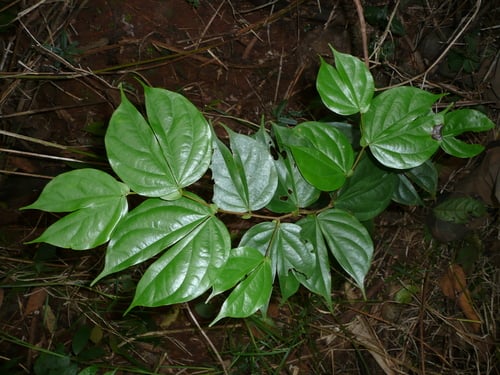
(c) Carel Jongkind, some rights reserved (CC BY-NC), uploaded by Carel Jongkind
iNaturalist· cc-by-nc
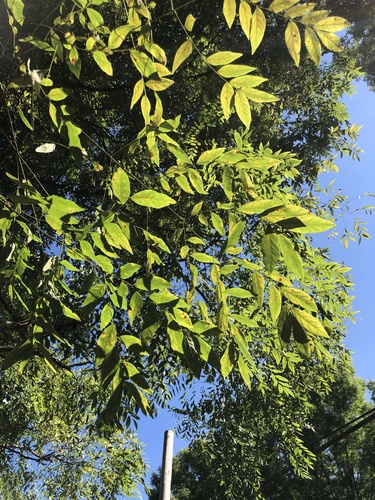
(c) wvclarke, some rights reserved (CC BY-NC)
wikimedia· cc0
Wikimedia Commons - Dorothy Amaury Talbot
Summary
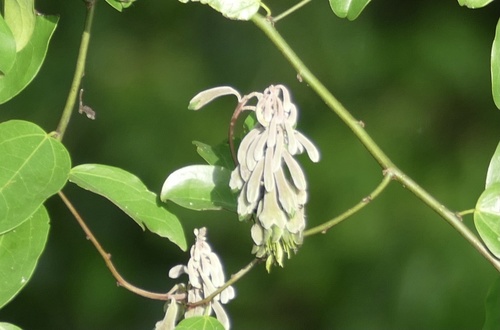
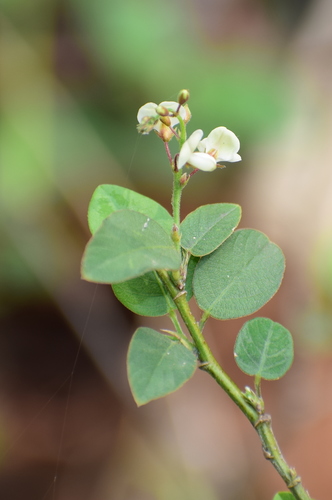
Source: WikipediaParkia bicolor, the African locust-bean, is a species of flowering plant, a tree in the family Fabaceae. It is native to tropical West and Central Africa. Its natural habitats are tropical moist lowland forests, swampland, woodland and savannah.
Description
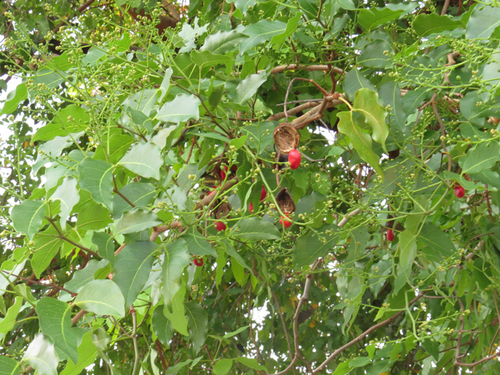
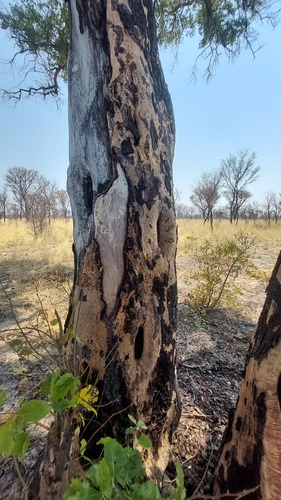
A tree. It grows 45 m high. The trunk is 90 cm across. It has buttresses. The crown is wide spreading and loses its leaves. The leaves are alternate and twice divided. There are 10-26 pairs of secondary leaflets. The fruit is a pod 15-40 cm long and 2-3 cm wide. They hang in groups at the ends of stalks. There are 20-30 seeds per pod. They are 1-1.5 cm long by 0.5-1 cm wide.
Edible Uses
The seeds are edible and widely used for thickening soups and making alcoholic drinks. Seeds are sold in local markets.
Traditional Uses
The seeds are edible and used for thickening soups. The seeds are used for making alcoholic drinks.
This uses section is brief — help expand it
Medicinal Uses
The timber of Parkia bicolor is not highly esteemed but is used to make planks, and canoes and for light construction work, joinery and turnery. Additionally, it is used to make plywood and pulpwood. The flesh of the fruit can be eaten, and the seeds can be fermented to make a condiment. The bark, leaves and roots are all used in traditional medicine and the spreading crown makes this a useful shade tree. Parkia bicolor exudes a water-soluble, proteinaceous gum. After hydrolysis, this yields 74% galactose, 9% arabinose, 9.5% glucuronic acid and 7.5% 4-0-methylglucuronic acid.
Distribution
A tropical plant. It grows in closed forest and seasonally deciduous forest in West Africa. It can grow in arid places.
Where It Grows
Africa, Angola, Benin, Cameroon, Central Africa, Central African Republic, CAR, Congo, Côte d'Ivoire, Equatorial Guinea, Gabon, Gambia, Ghana, Guinea, Guinée, Guinea-Bissau, Ivory Coast, Liberia, Niger, Nigeria, Sahel, Sierra Leone, West Africa,
Cultivation
Plants are grown by seeds. It needs a sunny position.
Propagation
Seed - it loses its viability rapidly and should be sown fresh. Removal of the seed coat improves germination. Germination occurs 4 - 10 days after sowing. The seedlings are sensitive to damping off.
Other Uses
The heartwood is pale yellow, sometimes with darker irregular streaks; it is indistinctly demarcated from the wide sapwood. The grain is variable, from straight to interlocked; texture coarse but even; fresh wood has an unpleasant odour. The wood is moderately light, soft and moderately tough; it is not durable and is liable to termite, pinhole borer and marine borer attacks. It saws moderately well and works satisfactorily with both hand and machine tool; it can be planed to a smooth and lustrous surface, but the wood is difficult to polish and varnish; the nailing and gluing properties are satisfactory. The wood yields about 57% sulphate pulp and is considered suitable for the paper industry. The wood is used for planks, carpentry and canoes. It is also suitable for light construction, interior trim, joinery, furniture, cabinet work, shipbuilding, toys, novelties, implements, turnery, boxes, crates, matches, veneer, plywood, hardboard, particle board and pulpwood. The tree with its open, widely spreading crown is used as a shade tree for crops, and it is sometimes retained when cutting the forest for agricultural land.
Other Information
Seeds are sold in local markets.
Notes
There are about 30 Parkia species. They are tropical. Also as Mimosaceae.
Synonyms
Also Known As
Asoma, Baa, Essang, Eseng, Ezieb, Kohan, Koin, Lo, Ndembe, Netto, Ugboro
References (17)
- Abbiw, D.K., 1990, Useful Plants of Ghana. West African uses of wild and cultivated plants. Intermediate Technology Publications and the Royal Botanic Gardens, Kew. p 48
- Bull. Soc. Bot. France 55(Mem. 8):34. 1908
- Burkill, H. M., 1985, The useful plants of west tropical Africa, Vol. 3. Kew.
- Busson, 1965,
- Codjia, J. T. C., et al, 2003, Diversity and local valorisation of vegetal edible products in Benin. Cahiers Agricultures 12:1-12
Show all 17 references Hide references
- Dalziel, J. M., 1937, The Useful plants of west tropical Africa. Crown Agents for the Colonies London.
- FAO, 1988, Traditional Food Plants, FAO Food and Nutrition Paper 42. FAO Rome p 389
- Hawthorne, W.& Marshall, C., 2013, Nimba Western Area Iron Ore Concentrator Mining Project Environmental and Social Impact Assessment. AcelorMittel Liberia. p 499
- Hwang, L. C., et al, 2020, Traditional Botanical Uses of Non-Timber Forest Products (NTFP) in Seven Counties in Liberia. ACS Symposium Series; American Chemical Society: Washington, DC, 2020.
- Jardin, C., 1970, List of Foods Used In Africa, FAO Nutrition Information Document Series No 2.p 27, 153
- Jusu, A. & Cuni-Sanchez, A., 2017, Priority indigenous fruit trees in the African rainforest zone: insights from Sierra Leone. Genet Resour Crop Evol (2017) 64:745–760
- Oteng-Amoako, A. A. (Ed.), 2006, 100 Tropical African Timber Trees from Ghana. Forestry Research Institute of Ghana. p 204
- Peters, C. R., O'Brien, E. M., and Drummond, R.B., 1992, Edible Wild plants of Sub-saharan Africa. Kew. p 130
- Royal Botanic Gardens, Kew (1999). Survey of Economic Plants for Arid and Semi-Arid Lands (SEPASAL) database. Published on the Internet; http://www.rbgkew.org.uk/ceb/sepasal/internet [Accessed 28th April 2011]
- Terra, G.J.A., 1973, Tropical Vegetables. Communication 54e Royal Tropical Institute, Amsterdam, p 64
- Ubom, R. M., 2010, Ethnobotany and Diversity Conservatioon in the Niger Delta, Nigeria. International Journal of Botany. 6(3): 310-322
- Vivien, J. & Faure, J.J., 1985, Abres des forets dense d'Afrique Centrale. Agence de Cooperation Culturelle et Technique. Paris. p 294