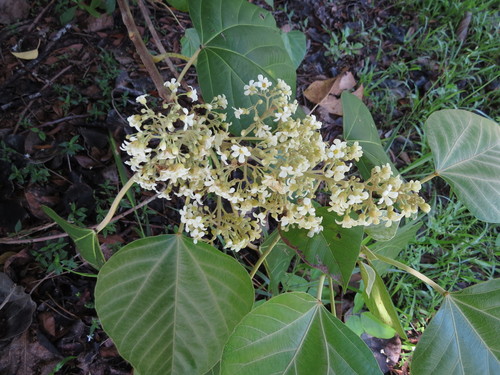
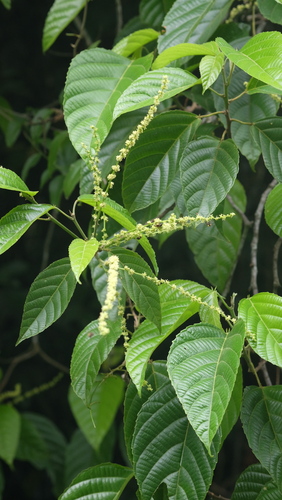
Acalypha glabrata
Thunb.
Forest false-nettle, Silky-berry
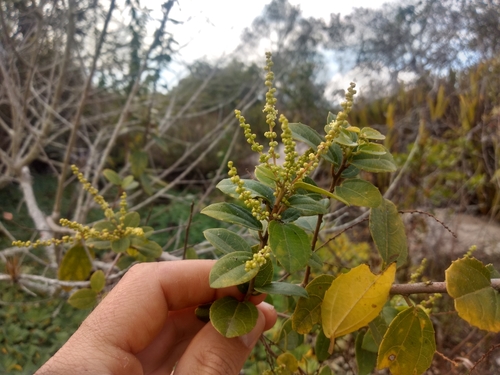
iNaturalist· cc-by-nc
(c) graham_g, some rights reserved (CC BY-NC)
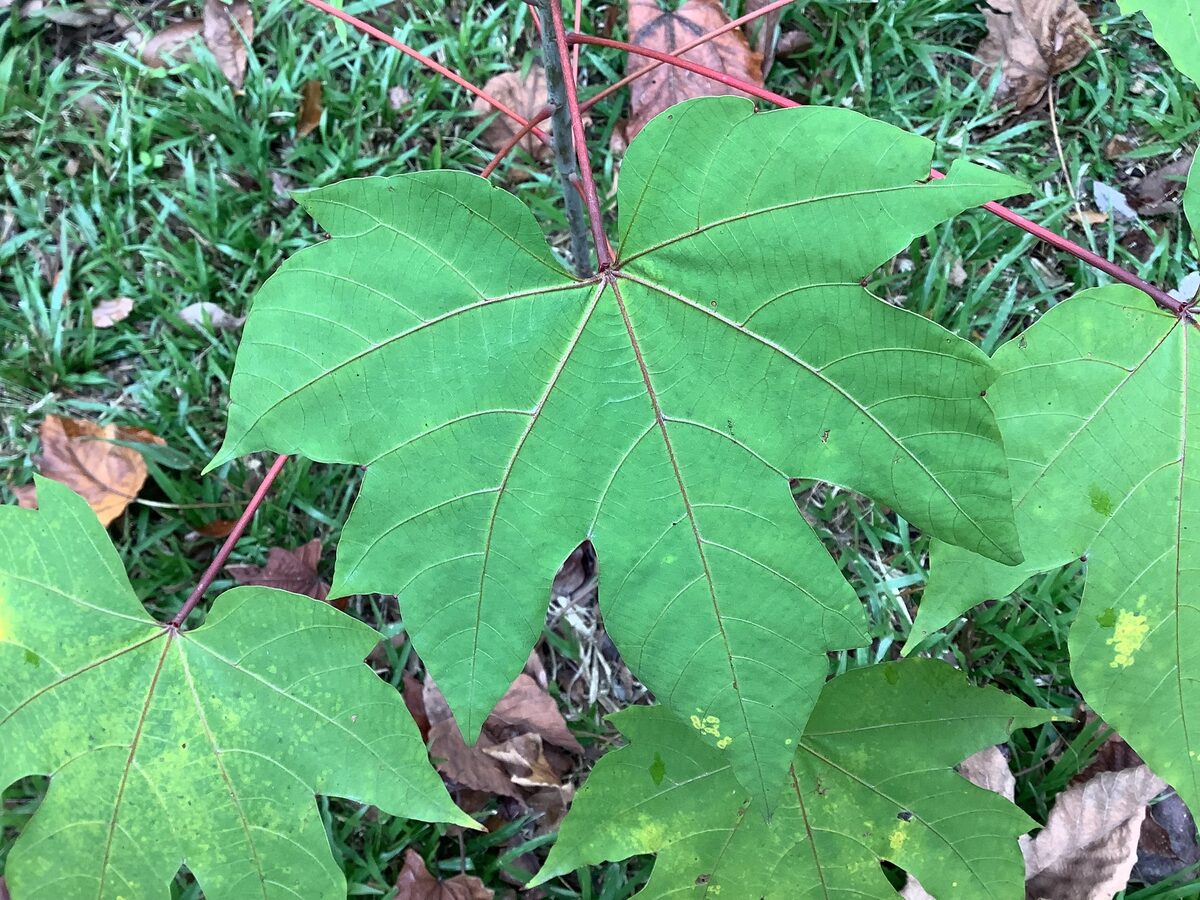
iNaturalist· cc-by-sa
(c) Margaret Burger, some rights reserved (CC BY-SA), uploaded by Margaret Burger
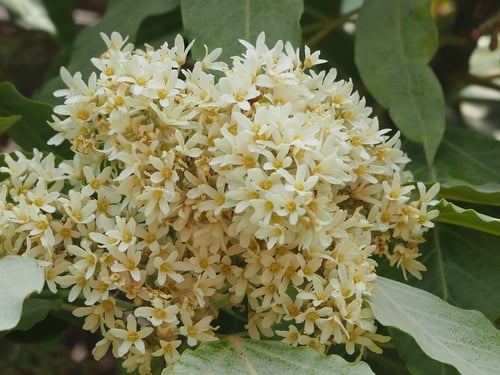
iNaturalist· cc-by-nc
(c) Reuben Heydenrych, some rights reserved (CC BY-NC), uploaded by Reuben Heydenrych
Description
A shrub or small tree. It grows 5 m tall. There are prickles along the stem. The leaves are twice divided and there are 8-18 pairs of pinnae. There are up to 50 pairs of pinnules on each pinnae. The flowers are yellow. They are in large clusters at the ends of branches. The pods are flattened.
Edible Uses
A. hispida, the chenille plant or red-hot cat's tail, is cultivated as a houseplant for its interesting flowers. It earned the Royal Horticultural Society's Award of Garden Merit, as has A. hispaniolae, the Hispaniola cat's tail. Others are grown for their foliage and a number of cultivars have been developed, such as A. wilkesiana 'Obovata Cristata' and A. wilkesiana 'Hoffmannii'. A. bipartita is eaten as a vegetable in some parts of Africa, and it is used in basketry and as animal fodder.
Traditional Uses
The young leaves are cooked and eaten as a vegetable.
This uses section is brief — help expand it
Distribution
It is a subtropical plant. It occurs in savannah woodland and stream banks. It grows in hot arid places. It grows between 5-1,400 m above sea level.
Where It Grows
Africa, Botswana, East Africa, Eswatini, Mozambique, South Africa, Southern Africa, Swaziland, Zimbabwe,
Other Uses
The long, tough and flexible branches are used to make traditional baskets. The wood is used for house building and more widely for fence posts and stakes.
Notes
There are over 450 Acalypha species. They are tropical. There are 225 in tropical America.
Synonyms
Also Known As
Isithombothi, Uthobothi tree
References (11)
- Fox, F. W. & Young, M. E. N., 1982, Food from the Veld. Delta Books. p 195
- Long, C., 2005, Swaziland's Flora - siSwati names and Uses http://www.sntc.org.sz/flora/
- Palgrave, K.C., 1996, Trees of Southern Africa. Struik Publishers. p 429
- Palmer, E and Pitman, N., 1972, Trees of Southern Africa. Vol. 2. A.A. Balkema, Cape Town p 1145
- Peters, C. R., O'Brien, E. M., and Drummond, R.B., 1992, Edible Wild plants of Sub-saharan Africa. Kew. p 107
Show all 11 references Hide references
- Plowes, N. J. & Taylor, F. W., 1997, The Processing of Indigenous Fruits and other Wildfoods of Southern Africa. in Smartt, L. & Haq. (Eds) Domestication, Production and Utilization of New Crops. ICUC p 184
- Royal Botanic Gardens, Kew (1999). Survey of Economic Plants for Arid and Semi-Arid Lands (SEPASAL) database. Published on the Internet; http://www.rbgkew.org.uk/ceb/sepasal/internet [Accessed 16th April 2011]
- Ruiters-Welcome, A. K., 2019, Food plants of southern Africa. Ph.D. thesis. Univ. of Johannesburg p 53
- Swaziland's Flora Database http://www.sntc.org.sz/flora
- Welcome, A. K. & Van Wyk, B.-E., 2019, An inventory and analysis of the food plants of southern Africa. South African Journal of Botany 122 (2019) 136–179
- World Checklist of Useful Plant Species 2020. Royal Botanic Gardens, Kew