Searsia pendulina
(Jacq. ex Willd.)
White karee
iNaturalist· cc-by-sa
(c) Tony Rebelo, some rights reserved (CC BY-SA), uploaded by Tony Rebelo
iNaturalist· cc-by-nc
(c) Susan Gie, some rights reserved (CC BY-NC), uploaded by Susan Gie
iNaturalist· cc-by-sa
(c) Tony Rebelo, some rights reserved (CC BY-SA), uploaded by Tony Rebelo
Summary
Source: WikipediaSearsia pendulina, commonly known as the white karee (English) or witkaree (Afrikaans), is a hardy, very fast growing, semi-deciduous tree. It is native to Namibia and to the Free State and Cape Provinces of South Africa. It occurs naturally along the Orange River and some of its tributaries.
Description
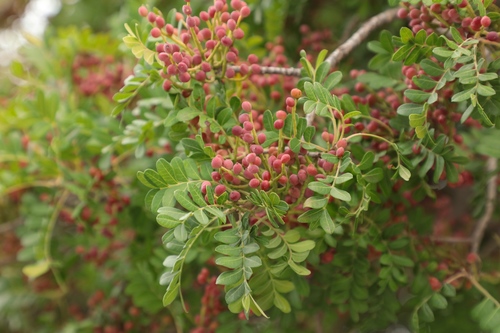
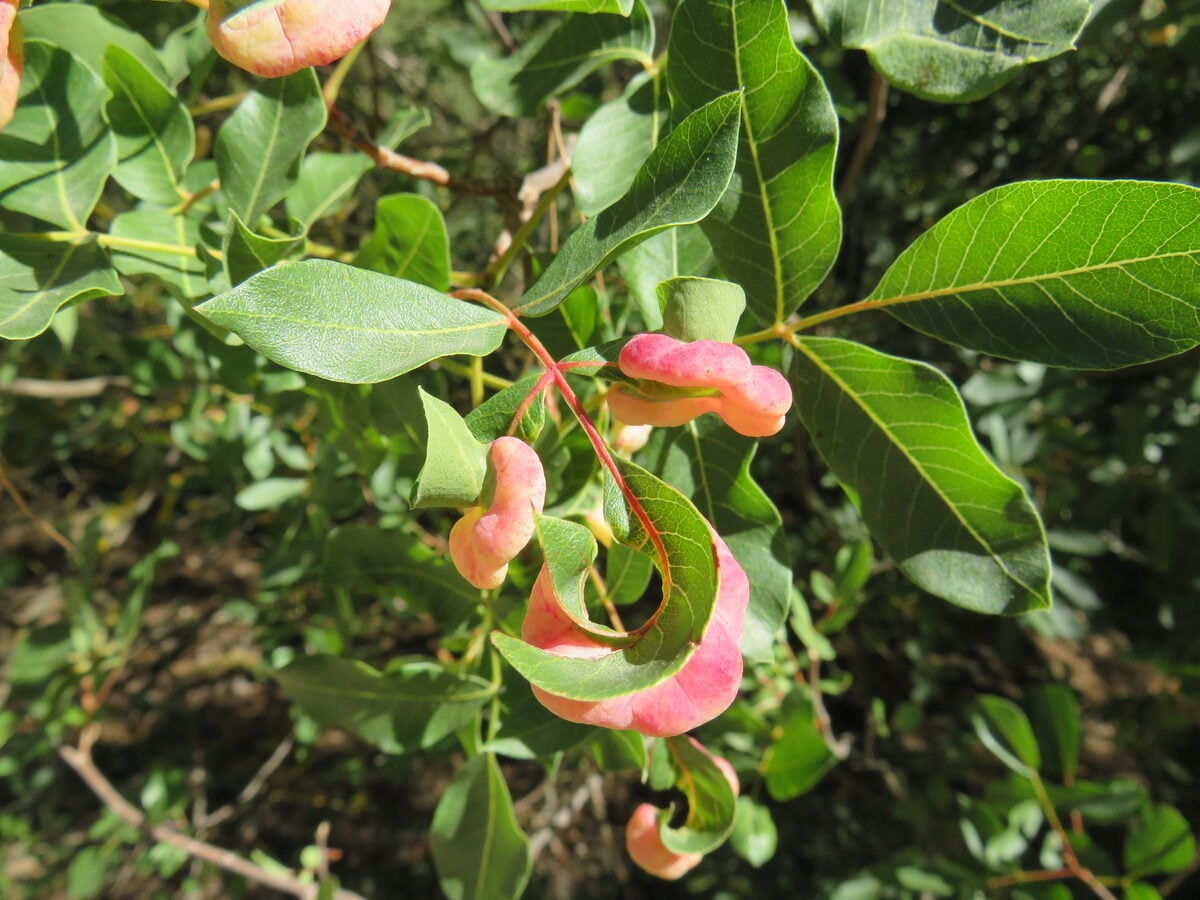
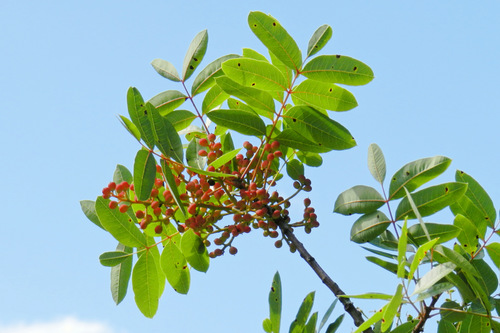
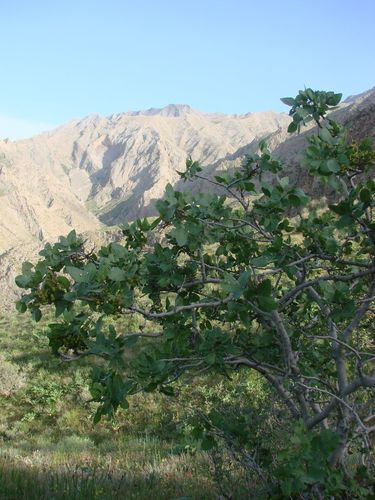
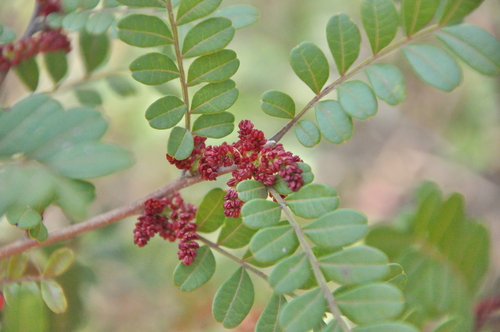
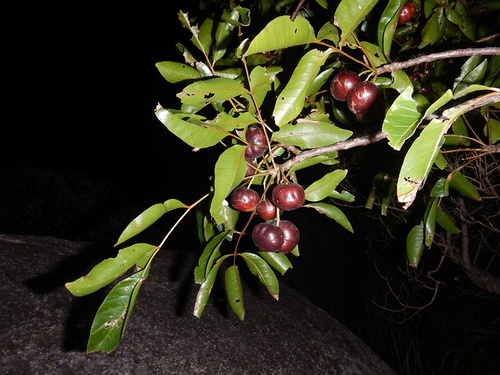
An evergreen shrub or small tree. It grows 4-10 m high. It has a single stem but can have several stems. It can form thickets. It often loses many leaves during the year. The crown is round with drooping branches. The bark is grey-brown. The side shoots on young stems often have spines. The leaves are alternate. The leaves have 3 leaflets. The leaflets do not have stalks. The leaves are dull green above. The leaf stalks are 4 cm long. The end leaflet is sword shaped. It is 3-9 cm long by 0.6-1.5 cm wide. It tapers to the tip. The flowers are in panicles. They are small and greenish-yellow. Male and female flowers are on separate plants. They are in branched groups in the axils of leaves or near the ends of branches. These are 9 cm long and are furry. The fruit is fleshy with a stone inside. It is round and red but dries black. They are 3 mm across.
Edible Uses
It is widely used in South Africa as a pavement and garden tree, as it propagates easily, grows fast and flourishes in full sun. It is not invasive and makes an excellent shade tree. As with most trees they should not be planted very near to paving, swimming pools, pipes or walls, as their fast growth may quickly affect these. They however have a non-aggressive root system. Medium semi-deciduous tree - strong and fast growth - usually with more than one trunk. It displays a soft green colour with very fine leaves. Not suited to plant close to buildings, nor to park underneath, due to a very fine powder which can cause staining. Excellent as a tree to lure birds and insects, as well as providing beautiful shade. Wind and weather resistant, can deal with too much water as well as droughts.
Traditional Uses
The fruit are eaten. They are tasty when dried. They are also soaked overnight in milk or are mixed with the gum of Acacia karoo to make a sticky sweet. The fruit are mixed with the gum or Acacia karoo to make a sticky sweet. They are also used for beer.
Distribution
It is a subtropical plant. It grows in places with a marked dry season. It is often on soils that are regularly waterlogged. It can tolerate frost. In southern Africa it grows from 360-900 m above sea level. It can grow in arid places. It grows in semi-desert areas mainly along river banks. It is reasonably drought resistant.
Where It Grows
Africa, Namibia, South Africa, Southern Africa,
Cultivation
Plants can be grown from seeds or cuttings. Fresh seeds germinate easily. Seeds germinate in 8-14 days. Seedlings can be transplanted at the 2 leaf stage. It can be cut back and re-grows. It can be grown from cuttings. Cuttings 10-20 cm long are suitable.
Production
Plants grow quickly. It grows 1 m in a year.
Synonyms
Also Known As
Rivierkaree, Witkaree
References (12)
- Enum. pl. 1:324. 1809 (As Rhus pendulina)
- Joffe, P., 2007, Creative Gardening with Indigenous Plants. A South African Guide. Briza. p 117 (As Rhus pendulina)
- Mannheimer, C. A. & Curtis. B.A. (eds), 2009, Le Roux and Muller's Field Guide to the Trees and Shrubs of Namibia. Windhoek: Macmillan Education Namibia. p 282
- Moffett, R. O., 2007, Name changes in the Old World Rhus and recognition of Searsia (Anacardiaceae). Bothalia 37,2: 165-175 (2007)
- Royal Botanic Gardens, Kew (1999). Survey of Economic Plants for Arid and Semi-Arid Lands (SEPASAL) database. Published on the Internet; http://www.rbgkew.org.uk/ceb/sepasal/internet [Accessed 28th March 2011]
Show all 12 references Hide references
- Ruiters-Welcome, A. K., 2019, Food plants of southern Africa. Ph.D. thesis. Univ. of Johannesburg p 16
- van Wyk, Be., & Gericke, N., 2007, People's plants. A Guide to Useful Plants of Southern Africa. Briza. p 56, 110 (As Rhus pendulina)
- van Wyk, B, van Wyk, P, and van Wyk B., 2000, Photographic guide to Trees of Southern Africa. Briza. p 10, 270 (As Rhus pendulina)
- Venter, F & J., 2009, Making the most of Indigenous Trees. Briza. p 256 (As Rhus pendulina)
- Wehmeyer, A. S, 1986, Edible Wild Plants of Southern Africa. Data on the Nutrient Contents of over 300 species.
- Welcome, A. K. & Van Wyk, B.-E., 2019, An inventory and analysis of the food plants of southern Africa. South African Journal of Botany 122 (2019) 136–179
- World Checklist of Useful Plant Species 2020. Royal Botanic Gardens, Kew