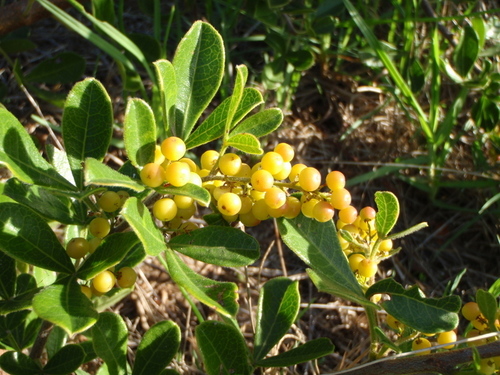
Pleiogynium timoriense
(DC.) Leenh.
Burdekin plum, Tulip plum
iNaturalist· cc-by-nc
(c) Aaron Bean, some rights reserved (CC BY-NC), uploaded by Aaron Bean
iNaturalist· cc-by-nc-sa
(c) Muggle Huggatree, some rights reserved (CC BY-NC-SA), uploaded by Muggle Huggatree
iNaturalist· cc-by-nc-sa
(c) Graeme Cocks, some rights reserved (CC BY-NC-SA), uploaded by Graeme Cocks
Summary
Source: WikipediaPleiogynium timoriense, commonly known as the Burdekin plum, sweet plum, tulip plum, or in the Djabugay language guybalum, is a medium-sized fruit-bearing tree in the cashew and mango family Anacardiaceae native to Malesia, Australia and the Pacific Islands.
Description
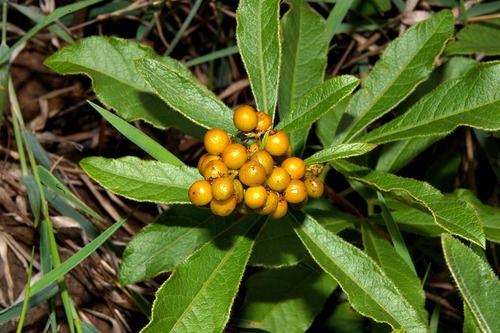
A medium sized deciduous tree. It can grow to 20-45 m high. It spreads 8-15 m wide. It can have buttresses. The bark is hard, grey-brown and cracked. Young growth is usually hairy. The leaves are compound. They are 10-18 cm long. The leaflets are on opposite sides of the stalk. New growth is red-brown. There are 5-11 leaflets and they are 4-10 cm long by 2-6 cm wide. The male flowers are in groups 15 cm long. The female flowers are in groups 5 cm long. The flowers are 0.8 cm across. They are white. The fruit are small and purple. They are 3-4 cm across. They have a thin acid pulp and a large irregular seed. The fruit occur singly or in bunches in the axils of leaves. They contain 5-12 seeds in a woody shell. The flesh is edible. The flesh can be white or purple.
Edible Uses
The fruit is edible but tart, although the pale greenish varieties have been found to be more palatable. Indigenous Australians are known to have buried the fruit underground to ripen. Fruit can be cooked, eaten raw or used in jellies, jams and preserves. Joseph Banks, on his voyage to Australia with Captain James Cook, collected some of the fruits when they stopped in the Endeavour River, and he made the note: "These when gathered off from the tree were very hard and disagreeable but after being kept for a few days became soft and tasted much like indifferent Damsons". The timber is decorative but seldom used due to the lack of supply of good logs.
Traditional Uses
The ripe fruit are edible. The flesh of the fruit is used to make jam. The seeds are edible.
This uses section is brief — help expand it
Distribution
A tropical plant. It is native to Malesia and Australia. It grows in open forest and coastal scrub. It suits tropical, subtropical and warm temperate regions. It needs well drained soil and a sunny position. It can tolerate light frost. It can tolerate slightly salty conditions. In Wittunga Botanical Gardens Adelaide.
Where It Grows
Africa, Asia, Australia*, Cook Is., East Timor, Fiji, India, Indonesia, Malaysia, New Caledonia, North America, Pacific, Papua New Guinea, PNG, Philippines, Rotuma, SE Asia, Solomon Islands, Timor-Leste, Tonga, USA,
Cultivation
Plants are grown from fresh seed. The seeds germinate erratically. It is best to scratch the hard seed coat then soak them in warm water for 24 hours. They can also be grown by cuttings and layering.
Other Uses
A good quality wood, it is used for turnery and cabinet joinery.
Production
Seedling trees take 7 years to produce fruit. Trees can produce large crops. Fruit are usually gathered after they have fallen from the tree. The fruit need to be softened in paper bags in the dark, or by burying for several days.
Notes
There are 1 or 2 Pleiogynium species.
Synonyms
Also Known As
Injo wato, Lumba, Pohon injo, Pohon lumba, Pohon wato, Woigiek
References (45)
- Ambasta, S.P. (Ed.), 2000, The Useful Plants of India. CSIR India. p 469
- Anon., 2003, Native Plants for the Fitzroy basin. Society for Growing Australian Plants Inc. (Rockhampton Branch) p 72
- Barwick, M., 2004, Tropical and Subtropical Trees. A Worldwide Encyclopedic Guide. Thames and Hudson p 330
- Beasley, J., 2011, Plants of Tropical North Queensland - the compact guide. Footloose publications. p 59
- Blumea 7:159. 1952
Show all 45 references Hide references
- Bodkin, F., 1991, Encyclopedia Botanica. Cornstalk publishing, p 812
- Bonney, N., 2012, Edible Wild Native Plants for Southern Australia. p 110
- Calvert, G., 2010, The Burdekin Delta Tree Guide. Lower Burdekin Landcare Association., Inc., Ayr p 143
- Cherikoff V. & Isaacs, J., The Bush Food Handbook. How to gather, grow, process and cook Australian Wild Foods. Ti Tree Press, Australia p 33, 201
- Cooper W & Cooper W T, 1994, Fruits of the Rain Forest. RD Press p 226
- Cooper, W. and Cooper, W., 2004, Fruits of the Australian Tropical Rainforest. Nokomis Editions, Victoria, Australia. p 17
- Cowie, I, 2006, A Survey of Flora and vegetation of the proposed Jaco-Tutuala-Lore National Park. Timor-Lests (East Timor) www.territorystories.nt/gov.au p 42
- Cribb, A.B. & J.W., 1976, Wild Food in Australia, Fontana. p 51
- Doran, J.C., & Turnbull, J.W. (Eds), 1997, Australian Trees and Shrubs: species for land rehabilitation and farm plantings in the tropics. ACIAR Monograph No 24. p 357
- Elliot, W.R., & Jones, D.L., 1997, Encyclopedia of Australian Plants suitable for cultivation. Vol 7. Lothian. p 382 (Photo)
- Facciola, S., 1998, Cornucopia 2: a Source Book of Edible Plants. Kampong Publications, p 10 (As Pleiogynium solandri)
- Franklin, J., Keppel, G., & Whistler, W., 2008, The vegetation and flora of Lakeba, Nayau and Aiwa Islands, Central Lau Group, Fiji. Micronesica 40(1/2): 169–225, 2008
- Hardwick, G., 2001, Economically Useful Plants for Northern Australia: Master Species List. Crusader eBooks.
- Hibbert, M., 2002, The Aussie Plant Finder 2002, Florilegium. p 236
- Hiddins, L., 1999, Explore Wild Australia with the Bush Tucker Man. Penguin Books/ABC Books. p 130
- Isaacs, J., 1987, Bush Food, Aboriginal Food and Herbal Medicine. Weldons. p 69
- Jackes, B.R., 2001, Plants of the Tropics. Rainforest to Heath. An Identification Guide. James Cook University. p 39
- Jones D, L, 1986, Ornamental Rainforest Plants in Australia, Reed Books, p 238, 340
- Kiple, K.F. & Ornelas, K.C., (eds), 2000, The Cambridge World History of Food. CUP p 1740
- Lord, E.E., & Willis, J.H., 1999, Shrubs and Trees for Australian gardens. Lothian. p 20
- Low, T., 1991, Wild Food Plants of Australia. Australian Nature FieldGuide, Angus & Robertson. p 89
- Low, T., 1992, Bush Tucker. Australia’s Wild Food Harvest. Angus & Robertson. p 61
- Lyle, S., 2006, Discovering fruit and nuts. Land Links. p 331
- Martin, F. W., et al, 1987, Perennial Edible Fruits of the Tropics. USDA Handbook 642 p 14 (As Pleiogonium solandri)
- Melzer, R., & Plumb, J., 2011, Plants of Capricornia. Belgamba, Rockhampton. p 66
- Menninger, E.A., 1977, Edible Nuts of the World. Horticultural Books. Florida p 53
- Nicholson, N & H., 1996, Australian Rainforest Plants 2, Terania Rainforest Publishing. NSW. p 50
- Pearson, S. & A., 1992, Rainforest Plants of Eastern Australia. Kangaroo Press p 168
- Queensland Forest Service, 1991, Trees and Shrubs. Department of Primary Industries. p 112
- Recher, P, 2001, Fruit Spirit Botanical Gardens Plant Index. www.nrg.com.au/~recher/ seedlist.html p 3
- Smith, K & I., 199, Grow your own bushfoods. New Holland. Australia. p 27
- Sukarya, D. G., (Ed.) 2013, 3,500 Plant Species of the Botanic Gardens of Indonesia. LIPI p 459
- Thaman, R.R., 1976, The Tongan Agricultural System, University of the South Pacific, Suva, Fiji. p 418 (As Pleiogynium solandri)
- Townsend, K., 1994, Across the Top. Gardening with Australian Plants in the tropics. Society for Growing Australian Plants, Townsville Branch Inc. p 318
- Townsend, K., 1999, Field Guide to Plants of the Dry Tropics. Society for Growing Australian Plants, Townsville Branch Inc. p 79
- Walter, A. & Sam C., 2002, Fruits of Oceania. ACIAR Monograph No. 85. Canberra. p 281
- Wickens, G.E., 1995, Edible Nuts. FAO Non-wood forest products. FAO, Rome. p 107
- Williams, J.B., Harden, G.J., and McDonald, W.J.F., 1984, Trees and shrubs in rainforests of New South Wales and Southern Queensland. Univ. of New England, Armidale. p 36
- World Checklist of Useful Plant Species 2020. Royal Botanic Gardens, Kew
- Yuncker, T.G., 1959, Plants of Tonga, Bernice P. Bishop Museum, Hawaii, Bulletin 220. p 171 (As Pleiogynium solandri)