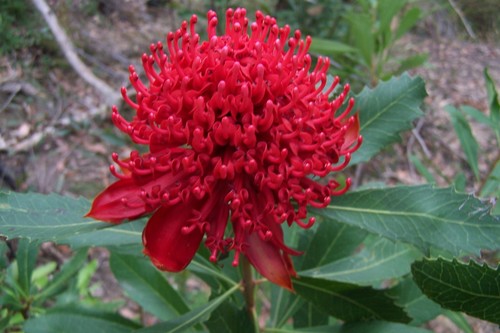
Heliciopsis terminalis
(Kurz) Sleumer
False protea, Field rat walnut
iNaturalist· cc-by-nc
(c) Phuentsho, some rights reserved (CC BY-NC), uploaded by Phuentsho
Description
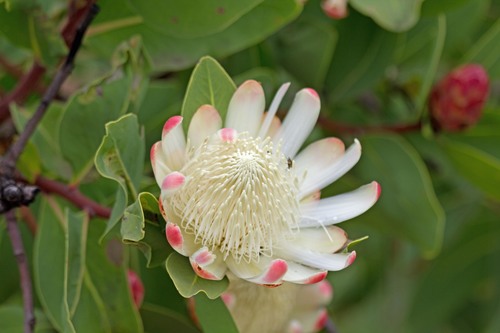
A tree. It grows 4-8 m high. The trunk is 1.5 m across. The leaves are sword shaped and 13-34 cm long by 4-9 cm wide. The leaves are smooth and do not have teeth. The flowers are white. Male and female flowers are on separate trees. The fruit are almost round and 3-4 cm long by 2.5 cm wide. They have a rough woody covering and a soft centre. There is only one seed.
Edible Uses
The fruit are eaten raw and the seeds are eaten as nuts.
Traditional Uses
The fruit are eaten raw. The seeds are eaten as nuts.
This uses section is brief — help expand it
Distribution
It grows between 900-1500 m altitude in Yunnan in China. It grows in subtropical broad-leaved evergreen forest.
Where It Grows
Asia, Bhutan, Cambodia, China, Himalayas, India, Indochina, Laos, Myanmar, SE Asia, Thailand, Vietnam,
Notes
There are 10 Heliciopsis species. They are in SE Asia and the Himalayas.
Synonyms
Also Known As
Bicheixikaza, Maiguen
References (3)
- Flora of China @ efloras.org Volume 5
- Hu, Shiu-ying, 2005, Food Plants of China. The Chinese University Press. p 366
- Jin, Chen et al, 1999, Ethnobotanical studies on Wild Edible Fruits in Southern Yunnan: Folk Names: Nutritional Value and Uses. Economic Botany 53(1) pp 2-14