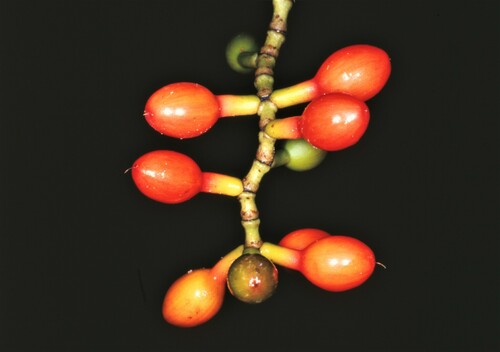
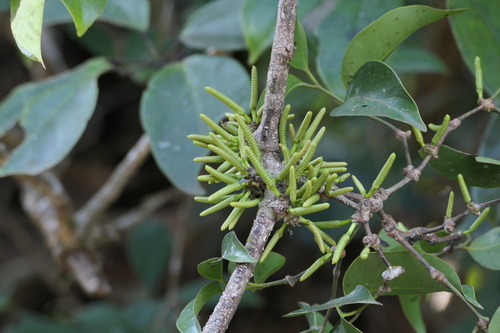
Gnetum gnemon var. tenerum
L., Margraf
Phak miang, Phak kariang, Liang
gbif· cc-by-nc
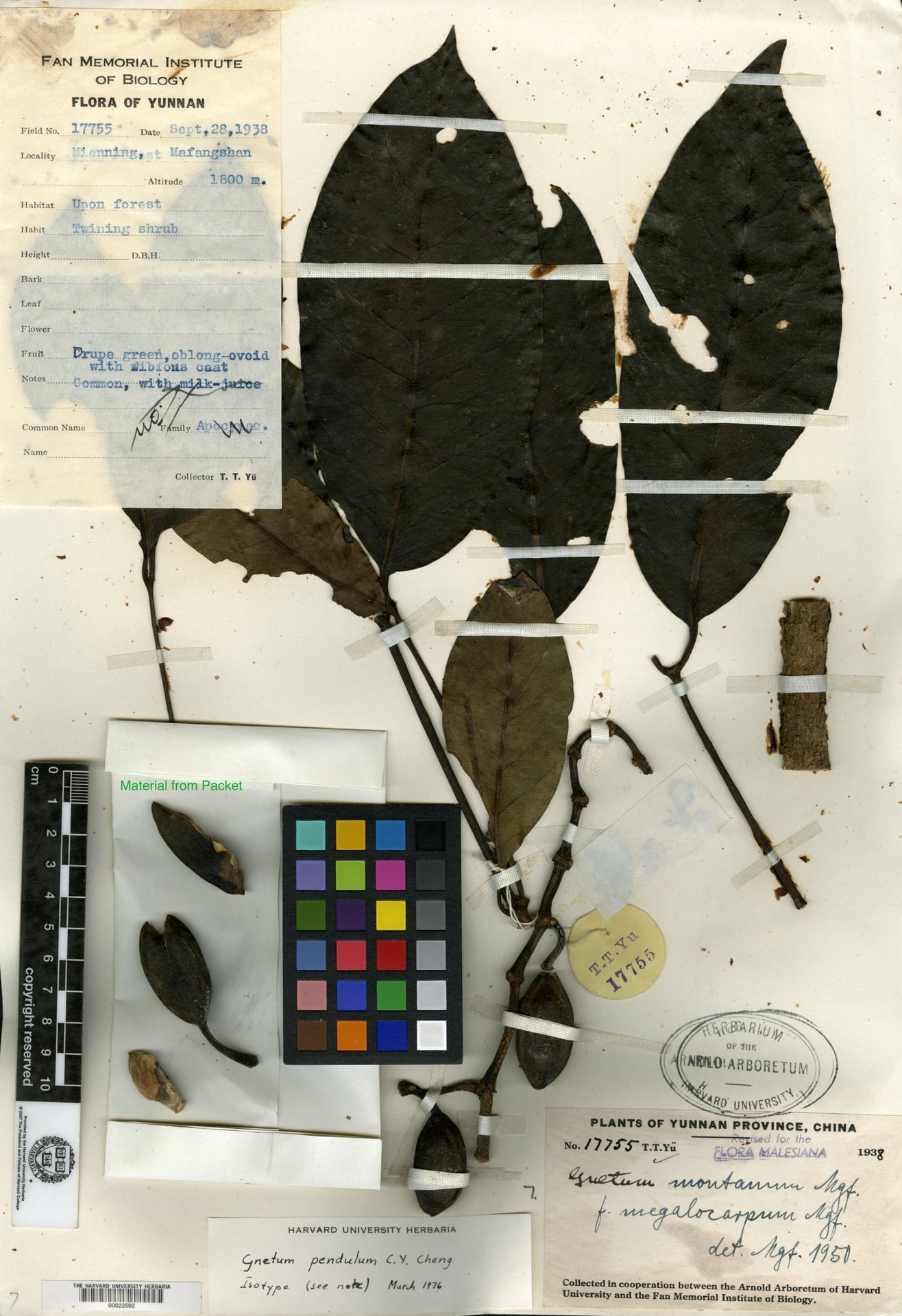
President and Fellows of Harvard College
gbif· cc-by-nc
President and Fellows of Harvard College
gbif· cc-by-nc
President and Fellows of Harvard College
Summary
Source: WikipediaGnetum gnemon is a gymnosperm species of Gnetum. Its native area spans from Mizoram and Assam in India down south through Malay Peninsula, Malay Archipelago and the Philippines in southeast Asia to the western Pacific islands. Common names include gnetum, joint fir, two leaf, melinjo/belinjo (Indonesian), bago/lumbay (Filipino), hanthu (Karbi) and tulip (Tok Pisin).
Description
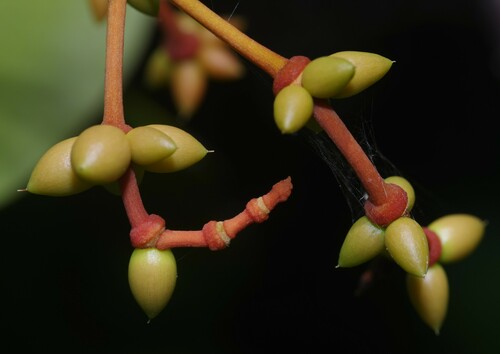
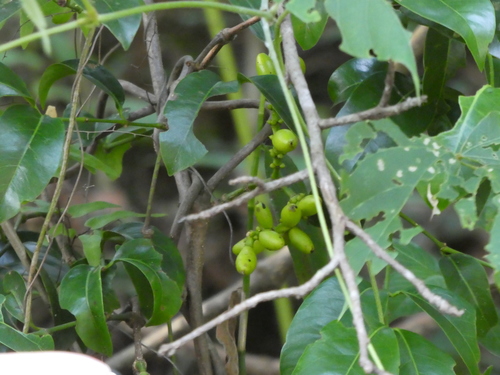
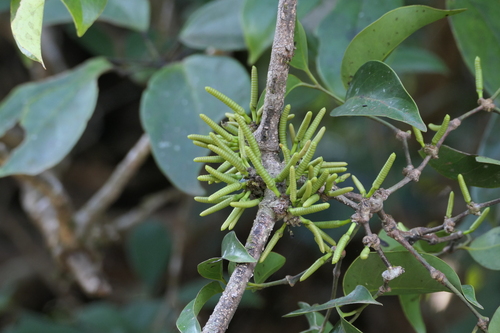
A shrub or small tree. It grows 3-4 m tall. The leaves are oblong to sword shaped and taper to the tip. They are 10-20 cm long by 4-10 cm wide. Plants are separately male and female. The seed is oval and 1.8 cm long by 1.2 cm wide. The ripe seed is yellow.
Edible Uses
Gnetum nuts are eaten boiled, roasted, or raw in most parts of Southeast Asia and Melanesia. The young leaves, the male strobili (often incorrectly referred as "flowers"), and the outer flesh of the fruits are also edible when cooked and are eaten in Indonesia, the Philippines, Thailand, Vanuatu, Papua New Guinea, the Solomon Islands, and Fiji. They have a slightly sour taste and are commonly eaten in soups and stews. Gnetum is most widely used in Indonesian cuisine where it is known as melinjo or belinjo. The seeds are used for sayur asem (sour vegetable soup) and also, made into raw chips that later need to be deep-fried as crackers (emping, a type of krupuk). The crackers have a slightly bitter taste and are frequently served as a snack or accompaniment to Indonesian dishes. This plant is commonly cultivated throughout the Aceh region and is regarded as a vegetable of high status. Its male strobili, young leaves and female strobilus are used as ingredients in traditional vegetable curry called kuah pliek. This dish is served on all important traditional occasions, such as khanduri and keureudja. In the Pidie district, the women pick the red-skinned ripe fruit and make keureupuk muling from it.
Distribution
A tropical plant. It does well in shade.
Where It Grows
Asia, Indochina, SE Asia, Thailand, Vietnam,
Cultivation
Plants can be grown from seed, air layers or root suckers. They are planted 2 m apart.
Other Information
It is an important leafy vegetable in peninsula Thailand.
Notes
There are about 28 Gnetum species.
Nutrition
| Part | Moisture | kJ | kcal | Protein | Vit A | Vit C | Iron | Zinc |
|---|---|---|---|---|---|---|---|---|
| Leaves | — | — | — | 92 | 50 | — | — | — |
Also Known As
Le-kwawng-du
References (4)
- Elevitch, C.R.(ed.), 2006, Traditional Trees of the Pacific Islands: Their Culture, Environment and Use. Permanent Agriculture Resources, Holualoa, Hawaii. p 387
- Kuhnlein, H. V., et al, 2009, Indigenous Peoples' food systems. FAO Rome p 171
- PROSEA (Plant Resources of South East Asia) handbook, Volume 2, 1991, Edible fruits and nut. p 182
- Sakunpak, A. & Panichayupakaranant, P., 2012, Antibacterial activity of Thai edible plants against gastrointestinal pathogenic bacteria and isolation of a new broad spectrum antibacterial polyisoprenylated benzophenone, chamuangone. Food Chemistry 130 (2012) 826–831