Gnetum parvifolium
(Warburg) Chun
Mountain ginkgo, Small-leaved jointfir
iNaturalist· cc-by
(c) Aaron Liston, some rights reserved (CC BY)
iNaturalist· cc-by
(c) Aaron Liston, some rights reserved (CC BY)
iNaturalist· cc-by
(c) Aaron Liston, some rights reserved (CC BY)
Description
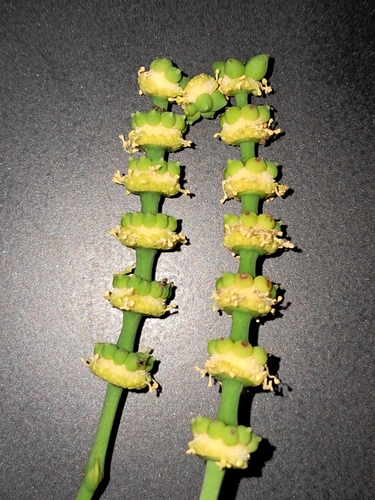
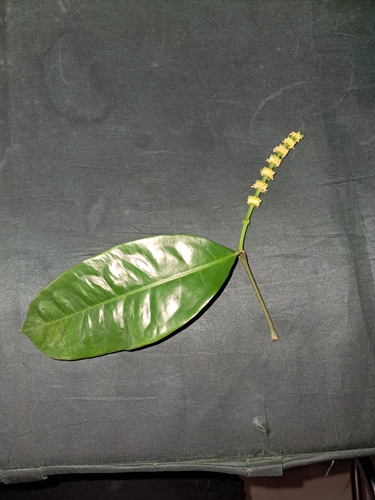
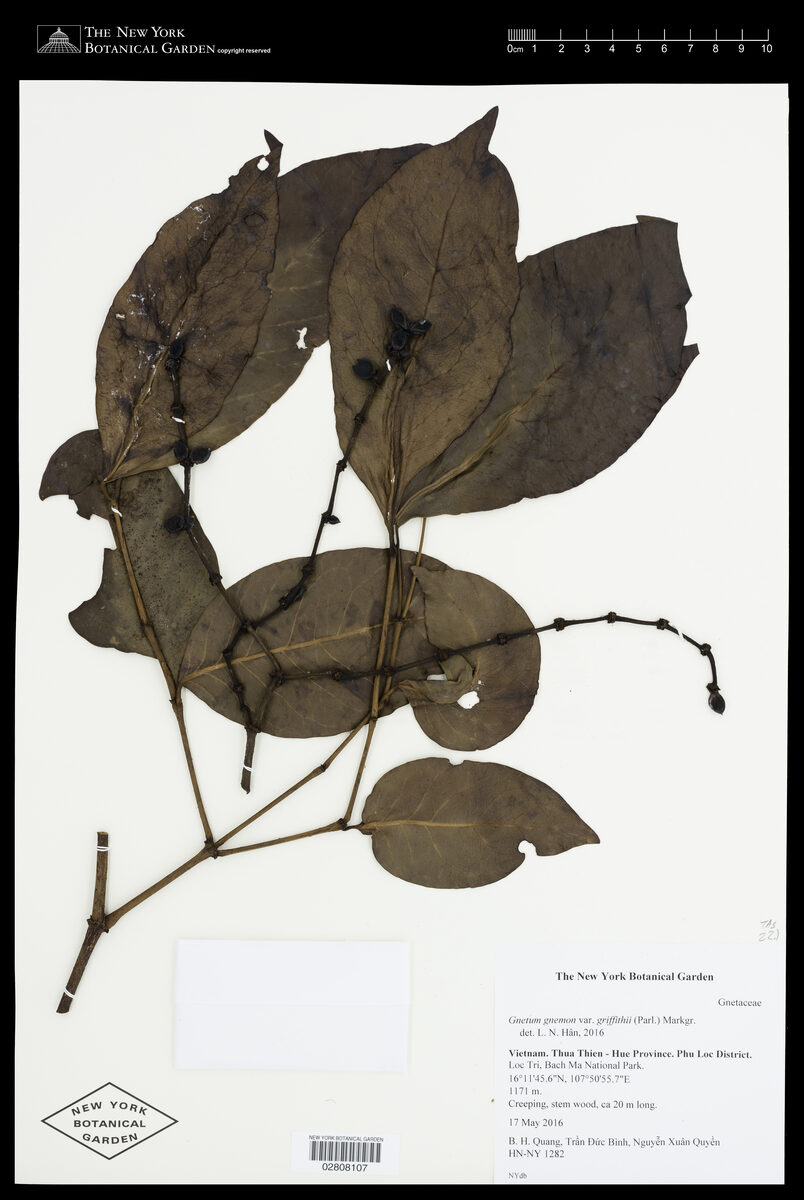
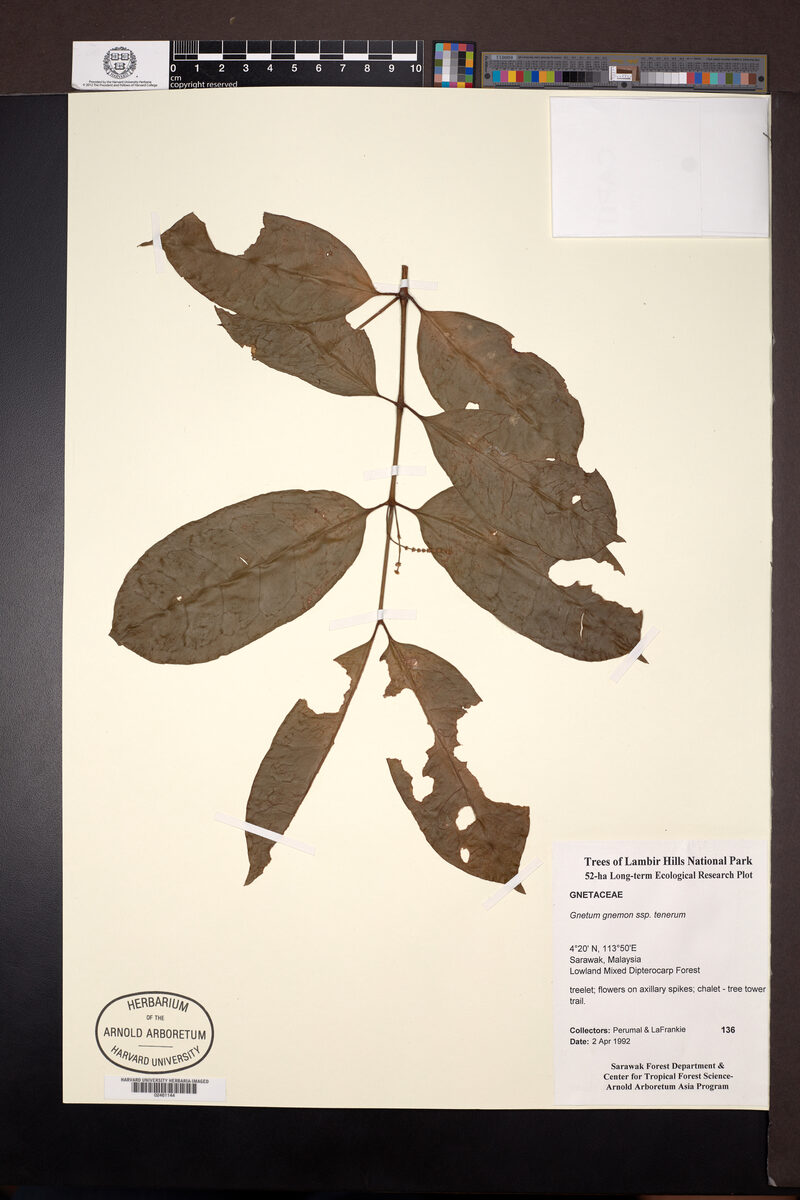
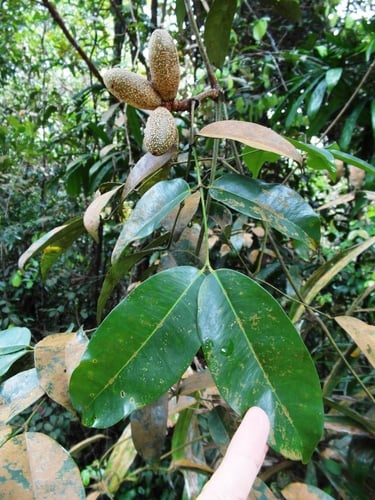
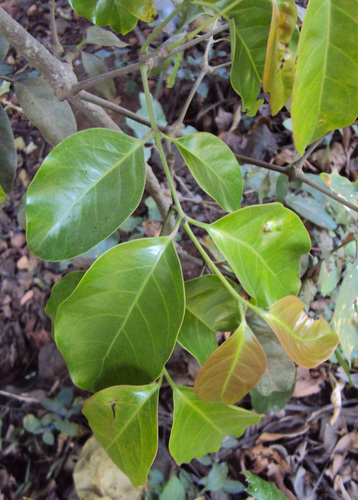
A coarse woody vine which grows up to 12 m long. It is usually thin and weak. The bark is pale or greyish brown. A coarse woody vine with large opposite leaves. The leaf stalk is 5-8 (-10) mm long and the leaf blade is like a narrow ellipse, or oval. The leaves are pointed at the tip and rounded at the base. They are 10 to 22 cm long by 2-5 cm wide. The leaves are leathery with 5-8 (-11) lateral veins on each side. Male flower stalks are simple or once branched. There are 40-70 flowers on a collar and there are 5-10 collars on a flower stalk. There are also some infertile female flowers. The female flower stalk is on old branches and branches once. These flower groups are 10-15 cm long. The fruit occurs in rings. The fruit are red, long and oval. They only have very short stalks. They can be 3 cm long and 1 cm wide. The seeds are black. Each fruit contains a single nut.
Edible Uses
Seeds - cooked. They are usually eaten fried. The fruit is edible when cooked. The red, oval fruits are about 3cm long. An edible oil is obtained from the seed. The stems are used as a source of water for drinking by people in the forest. When freshly cut the stems yield a good quality of drinking water.
Traditional Uses
The seeds yield edible oil. The kernels are eaten boiled or fried.
This uses section is brief — help expand it
Medicinal Uses
Also used in traditional medicine.
Known Hazards
Many Gnetum species are edible, with the seeds being roasted, and the foliage used as a leaf vegetable. The plant is harvested and yields a useful fiber. There is no sense of danger in consuming the fruit or the seeds. There is also a study done on the plant to see if it has any medicinal properties, finding some anti-coagulation effects due to its stilbenoid content. The family Gnetaceae is well known as a rich source of plant-derived stilbenoids as well as Cyperaceae, Dipterocarpaceae, Fabaceae, and Vitaceae.
Distribution
A tropical plant. They occur in forests between 100 and 1,000 m altitude in China and Vietnam. They are common and widely distributed in the forests of the Philippines. In Yunnan.
Where It Grows
Africa, Asia, China, Indochina, Laos, Macao, Myanmar, Pacific, Philippines, SE Asia, Vietnam,
Cultivation
Plants can be grown from stem cuttings.
Other Uses
The fibres from the bark are used tying purposes and to make ropes.
Notes
It is also used in medicine. There are about 28 Gnetum species.
Synonyms
Also Known As
Koliat, Kuliat, Laiqguqlaigni, Xiao ye mai ma teng, Yaossaqjaiq
References (13)
- Acta Phytotax. Sin. 9: 386. 1964.
- Brown, W.H., 1920, Wild Food Plants of the Philippines. Bureau of Forestry Bulletin No. 21 Manila. p 24 (As Gnetum indicum)
- Coronel, R.E., 1982, Fruit Collections in the Philippines. IBPGR Newsletter p 10 (As Gnetum indicum)
- Ferns, Useful Tropical Plants
- Flora of China. Vol 4 p 104 www.eFloras.org
Show all 13 references Hide references
- Hani Medicine of Xishuangbanna, 1999, p 355
- Hu, Shiu-ying, 2005, Food Plants of China. The Chinese University Press. p 280 (As Gnetum indicum)
- Interpr. Herb. amboin. 77. 1917 (As Gnetum indicum)
- Martin, F.W. & Ruberte, R.M., 1979, Edible Leaves of the Tropics. Antillian College Press, Mayaguez, Puerto Rico. p 193 (As Gnetum indicum)
- Monsalud, M.R., Tongacan, A.L., Lopez, F.R., & Lagrimas, M.Q., 1966, Edible Wild Plants in Philippine Forests. Philippine Journal of Science. p 472 (As Gnetum indicum)
- NYBG herbarium 'edible" (As Gnetum indicum)
- Terra, G.J.A., 1973, Tropical Vegetables. Communication 54e Royal Tropical Institute, Amsterdam, p 49 (As Gnetum indicum)
- Wickens, G.E., 1995, Edible Nuts. FAO Non-wood forest products. FAO, Rome. p 175 (As Gnetum indicum)