Barringtonia novae-hiberniae
Laut.
Pao nuts, Cut nut, Navele
gbif· cc0
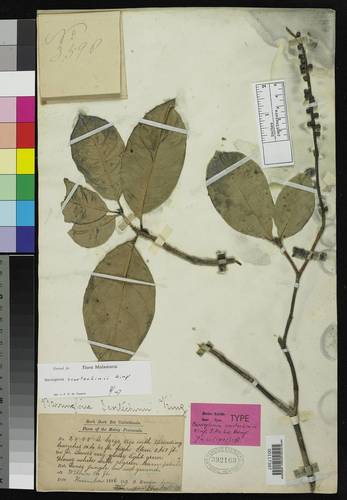
President and Fellows of Harvard College
gbif· cc0
President and Fellows of Harvard College
gbif· cc0
President and Fellows of Harvard College
Description
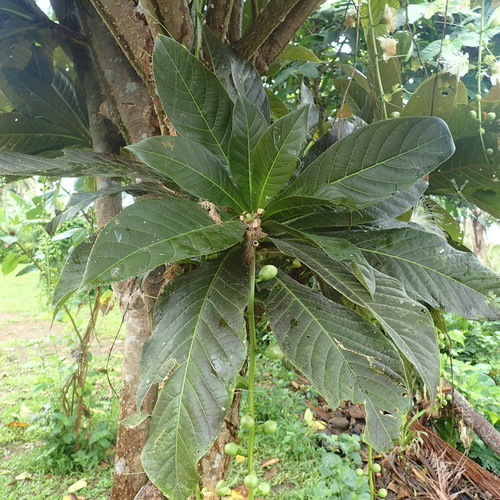
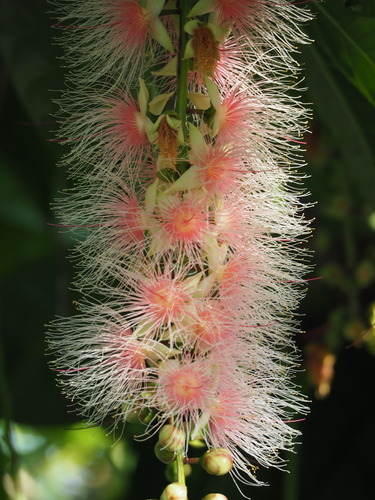
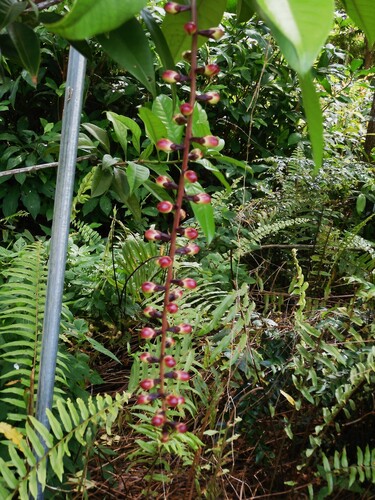
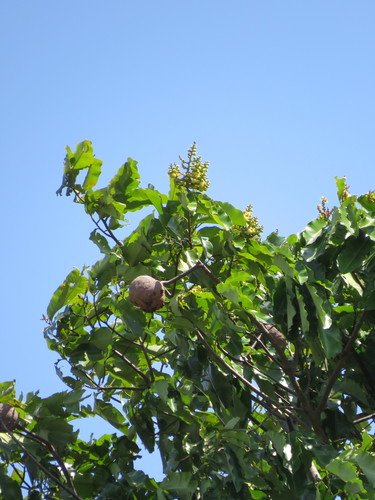
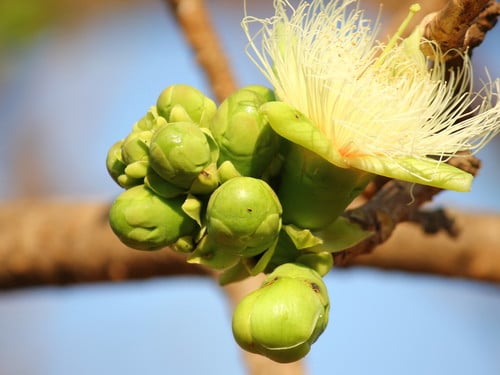
The tree. It grows up to 6 or 8 metres tall. The trunk is often only 10-15 cm across and near the top the tree has a few short thick branches. The leaves are large and shiny. The leaves are crowded towards the end of branches. A leaf can be 50-60 cm long and 20-24 cm across. Near the tip of the leaf the edge is wavy and often slightly toothed, with the tip bent backwards. The veins of the leaf show up clearly on both sides of the leaf. The leaf stalk is only short, about 1 cm long. A long hanging yellow flower is produced from the branches. It can be 80 cm long and is densely covered with flowers. There can be up to 120 flowers along a stalk. The flowers do not have a scent. Along this the fruits form, giving a long hanging stalk of quite large nuts. The fruit are oval shaped and about 6-8 cm long by 3-4 cm across. The seed or nut inside the fruit has lines running along its surface. This edible part is about 3 cm long by 1-2 cm across and white coloured. The seed is flattened particularly on one side. Pao nut trees tend to flower and produce nuts throughout the year. There are some different kinds. The size and shape of the nuts can vary slightly. Also some are white inside and some are red. The most obvious difference is the colour of the outside of the fruit. Some kinds are green or slightly blue whereas other kinds are a dark reddish black. The nuts have a fairly hard shell and are split open with a knife. The white part in the centre is eaten raw. It also has a fairly hard texture.
Edible Uses
The white kernels inside the nuts are eaten raw or roasted, with a fairly hard texture.
Traditional Uses
The kernels inside the nuts are eaten raw or roasted. CAUTION The related plant Barringtonia asiatica (L) Kurz which grows along the foreshore is used as a fish poison.
Medicinal Uses
The bark is used in the treatment of stomach ailments and gonorrhoea.
Known Hazards
The related species Barringtonia asiatica is used as a fish poison.
Distribution
A tropical plant. Trees grow in tropical coastal areas and up to about 600 m altitude. They occur in primary rainforest on rich alluvial soil. They grow naturally and are also planted. In Papua New Guinea it grows in the Huon Peninsula, Manus, New Britain, New Ireland and Bougainville.
Where It Grows
Asia, Bougainville, Indonesia, Niue, Pacific, Papua New Guinea*, PNG, SE Asia, Solomon Islands, Vanuatu,
Cultivation
Pao nut trees are mostly grown from seed. Several different races or types of pao nut have been selected by villagers and these trees seem to produce fruit that is similar to the seed that was planted. Trees can be grown from stem cuttings. Trees grown from cuttings have shorter trunks and branch closer to the ground.
Propagation
Seed - best sown as soon as it is ripe. Stem cuttings.
Other Uses
The wood is light in weight. It is used for canoe paddles, casing, light construction. The wood is used as a quick-burning firewood.
Production
If trees are planted in suitable sites and well looked after, they can produce fruit in a year or two. As pao nuts often do well and are most common on low off shore islands and coral waterfront villages, it may be particularly suited to coral and alkaline soils. This needs to be further studied. Flowering is not seasonal. Well grown trees can produce after one year.
Other Information
A common and popular nut in some coastal areas of Papua New Guinea.
Notes
There are about 40 Barringtonia species.
Synonyms
Also Known As
Ai ai, Aikenu, A pana kubar, A pana nasilsil, Arpo, Fa, Fala, Hala, Hansanae, Hara, Hari, Kapulpes, Kenu, Navele, Nevingen, Pao, Pau, Pohon putat utan, Sioko, Velingeh
References (15)
- Blench, R., 2004, Fruits and Arboriculture in the Indo-Pacific Region. Indo-Pacific Prehistory Association Bulletin 24. (Taipei Papers Volume 2) p 35
- Clarke, W.C. & Thaman, R.R., 1993, Agroforestry in the Pacific Islands: Systems for sustainability. United Nations University Press. New York.
- Evans, B. R, 1999, Edible nut Trees in Solomon Islands. A variety collection of Canarium, Terminalia and Barringtonia. ACIAR Technical Report No. 44 96pp
- French, B.R., 1986, Food Plants of Papua New Guinea, Asia Pacific Science Foundation p 167
- French, B.R., 2010, Food Plants of Solomon Islands. A Compendium. Food Plants International Inc. p 170
Show all 15 references Hide references
- Global Plants JSTOR (As Barringtonia brosimos)
- Henderson, C.P. and Hancock, I.R., 1988, A Guide to the Useful Plants of Solomon Islands. Res. Dept. Ministry of Agriculture and Lands, Honiara, Solomon Islands, p 63
- Payens, J.P.D.W., 1967, A monograph of the genus Barringtonia (Lecythidaceae) in Blumea Vol. XV No 2 1967, p 204
- Peekel, P.G., 1984, (Translation E.E.Henty), Flora of the Bismarck Archipelago for Naturalists, Division of Botany, Lae, PNG. p 397, 396
- Prance, G. T., 2013, A revision of Barringtonia (Lecythidaceae). Allertonia 12 : 1-164.
- Sukarya, D. G., (Ed.) 2013, 3,500 Plant Species of the Botanic Gardens of Indonesia. LIPI p 150
- Walter, A & Sam, C., 1995, Indigenous Nut Trees in Vanuatu: Ethnobotany and Variability. In South Pacific Indigenous Nuts. ACIAR Proceedings No 69. Canberra. p 57
- Walter, A. & Sam C., 2002, Fruits of Oceania. ACIAR Monograph No. 85. Canberra. p 114
- Wickens, G.E., 1995, Edible Nuts. FAO Non-wood forest products. FAO, Rome. p 139
- World Checklist of Useful Plant Species 2020. Royal Botanic Gardens, Kew