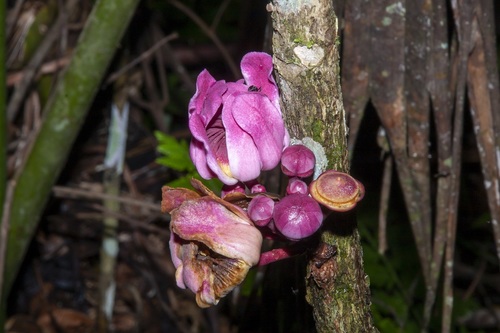
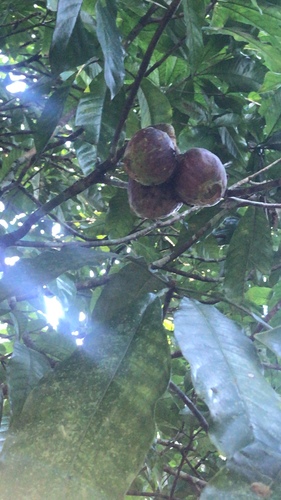
Barringtonia racemosa
(L.) Sprengel
Fish Poison Tree
iNaturalist· cc0
no rights reserved, uploaded by 葉子
iNaturalist· cc-by-nc
(c) sllee_travels, some rights reserved (CC BY-NC)
iNaturalist· cc-by-nc
(c) Margaret Lilienfeld, some rights reserved (CC BY-NC), uploaded by Margaret Lilienfeld
Summary
Source: WikipediaBarringtonia racemosa, commonly known as powder-puff tree, is a species of tree in the family Lecythidaceae. It is found in coastal swamp forests and on the edges of estuaries in the Indian Ocean, starting at the east coast of Mozambique and KwaZulu-Natal (South Africa) to Madagascar, India, Sri Lanka, Malesia, Maldives, Thailand, Laos, southern China, northern Australia, coastal Taiwan, the Ryukyu Islands and many Polynesian islands. The 1889 book 'The Useful Native Plants of Australia' records that the Indigenous people of the Mitchell River District called this plant "Yakooro" and that "The root of this tree has a bitter taste, and is used by Hindoo [sic.] practitioners on account of its aperient and cooling qualities. The seeds and bark are also used in native medicine; the latter is of a reddish colour, and is said to possess properties allied to the Cinchonas. The pulverised fruit is used as snuff, and, combined with other remedies, is applied externally in diseases of the skin. (Treasury of Botany)." The powder-puff tree is a protected tree in South Africa.
Description
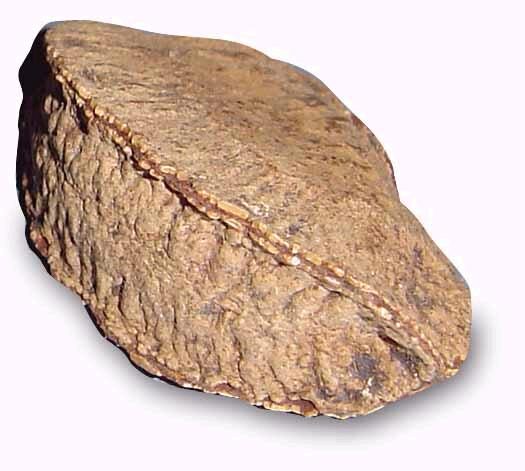
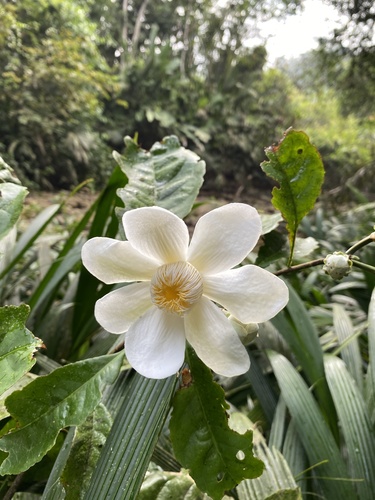
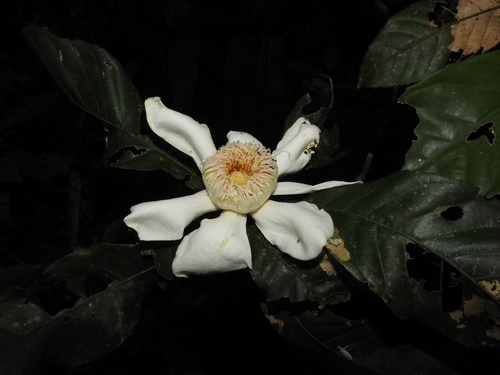
A small evergreen tree or shrub reaching a height of 10-16 m. It spreads to 5 m across. The stem is erect and branching. The tree has a rounded crown. The leaves are crowded at the ends of the branches. They are dark green and 25 cm long by 2-3 cm wide. Leaves can be twice this size. They are pointed at both ends and with toothed edges. The branches are marked with leaf scars. The flowers are white or pink and about 2 cm across. They occur in hanging stalks with individual flowers along the stalk. These stalks can be 25 cm long. The fruit hang along these stalks. The fruit is oblong to oval and somewhat 4 angled. Fruit can be 8 cm long and 2-5 cm wide. They are oval and irregular. They are green or purple. They contain only one seed.
Edible Uses
The seeds are pounded and starch is extracted from them. Young leaves are eaten as a cooked vegetable after being soaked in lime water.
Traditional Uses
The seeds and young leaves are eaten. The seeds are pounded and starch extracted. The leaves are cooked and eaten as a vegetable. They are first soaked in lime water. Caution: The fruit are used to poison wild pigs.
Medicinal Uses
The root is febrifuge. A decoction of the bark is externally applied as an antirheumatic and to treat chickenpox. The bark is applied externally to treat chicken pox and as a poultice to relieve itch. The fruit is used to treat coughs, asthma and diarrhoea. It is pulverized and used as snuff. The Zulu tribe of South Africa uses the fruit as a remedy for malaria. The fruit is used externally for poulticing sore throat and skin eruptions. A decoction of the scraped nut is drunk to relieve a cough, sinusitis or bronchitis. Although considered poisonous, the seeds are used to treat intestinal worms, and are employed by midwives for promoting parturition. The seed is peeled, mixed with flour and oil, and used in the treatment of diarrhoea. The seed is used externally to treat ophthalmia. In Malaysia, the leaves traditionally are used to treat high blood pressure and as a depurative. The pounded leaves are applied externally to treat chicken pox and as a poultice to relieve itch.
Known Hazards
The seed contains saponins and is poisonous. It is sometimes used as a fish poison. The pounded roots, fruits and bark are all used as fish poisons. The fruits are used to poison wild pigs.
Distribution
A tropical plant. It prefers well-drained, moist, humus rich soil. It can grow in a sheltered, partly shaded position. It is drought tender and very frost tender. Found throughout the Philippines in areas of shrub near the seashore and open lowlands up to 320 m altitude. It grows in coastal swamps and along stream banks. It can resist strong sea breezes. It is salt tolerant. It can grow in arid places. It suits hardiness zones 10-12.
Where It Grows
Africa, Andamans, Asia, Australia, Bangladesh, Carolines, China, Christmas Island, Chuuk, Comoros, East Africa, East Timor, Fiji, FSM, Guam, Hawaii, India, Indochina, Indonesia, Japan, Kenya, Laos, Madagascar, Malaysia, Maldives, Marquesas, Micronesia, Mozambique, Myanmar, New Caledonia, Pacific, Palau, Papua New Guinea, PNG, Philippines, Rotuma, Samoa, SE Asia, Seychelles, Singapore, Solomon Islands, Somalia, South Africa, Southern Africa, Sri Lanka, Taiwan, Tanzania, Thailand, Timor-Leste, Vanuatu, Yap,
Cultivation
Plants are grown from seed. Seed need to be sown fresh. It can be grown from cuttings.
Propagation
Seed - best sown as soon as it is ripe. It can be sown in situ or in a partially shaded nursery seedbed and then planted out when large enough. The seed should be sown 3 - 5cm deep in a vertical position with the basal end down -the roots emerge from this end and the shoots emerge from the apex. Seeds from ripe fruits will start to germinate after 7 days. Seeds on their side will take longer to become established. Nearly 100% of viable seeds can be expected to germinate, as there is no seed dormancy. It takes 2 - 3 months to germinate a ripe fruit. Seedlings are ready for field planting about 2 - 3 months after germination, when around 20 - 30cm tall Cuttings of half-ripe wood. Air layering.
Other Uses
An oil is obtained from the seed. It is used as an illuminant. The bark yields tannin. The bark of the stems and roots has a high tannin content and is used locally for tanning. Uses as a dye have not been recorded, but the type of tannins present in the bark is widely used all over the world for dyeing vegetable fibres into shades of reddish brown and also grey and black with iron mordants. The seed contains saponins and is used as an insecticide. Extracts of the plant have proved effective against Citrus aphis. The bark is utilized as cordage. The heartwood is a pale yellow-brown wood, sometimes with a reddish tinge; it is not differentiated from the sapwood. The grain is straight, texture moderately fine and even. The wood is light in weight, soft, not durable. It yields a medium-weight hardwood. The sapwood is permeable, the heartwood moderately resistant to pressure impregnation. The wood is used for light work that does not require great strength. It is utilized for temporary construction, local house building (posts and beams), general planking, flooring, boat building, mouldings, interior finish, handles of non-striking tools, household utensils, agricultural implements, boxes and crates and wooden pallets. It is suitable for veneer and plywood manufacturing. In India, it is used additionally for carts, rice pounders and cabinetwork. In the Philippines, it has been reported that when treated with preservatives, the timber can be used to make good ties and paving blocks. In the Pacific region, the wood has additionally been used for carving and turnery. The wood has been applied in various kinds of wood-based panels such as hardboard, particleboard and block board, and has also been used for the production of pulp. As the trees are often not large enough to be converted in saw mills and supplies are small, use of the timber is limited and it is not sold on the international market. Provides suitable firewood.
Production
Trees grow easily and rapidly.
Other Information
It is not known if it is used for food in Papua New Guinea.
Notes
Many parts of the plant are used to stun fish. There are about 40 Barringtonia species. It possibly has anti-cancer properties.
Synonyms
Also Known As
Butun darat, Cassowary pine, Foto-be, Freshwater mangrove, Ijjal, Jik, Kaiengal, Kyi-byu, Mango Pine, Massinhava, Midhilijan, Mtoko, Mutovatova, Paopao, Pneggung, Poeierkwasboom, Pohon putat sungai, Powder-puff tree, Putat darat, Putat kamp, Putat kampung, Putat kedul, Putat sungai, Rfungue, Samudraphala, Taung-kyi
References (48)
- Ambasta S.P. (Ed.), 2000, The Useful Plants of India. CSIR India. p 68
- Arora, R. K., 2014, Diversity in Underutilized Plant Species - An Asia-Pacific Perspective. Bioversity International. p 90
- Barwick, M., 2004, Tropical and Subtropical Trees. A Worldwide Encyclopedic Guide. Thames and Hudson p 45
- Bircher, A. G. & Bircher, W. H., 2000, Encyclopedia of Fruit Trees and Edible Flowering Plants in Egypt and the Subtropics. AUC Press. p 54
- Bodkin, F., 1991, Encyclopedia Botanica. Cornstalk publishing, p 133
Show all 48 references Hide references
- Bole, P.V., & Yaghani, Y., 1985, Field Guide to the Common Trees of India. OUP p 19
- Burkill, I.H., 1966, A Dictionary of the Economic Products of the Malay Peninsula. Ministry of Agriculture and Cooperatives, Kuala Lumpur, Malaysia. Vol 1 (A-H) p 308
- Cooper, W. and Cooper, W., 2004, Fruits of the Australian Tropical Rainforest. Nokomis Editions, Victoria, Australia. p 266
- Cowie, I, 2006, A Survey of Flora and vegetation of the proposed Jaco-Tutuala-Lore National Park. Timor-Lests (East Timor) www.territorystories.nt/gov.au p 49
- Cribb, A.B. & J.W., 1976, Wild Food in Australia, Fontana. p 74
- Cundall, P., (ed.), 2004, Gardening Australia: flora: the gardener's bible. ABC Books. p 220
- Dobriyal, M. J. R. & Dobriyal, R., 2014, Non Wood Forest Produce an Option for Ethnic Food and Nutritional Security in India. Int. J. of Usuf. Mngt. 15(1):17-37
- Elliot, W.R., & Jones, D.L., 1982, Encyclopedia of Australian Plants suitable for cultivation. Vol 2. Lothian. p 307
- Etherington, K., & Imwold, D., (Eds), 2001, Botanica's Trees & Shrubs. The illustrated A-Z of over 8500 trees and shrubs. Random House, Australia. p 119
- Flora of Australia, Volume 8, Lecythidales to Batales, Australian Government Publishing Service, Canberra (1982) p 5
- Franklin, J., Keppel, G., & Whistler, W., 2008, The vegetation and flora of Lakeba, Nayau and Aiwa Islands, Central Lau Group, Fiji. Micronesica 40(1/2): 169–225, 2008
- Hinton, B & B., 1982, A Wilderness in Bloom. Wildflowers of tropical Australia. p 51
- Jones D, L, 1986, Ornamental Rainforest Plants in Australia, Reed Books, p 198
- Kaume, R.N., 2005. Barringtonia racemosa (L.) Spreng. [Internet] Record from Protabase. Jansen, P.C.M. & Cardon, D. (Editors). PROTA (Plant Resources of Tropical Africa / Ressources végétales de l’Afrique tropicale), Wageningen, Netherlands. < http://database.prota.org/search.htm>. Accessed 14 October 2009.
- Lazarides, M. & Hince, B., 1993, Handbook of Economic Plants of Australia, CSIRO. p 31
- Lebot, V. & Sam, C., Green desert or ‘all you can eat’? How diverse and edible was the flora of Vanuatu before human introductions?. Terra australis 52 p 410
- Llamas, K.A., 2003, Tropical Flowering Plants. Timber Press. p 244
- Lovelock, C., & Clarke, S., 1999, Field Guide to the Mangroves of Queensland. Australian Institute of Marine Science. p 44
- Martin, F.W. & Ruberte, R.M., 1979, Edible Leaves of the Tropics. Antillian College Press, Mayaguez, Puerto Rico. p 197
- Menninger, E.A., 1977, Edible Nuts of the World. Horticultural Books. Florida p 38
- Monsalud, M.R., Tongacan, A.L., Lopez, F.R., & Lagrimas, M.Q., 1966, Edible Wild Plants in Philippine Forests. Philippine Journal of Science. p 485
- Morley, B.D., & Toelken, H.R., (Eds), 1983, Flowering Plants in Australia. Rigby. p 174
- Murakami, A. et al, 2014, Screening for the In Vitro Anti-tumor-promoting Activities of Edible Plants from Malaysia. Bioscience, Biotechnology, and Biochemistry, 64:1, 9-16.
- Nurfadilah, S., et al, 2017, Species richness, conservation status, and potential uses of plants in Segara Anakan Area of Sempu Island, East Java, Indonesia. BIODIVERSITAS. Volume 18, Number 4
- Palgrave, K.C., 1996, Trees of Southern Africa. Struik Publishers. p 652
- Palmer, E and Pitman, N., 1972, Trees of Southern Africa. Vol. 3. A.A. Balkema, Cape Town p 1597
- Peekel, P.G., 1984, (Translation E.E.Henty), Flora of the Bismarck Archipelago for Naturalists, Division of Botany, Lae, PNG. p 397, 396
- Prance, G. T. & Jongkind, C. H., 2015, A Revision of African Lecythidaceae. Kew Bulletin. 70:1-68
- Roth, W.E., 1901,
- Royal Botanic Gardens, Kew (1999). Survey of Economic Plants for Arid and Semi-Arid Lands (SEPASAL) database. Published on the Internet; http://www.rbgkew.org.uk/ceb/sepasal/internet [Accessed 21st April 2011]
- Samy, J., Sugumaran, M., Lee, K. L. W., 2009, Herbs of Malaysia, Marshall Cavendish. p 61
- Scarth-Johnson, V., 2000, National Treasures. Flowering Plants of Cooktown and Northern Australia. Vera Scarth-Johnson Gallery Association. Cooktown, Australia. p 35
- Schatz, G.E., 2001, Generic Tree Flora of Madagascar. Royal Botanical Gardens, Kew and Missouri Botanical Garden. p 230
- Smith, A.C., 1981, Flora Vitiensis Nova: A New flora of Fiji, Hawai Botanical Gardens, USA Vol 2 p 495
- Somnasang, P., Moreno, G and Chusil K., 1998, Indigenous knowledge of wild hunting and gathering in north-east Thailand. Food and Nutrition Bulletin 19(4) p 359f
- Specht, R.L., 1958,
- Sujanapal, P., & Sankaran, K. V., 2016, Common Plants of Maldives. FAO & Kerala FRI, p 51
- Sukarya, D. G., (Ed.) 2013, 3,500 Plant Species of the Botanic Gardens of Indonesia. LIPI p 149
- Townsend, K., 1994, Across the Top. Gardening with Australian Plants in the tropics. Society for Growing Australian Plants, Townsville Branch Inc. p 98
- van Wyk, B, van Wyk, P, and van Wyk B., 2000, Photographic guide to Trees of Southern Africa. Briza. p 61
- World Checklist of Useful Plant Species 2020. Royal Botanic Gardens, Kew
- www.worldagroforestrycentre.org/treedb/
- Zawiah, N. & Othaman, H., 2012, 99 Spesies Buah di FRIM. Institut Penyelidikan Perhutanan Malaysia. p 68