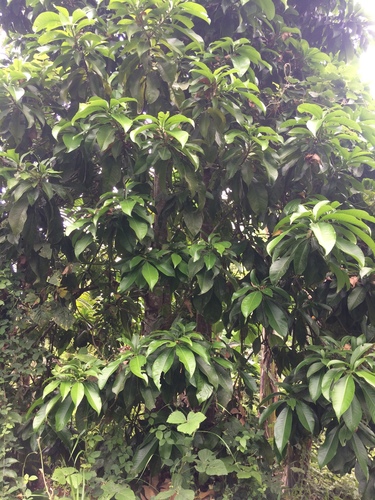
Barringtonia macrocarpa
Hassk.
Large-leaf putat tree
iNaturalist· cc-by-nc
(c) Tom Kirschey, some rights reserved (CC BY-NC), uploaded by Tom Kirschey
gbif· cc-by-sa
mmckindley
Summary
Source: WikipediaBarringtonia macrocarpa grows as a shrub or tree up to 30 metres (100 ft) tall, with a trunk diameter of up to 24 centimetres (9 in). The fruits are winged, up to 12.5 cm (5 in) long. Habitat is lowland riverine and swamp forest. B. macrocarpa is found in Burma, Thailand, Vietnam, Malaysia and Indonesia.
Description
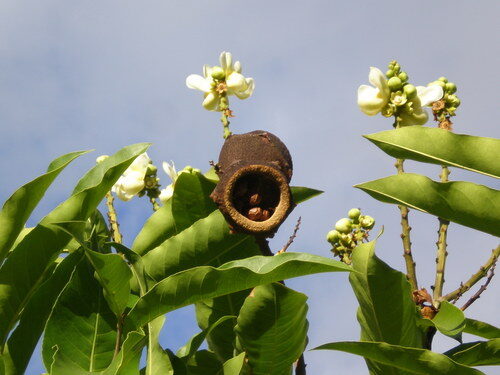
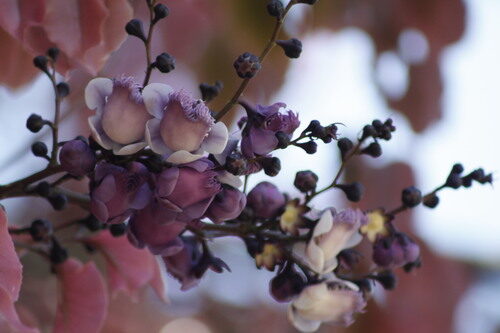
A small tree. It grows 3-7 m tall. The trunk is thin and straight. It is 5-15 cm across. The leaves are alternate. The leaves are broadly sword shaped. They extend down along the stem at the base. The flowers hang down along a long stalk amongst the leaves. The flowers are greenish with red tips.
Edible Uses
The young slender sprouts or shoots are eaten.
Traditional Uses
The young slender sprouts or shoots are eaten.
This uses section is brief — help expand it
Known Hazards
The roots and root bark contain saponins. They are pounded and used as a fish poison.
Distribution
A tropical plant. In Java it grows from the lowlands to 600 m above sea level. It grows in shady places and near water on non saline soils.
Where It Grows
Asia, Indonesia, Malaysia, Myanmar, SE Asia, Thailand, Vietnam,
Cultivation
Plants can be grown by seeds and cuttings.
Propagation
Seed - best sown as soon as it is ripe.
Notes
There are about 40 Barringtonia species.
Synonyms
Also Known As
Bulat, Chik nom yan, Inonoi, Pohon putat songgom, Potet, Songgom, Songol
References (5)
- Bircher, A. G. & Bircher, W. H., 2000, Encyclopedia of Fruit Trees and Edible Flowering Plants in Egypt and the Subtropics. AUC Press. p 54 (As Barringtonia insignis)
- Martin, F.W. & Ruberte, R.M., 1979, Edible Leaves of the Tropics. Antillian College Press, Mayaguez, Puerto Rico. p 197
- Ochse, J.J. et al, 1931, Vegetables of the Dutch East Indies. Asher reprint. p 357 (As Barringtonia insignis)
- Prance, G. T. & Jongkind, C. H., 2015, A Revision of African Lecythidaceae. Kew Bulletin. 70:1-68
- Sukarya, D. G., (Ed.) 2013, 3,500 Plant Species of the Botanic Gardens of Indonesia. LIPI p 149