Banksia grandis
Willd.
Bull Banksia, Poolgarla, Mangite, Beera, Boolgalla, Boorarup
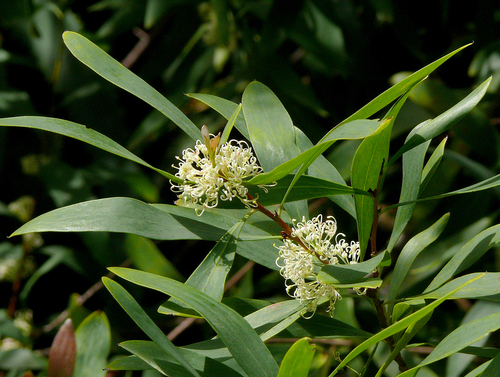
iNaturalist· cc-by
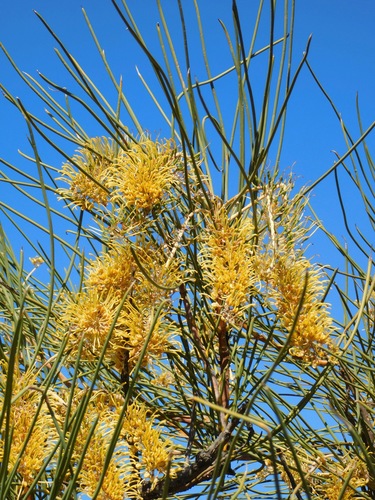
(c) Ruth Clark, some rights reserved (CC BY), uploaded by Ruth Clark
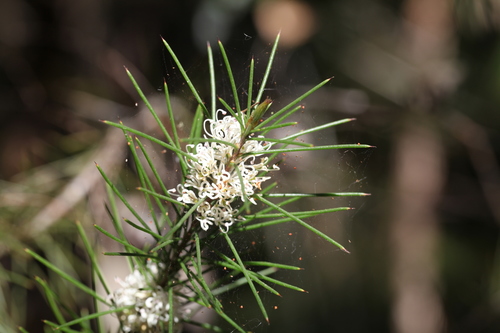
iNaturalist· cc-by-nc-sa
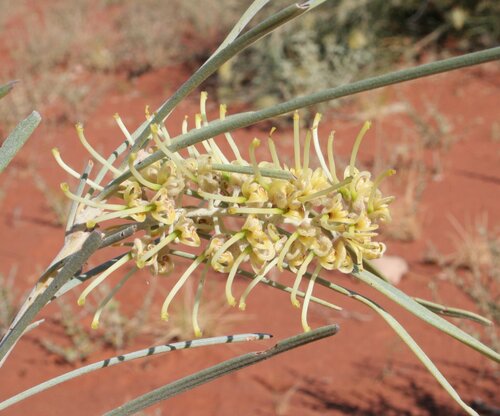
(c) Nick Lambert, some rights reserved (CC BY-NC-SA), uploaded by Nick Lambert
iNaturalist· cc-by-nc
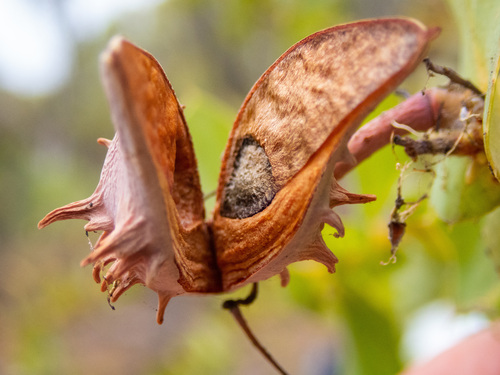
(c) Caro Telfer, some rights reserved (CC BY-NC), uploaded by Caro Telfer
Summary
Source: WikipediaBanksia grandis, commonly known as bull banksia or giant banksia, is a species of common and distinctive tree in the south-west of Western Australia. The Noongar peoples know the tree as beera, biara, boongura, gwangia, pira or peera. It has a fire-resistant main stem with thick bark, pinnatisect leaves with triangular side-lobes, pale yellow flowers and elliptical follicles in a large cone.
Description
A tree. It grows up to 5-10 m high and spreads 3-8 m wide. The leaves are large. They can be 50 cm long. They are held in clumps. They have triangular lobes arranged along a central spine. It has large flower spikes. They are pale yellow and 40 cm long.
Edible Uses
Flowers are soaked in water to produce a sweet drink, and nectar can be sucked directly from the plant. The tree also hosts edible grubs.
Traditional Uses
The flowers are soaked in water to produce a sweet drink. The nectar is also soaked directly from the plant. It also has edible grubs.
This uses section is brief — help expand it
Distribution
It grows in SW regions of Western Australia. It suits temperate and semiarid regions. It can grow on alkaline soils. It can stand light frosts. It suits hardiness zones 9-11.
Where It Grows
Australia*,
Cultivation
Plants are grown from seed.
Notes
There are about 75 Banksia species. They are mostly in Australia.
References (16)
- Bindon, P., 1996, Useful Bush Plants. Western Australian Museum. p 51
- Bodkin, F., 1991, Encyclopedia Botanica. Cornstalk publishing, p 129
- Bonney, N., 1997, Economic Native Trees and Shrubs for South Australia. Greening Australia (SA) inc. Campbelltown SA 5074 p 41
- Cundall, P., (ed.), 2004, Gardening Australia: flora: the gardener's bible. ABC Books. p 218
- Daw, B., Walley, T. & Keighery, G., 2001, Bush Tucker. Plants of the South-West. Department of Conservation and Land Management. Western Australia. p 40
Show all 16 references Hide references
- Elliot, W.R., & Jones, D.L., 1982, Encyclopedia of Australian Plants suitable for cultivation. Vol 2. Lothian. p 293
- Etherington, K., & Imwold, D., (Eds), 2001, Botanica's Trees & Shrubs. The illustrated A-Z of over 8500 trees and shrubs. Random House, Australia. p 116
- Holliday, I., 1989, A Field Guide to Australian Trees. Hamlyn. p 70
- Lazarides, M. & Hince, B., 1993, Handbook of Economic Plants of Australia, CSIRO. p 31
- Lord, E.E., & Willis, J.H., 1999, Shrubs and Trees for Australian gardens. Lothian. p 150
- Molyneux, B & Forrester, S., 1997, The Austraflora A-Z of Australian Plants. Reed. p 50
- Paczkowska, G . & Chapman, A.R., 2000, The Western Australian Flora. A Descriptive Catalogue. Western Australian Herbarium. p 466
- Plants and People in Mooro Country. Nyungar Plant use in Yellagonga Regional Park
- Rolsh, 1994, Wildflowers of the Western State, Rolsh Productions Albany WA. p 4
- Smith, K & I., 1999, Grow your own bushfoods. New Holland. Australia. p 105
- Sp. pl. 1(2):535. 1798