Bismarckia nobilis
Hildebrandt & H. Wendl.
Bismarck palm
iNaturalist· cc-by-nc
(c) lieselm, some rights reserved (CC BY-NC)
iNaturalist· cc-by-nc
(c) Andry.A.R, some rights reserved (CC BY-NC), uploaded by Andry.A.R
iNaturalist· cc-by-nc
(c) lieselm, some rights reserved (CC BY-NC)
Description
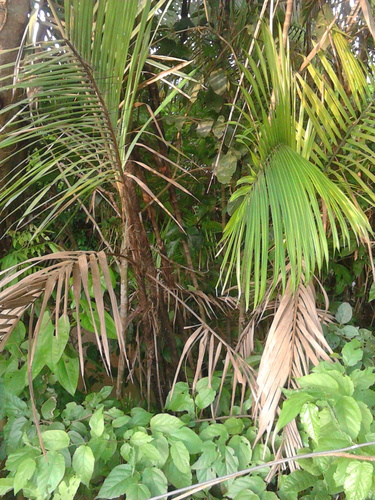
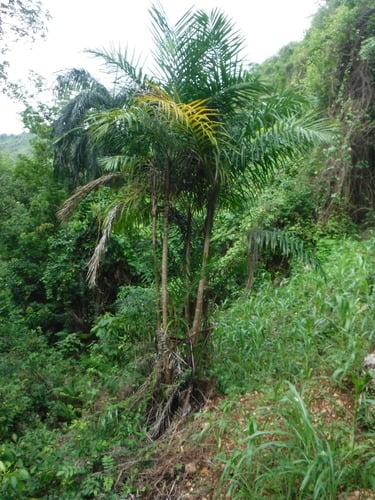
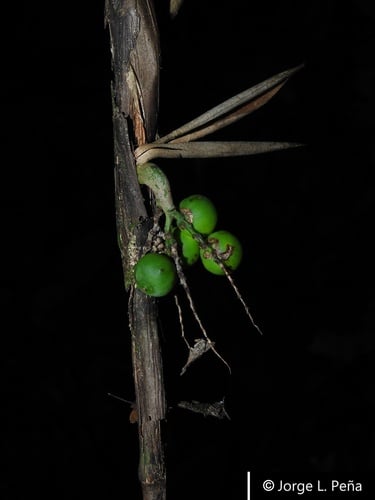
A large fan palm. It can be 60 m tall. It has a single trunk. The trunk is smooth and stout. The crown is large and heavy. The leaf blade may be 3 m across. The leaf stalk continues as a well developed rib into the leaf. The leaflets are spread out like fingers on a hand. The leaflets or segments are rigid and blue-green. The leaf stalk is covered by a woolly, waxy material. The leaf stalk splits are the base where it attaches to the trunk. There are separate male and female trees. The male flowers are very small and on curving crimson spikes. The female flowers are yellow. The fruit are about 3 cm across. They are brown when ripe.
Edible Uses
The starch from the stem can be eaten, though it is bitter.
Traditional Uses
The stem starch is bitter but can be eaten.
This uses section is brief — help expand it
Distribution
It is a tropical plant. It is native to Madagascar. It suits the drier subtropics. It needs sun and a well drained soil. It suits hardiness zones 10-12. Adelaide Botanical Gardens. It has some salt and drought tolerance. In Townsville palmetum.
Where It Grows
Africa, Asia, Australia, Comoros, East Africa, India, Madagascar*, Mayotte, North America, SE Asia, Singapore, USA,
Cultivation
Seeds are easy to germinate. Fresh seeds are used and the flesh stripped off. Germination takes 2 months. If it is planted in a pot it needs a deep pot. The seed leaves grow downwards before the tip turns upward. It is not easy to transplants and needs root pruning if transplanted.
Production
It is fast growing.
Notes
There is only one Bismarckia species.
Synonyms
Also Known As
Satra, Satrana, Satranabe, Satrapotsy, Strabe
References (16)
- Ann. Mus. Colon. Marseille 21: T. 38. 1913 (As Medemia nobilis)
- Balick, M.J. and Beck, H.T., (Ed.), 1990, Useful palms of the World. A Synoptic Bibliography. Colombia p 121 (As Medemia nobilis)
- Bois, D., 1927, (As Medemia nobilis)
- Bot. Zeitung (Berlin) 39:94. 1881
- Cundall, P., (ed.), 2004, Gardening Australia: flora: the gardener's bible. ABC Books. p 239
Show all 16 references Hide references
- Dransfield, J. & Beentje, H., 1995, The Palms of Madagascar. Royal Botanical Gardens, Kew and The International Palm Society. p 61
- Etherington, K., & Imwold, D., (Eds), 2001, Botanica's Trees & Shrubs. The illustrated A-Z of over 8500 trees and shrubs. Random House, Australia. p 133
- Gibbons, M., 2003, A pocket guide to Palms. Chartwell Books. p 49
- Hibbert, M., 2002, The Aussie Plant Finder 2002, Florilegium. p 44
- Jardin, C., 1970, List of Foods Used In Africa, FAO Nutrition Information Document Series No 2.p 18 (As Medemia nobilis)
- Johnson, D.V., 1998, Tropical palms. Non-wood Forest products 10. FAO Rome. p 116
- Jones, D.L., 1994, Palms throughout the World. Smithtonian Institution, Washington. p 143
- Kew Plants of the World Online
- Llamas, K.A., 2003, Tropical Flowering Plants. Timber Press. p 94
- Riffle, R.L. & Craft, P., 2003, An Encyclopedia of Cultivated Palms. Timber Press. p 274
- Schatz, G.E., 2001, Generic Tree Flora of Madagascar. Royal Botanical Gardens, Kew and Missouri Botanical Garden. p 64