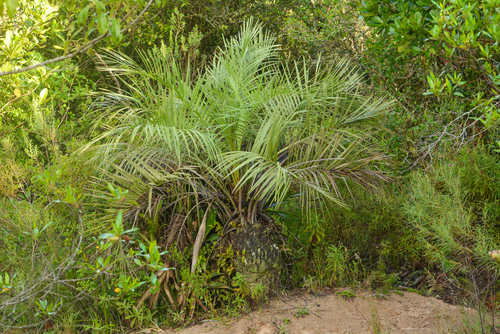
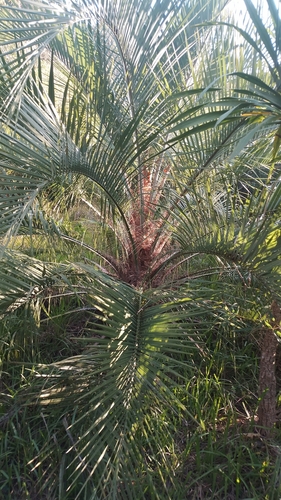
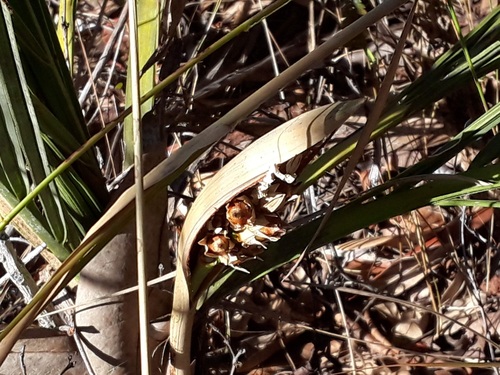
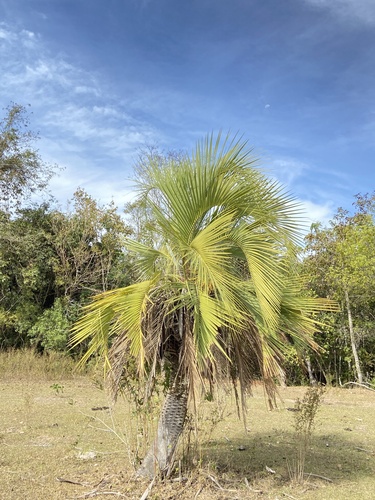
Phytelephas seemannii
O. F. Cook
Tagua, Seemann ivory palm
iNaturalist· cc-by-nc
(c) aulax, some rights reserved (CC BY-NC), uploaded by aulax
iNaturalist· cc-by
(c) Daniel Mesa, some rights reserved (CC BY)
Summary
Source: WikipediaPhytelephas seemannii, commonly called Panama ivory palm, is a species of flowering plant in the family Arecaceae. It is one of the plants used for vegetable ivory.
Description
A palm. The stems occur singly and are creeping. They form roots on the lower surface. The older section of the stems can die. It grows 4 m tall. The trunk is 30 cm across. It has many close leaf scars. There are 25-35 leaves. The leaves are 7 m long. There are 90 leaflets along each side. They are arranged regularly and are in one plane. The male flowers do not have stalks. The fruiting heads are 30 cm across. There are 5-9 fruit. There are 5-7 seeds per fruit.
Edible Uses
The seeds are traded at a regional international level as vegetable ivory, which is also called tagua. This commercial use is a threat to the species, but progress is being made on using more sustainable practices and conservation. As the tree typically grows only 1 metre (3 ft 3 in) tall, it fortunately was not chopped down to harvest the seeds as was done with Phytelephas aequatorialis at the peak of tagua harvesting. The jelly-like liquid in the immature seeds, which later turns into the vegetable ivory, is edible. Occasionally in the marketplaces of Guna Yala the thin crust surrounding the ivory is sold as food. In Colombia the fronds are sometimes used for thatch.
Traditional Uses
The young fruit is used as a drink. The mature fruit are eaten.
This uses section is brief — help expand it
Distribution
A tropical plant. They grow in lowland rainforest. They grow on alluvial soils under forest shade. They grow below 200 m altitude.
Where It Grows
Central America, Colombia, Panama, South America,
Cultivation
A dioecious species, both male and female forms need to be grown if fruit and seed are required.
Other Uses
The seeds are filled at first with a watery liquid, but this later becomes milky and finally almost as hard as ivory. The very hard seeds are a source of vegetable ivory, used for making buttons and a wide range of craft items. The leaves are used sometimes for thatching.
Synonyms
Also Known As
Anta, Tagwa
References (7)
- Balick, M.J. and Beck, H.T., (Ed.), 1990, Useful palms of the World. A Synoptic Bibliography. Colombia p 50
- Henderson, A., Galeano, G and Bernal, R., 1995, Field Guide to the Palms of the Americas. Princeton. p 237
- Grandtner, M. M. & Chevrette, J., 2013, Dictionary of Trees, Volume 2: South America: Nomenclature, Taxonomy and Ecology. Academic Press p 496
- Kermath, B. M., et al, 2014, Food Plants in the Americas: A survey of the domesticated, cultivated and wild plants used for Human food in North, Central and South America and the Caribbean. On line draft. p 653
- Marcia, M. J., et al, 2011, Palm Uses in Northwestern South America: A Quantitative Review. Bot. Rev. (2011) 77:462-570
Show all 7 references Hide references
- Roa, J. A. G. & Boada, D. S. G., 2018, Fundación para el Fortalecimiento de la Fruticultura y Plantas Alimenticias no Convencionales en Colombia.
- U.S.D.A. Bur. Pl. Industr. Bull. 242:68. 1912