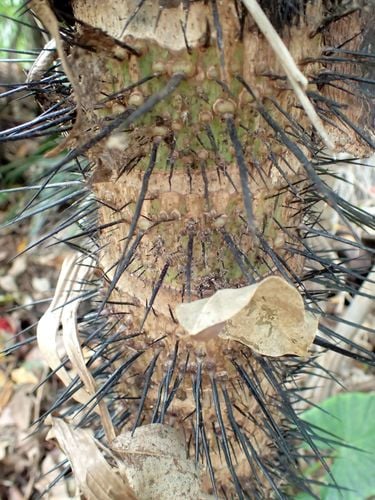
Pinanga caesia
Blume
Blue palm
iNaturalist· cc-by-nc
(c) Igor Azevedo, some rights reserved (CC BY-NC), uploaded by Igor Azevedo
iNaturalist· cc-by-nc
(c) Igor Azevedo, some rights reserved (CC BY-NC), uploaded by Igor Azevedo
gbif· cc0
President and Fellows of Harvard College
Description
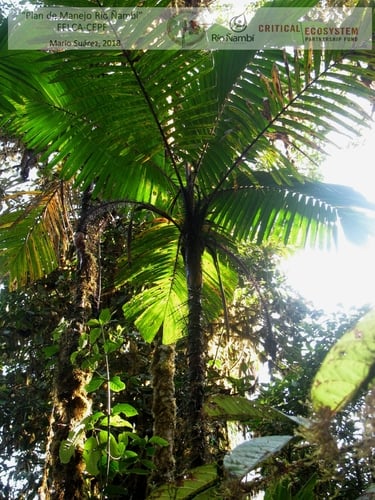
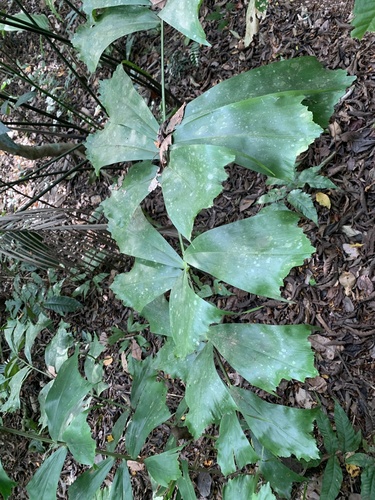
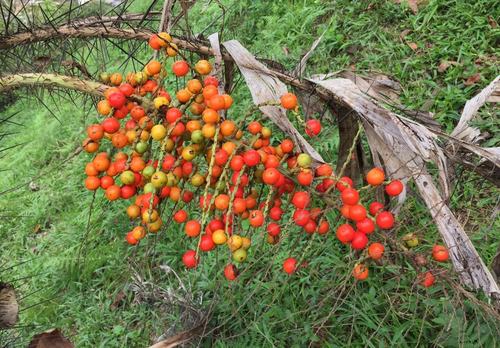
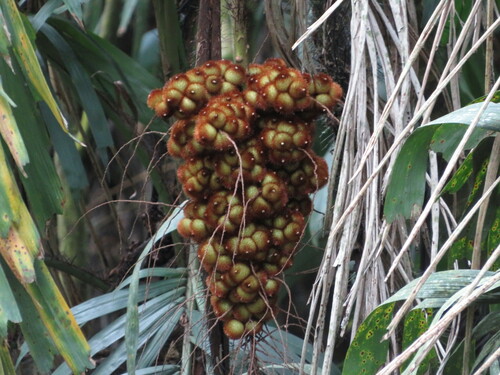
A solitary palm. It grows 3-10 m tall. It is 8 cm across. The trunk is deep olive green. It has light brown wavy rings of leaf base scars. The leaf crown is half round. The crown-shaft can have blue or violet tones. It is 45 cm tall and bulges at the base. The leaf stalks are yellow or bluish. The leaves are 1.6-2 m long. They arch over slightly. The leaflets are dark green. They are regularly spaced and wedge shaped with jagged tips. The new growth is orange-brown. The flowering branches are light pink and turn red with time. The fruit are red and occur in clusters.
Edible Uses
The nuts are sometimes used as a betel substitute and are chewed as a masticatory.
Traditional Uses
The nut is sometimes used as a betel substitute.
This uses section is brief — help expand it
Distribution
A tropical plant. It grows well in the tropics. It grows in secondary forests on hill slopes between 200-1,200 m above sea level. It grows in Sulawesi, Indonesia. In Cairns Botanical Gardens. In Townsville palmetum.
Where It Grows
Asia, Australia, Indonesia*, SE Asia,
Cultivation
Plants can be grown from seeds.
Other Uses
The leaves are used for thatching. The tough outer portion of the stems are used as laths.
Synonyms
Also Known As
Salak, Ridan
References (5)
- Johnson, D.V., 1998, Tropical palms. Non-wood Forest products 10. FAO Rome. p 48
- Jones, D.L., 1994, Palms throughout the World. Smithtonian Institution, Washington. p 294
- Jones, D.L., 2000, Palms of Australia 3rd edition. Reed/New Holland. p 201
- Riffle, R.L. & Craft, P., 2003, An Encyclopedia of Cultivated Palms. Timber Press. p 411
- Sukarya, D. G., (Ed.) 2013, 3,500 Plant Species of the Botanic Gardens of Indonesia. LIPI p 804