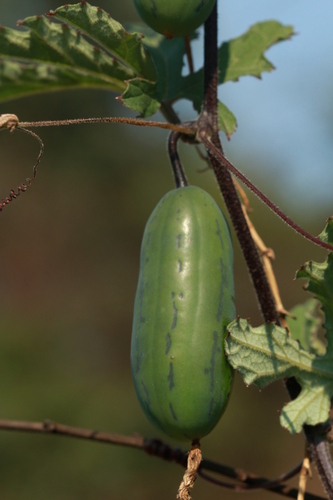
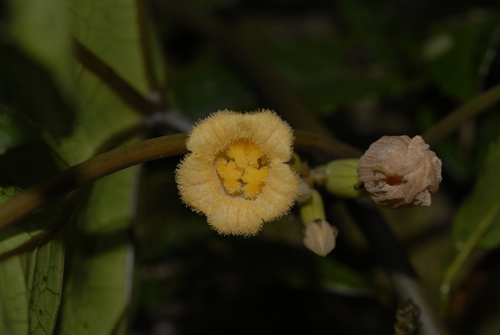
Trichosanthes bracteata
(Lam.) Voigt
iNaturalist· cc-by-sa
(c) Dinesh Valke, some rights reserved (CC BY-SA)
iNaturalist· cc-by-nc
(c) Radha Veach, some rights reserved (CC BY-NC)
Description
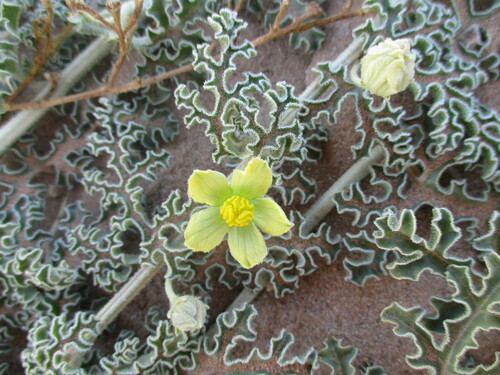
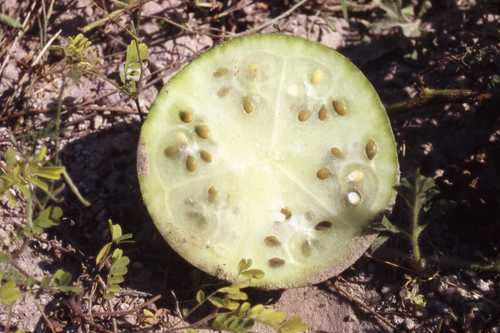
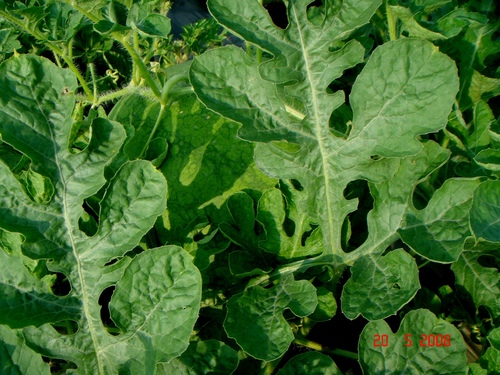
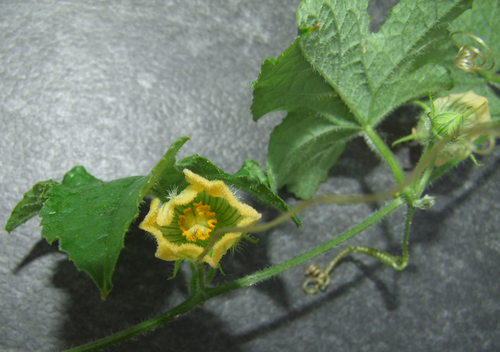
A large climbing vine in the pumpkin family (Cucurbitaceae) found in tropical regions. The fruit, leaves, and roots are all edible parts of this plant.
Edible Uses
The fruit are eaten after roasting. The leaves and roots are also consumed.
Traditional Uses
The fruit are eaten after roasting.
This uses section is brief — help expand it
Distribution
A tropical plant.
Where It Grows
Andamans, Asia, Australia, Bangladesh, India, Myanmar, SE Asia,
Notes
Trichosanthes palmata is probably now Ceratosanthes palmata and Trichosanthes bracteata is probably now Trichosanthes tricuspidata
Synonyms
Also Known As
Avaduta, Avaguda-hannu, Bonion, Kakatonti, Kahira, Kauandala, Koratti, Kyi-arh, Lalindrayan, Mahakal, Makal, Onto, Ratanindrayan, Shvetpushpi, Thowan, Tulero
References (10)
- Ambasta, S.P. (Ed.), 2000, The Useful Plants of India. CSIR India. p 649 (As Trichosanthes bracteata )
- Bodkin, F., 1991, Encyclopedia Botanica. Cornstalk publishing, p 992 (As Trichosanthes palmata)
- Bhargava, N., 1983, Ethnobotanical Studies of the Tribes of Andaman and Nicobar Islands, India. 1. Onge. Economic Botany 37(1): 110-119
- Cribb, A.B. & J.W., 1976, Wild Food in Australia, Fontana. p 144 (As Trichosanthes palmata)
- Hort. suburb. Calcutt. 58. 1845
Show all 10 references Hide references
- Jones, D.L. & Gray, B., 1977, Australian Climbing Plants. Reed. p 61 (As Trichosanthes palmata)
- Martin, F.W. & Ruberte, R.M., 1979, Edible Leaves of the Tropics. Antillian College Press, Mayaguez, Puerto Rico. p 190 (As Trichosanthes palmata)
- Pandy, R. K. & Saini, S. K., 2007, Edible plants of tropical forests among tribal communities of Madhya Pradesh. Indian Journal of Traditional Knowledge. 6(1), pp 185-190
- Terra, G.J.A., 1973, Tropical Vegetables. Communication 54e Royal Tropical Institute, Amsterdam, p 79 (As Trichosanthes palmata)
- World Checklist of Useful Plant Species 2020. Royal Botanic Gardens, Kew