Citrullus ecirrhosus
Cogn.
Namib tsama
iNaturalist· cc0
no rights reserved
iNaturalist· cc0
no rights reserved
Summary
Source: WikipediaCitrullus ecirrhosus, commonly known as Namib tsamma, is a species of perennial desert vine in the gourd family, Cucurbitaceae, and a relative of the widely consumed watermelon (Citrullus lanatus). It can be found in both Namibia and the Cape Provinces of South Africa, in particular the Namib Desert. It is the sister species to the bitter melon, Citrullus amarus with which it shares hard, white and bitter flesh. The vines can crawl for up to two metres, and it has yellow flowers. As a desert plant, it is a hardy species, surviving with little water and strong sunlight. The leaves form annual stems which die back each year. The plant relies on water deep in the ground and morning fogs. It is an important source of water for numerous desert fauna. The bitter-tasting fruit it produces are known as tsamma melons.
Description
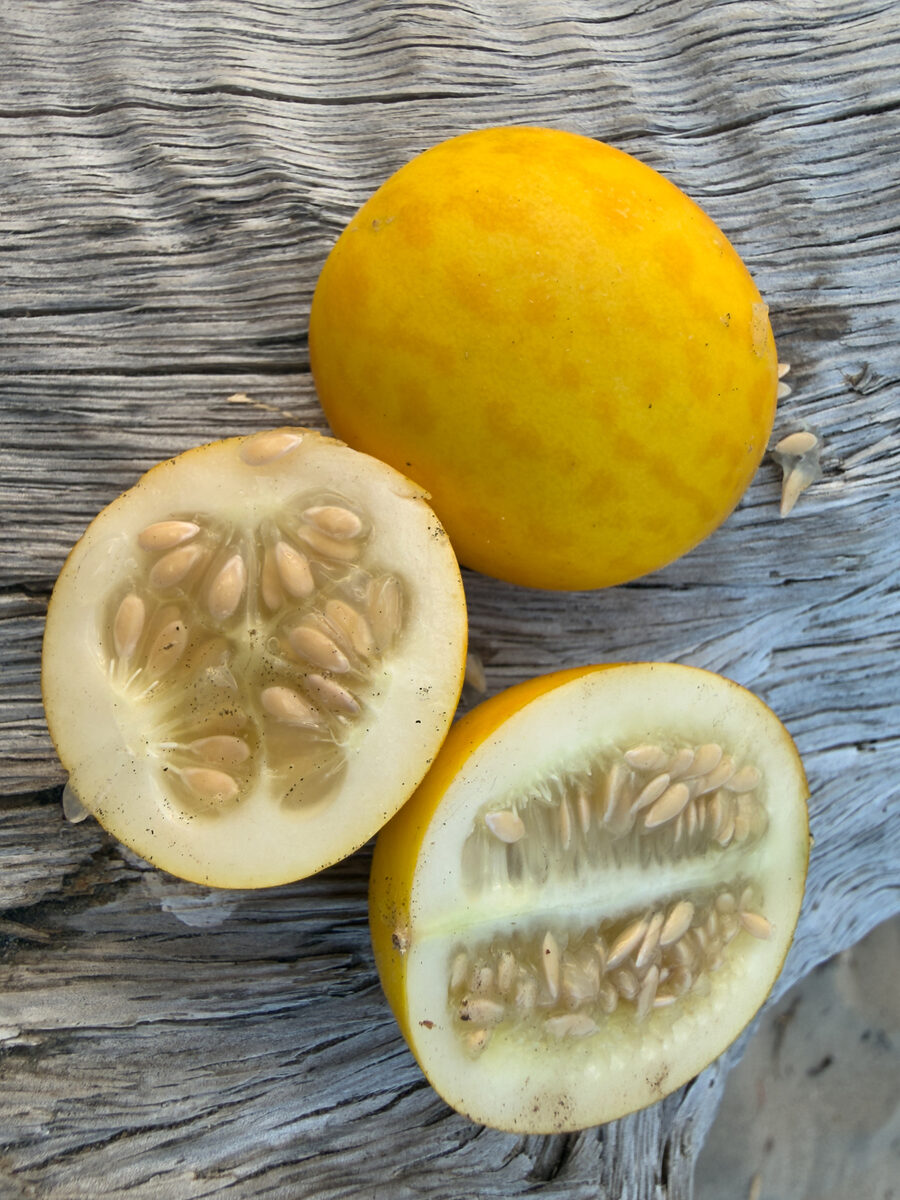
A pumpkin family herb. It lies along the ground. It has a woody taproot and keeps growing from year to year. New shoots develop after rain. They can be 2 m long. It does not have tendrils. The leaves when crushed have the smell of peanut butter. The flowers are yellow. Both male and female flowers are on the same plant but separate. The fruit are pale green with dark streaks. The fruit are 8-18 cm across.
Edible Uses
The fruit yields juice and is added to porridge; young fruit are boiled with water changed to remove bitterness, or buried in fire overnight and the liquid drunk the next morning. The seeds are roasted, crushed, and eaten, or yield oil.
Traditional Uses
The fruit are used for juice and also in porridge. The young fruit are boiled and the water changed to remove the bitterness. The fruit are also buried under the fire at night and the liquid drunk when they are dug up next morning. The seeds yield oil. The seeds are also roasted and crushed then eaten.
Known Hazards
The young fruit are bitter and require boiling with water changes to remove bitterness.
Distribution
A tropical plant. It grows in desert. It grows in stony and sandy soils. It grows between 150-1,065 m above sea level. It can grow in arid places.
Where It Grows
Africa, Namibia, South Africa, Southern Africa,
Other Information
The seeds are a famine food.
Synonyms
Also Known As
Ekania, Enuua, Omanuua, Tsama melon, Tsamab, Tsamas
References (8)
- Facciola, S., 1998, Cornucopia 2: a Source Book of Edible Plants. Kampong Publications, p 84
- Fox, F. W. & Young, M. E. N., 1982, Food from the Veld. Delta Books. p 178
- Royal Botanic Gardens, Kew (1999). Survey of Economic Plants for Arid and Semi-Arid Lands (SEPASAL) database. Published on the Internet; http://www.rbgkew.org.uk/ceb/sepasal/internet [Accessed 15th April 2011]
- Ruiters-Welcome, A. K., 2019, Food plants of southern Africa. Ph.D. thesis. Univ. of Johannesburg p 48
- Van Damme, P et al, 1922, Plant Uses by the Topnaar of the Kuiseb Valley Namib Desert. Afrika Focus Vol. 8(3-4):223-252
Show all 8 references Hide references
- Verh. Bot. Vereins Prov. Brandenburg 30:151. 1888
- Welcome, A. K. & Van Wyk, B.-E., 2019, An inventory and analysis of the food plants of southern Africa. South African Journal of Botany 122 (2019) 136–179
- World Checklist of Useful Plant Species 2020. Royal Botanic Gardens, Kew